


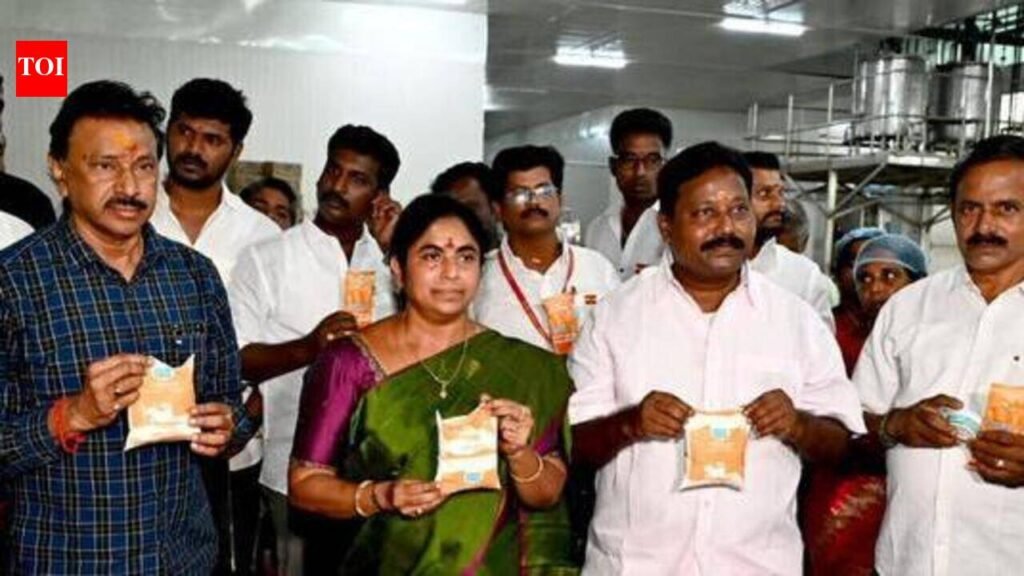
Tamil Nadu’s state-run dairy cooperative Aavin is witnessing increased milk procurement following a hike in the price paid to dairy farmers, according to Milk and Dairy Development Minister C. Vijayalakshmi. The minister said more producers are choosing to supply milk to Aavin after the government raised its procurement price to ₹44 per litre, strengthening the cooperative’s milk collection network.
The announcement came during a visit to Trichy, where the minister launched three new Aavin products at the Kottapattu dairy unit. The development highlights the importance of procurement pricing, farmer participation and product diversification in sustaining cooperative dairy operations.
Aavin Expands Its Consumer Product Range
During the event, Aavin introduced three products for consumers: 500 ml full-cream milk priced at ₹30, a 50-gram cup of curd priced at ₹5 and candy ice cream priced at ₹15.
The new offerings expand the cooperative’s range across milk, fermented dairy products and frozen desserts. Smaller pack sizes and accessible price points can help dairy brands reach different consumer groups while creating additional opportunities to market processed dairy products.
For dairy cooperatives, product diversification is important because milk procurement must be supported by effective processing, distribution and sales. Converting milk into products such as curd and ice cream can help serve different consumption needs, although commercial performance depends on demand, production costs and distribution efficiency.
Procurement Price Increase Supports Farmer Participation
Minister C. Vijayalakshmi said the increase in the procurement price to ₹44 per litre has encouraged more dairy farmers to supply milk to Aavin. She also reported a significant increase in the cooperative’s daily milk procurement and said the government was taking steps to raise production further.
Procurement prices are a key consideration for dairy farmers when deciding where to sell their milk. Competitive and reliable payments can encourage producers to remain within cooperative networks and potentially bring additional suppliers into the system.
For farmers, the price received must be considered alongside feed, veterinary care, labour, breeding and other operating expenses. For cooperatives, higher procurement volumes also require sufficient chilling, processing, storage and distribution capacity to maintain milk quality and manage costs.
Aavin’s reported increase in milk collection suggests that procurement policy can influence participation in organised dairy marketing. However, the longer-term impact will depend on whether higher collections can be sustained and matched with consumer demand.
Trichy Cooperative Network Handles Two Lakh Litres Daily
The Trichy District Cooperative Milk Producers’ Union procures an average of approximately two lakh litres of milk per day from 19,769 producers associated with 341 primary milk producers’ cooperative societies.
Of the milk collected, around 1.51 lakh litres are sold daily to meet consumer demand within the district. This demonstrates the scale of the cooperative’s collection and distribution network and its role in connecting local dairy farmers with consumers.
The difference between daily procurement and sales within the district does not, by itself, establish a surplus, as the figures do not specify other distribution channels, processing requirements or stock movements. Nevertheless, balancing milk collection with market demand remains essential for maintaining an efficient dairy supply chain.
Reliable procurement systems can provide farmers with an organised route to market, while consumers benefit from a structured system for milk collection, processing and distribution.
Quality-Based Procurement and Payment Transparency
During her Trichy visit, the minister inspected the TRD 545 Rettimangudi Milk Producers Cooperative Society and discussed its milk procurement and payment practices.
She examined the use of quality-based milk procurement acknowledgement slips and the corresponding payment system. Quality-linked procurement can encourage farmers to maintain milk hygiene and composition standards while supporting more transparent transactions between producers and cooperative societies.
Clear records and dependable payments are particularly important in cooperative dairy systems, where thousands of farmers supply relatively small quantities of milk each day. Efficient testing, documentation and payment procedures can strengthen trust between producers and collection societies.
The minister also distributed selection-grade promotion orders to 10 employees of the Trichy District Cooperative Milk Producers’ Union, recognising staff progression within the organisation.
Strengthening Tamil Nadu’s Cooperative Dairy Sector
Aavin’s procurement price increase, expanding milk collection and launch of new consumer products reflect several interconnected priorities for the dairy industry: farmer participation, dependable procurement, product diversification and market access.
For the cooperative to sustain growth, higher milk collections must be supported by adequate processing infrastructure, quality assurance and demand for both liquid milk and value-added products. At the farm level, fair procurement arrangements and transparent payments remain important to maintaining producer confidence.
The latest developments in Trichy underline the role that cooperative institutions can play in linking dairy farmers to organised markets while expanding the availability of milk and dairy products for consumers across Tamil Nadu.