


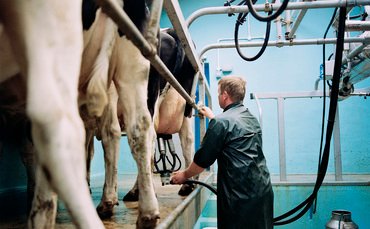
Automated milking systems are becoming an important investment option for dairy farms seeking to address labor shortages and improve herd management. However, the high capital cost of milking robots means producers must carefully evaluate whether increased milk production and operational efficiencies can generate sufficient returns.
According to dairy nutrition specialist Alvaro Garcia, automated milking systems can cost several million dollars depending on herd size and facility design. The economic benefits therefore extend beyond reducing labor requirements and depend heavily on how effectively farms manage cows, nutrition and robot utilization.
Early-Lactation Milking Frequency
One key factor is milking frequency during early lactation. A recent study published in the Journal of Dairy Science examined commercial Wisconsin dairy farms using guided-flow automated milking systems. Researchers compared cows that averaged at least three milkings per day during the first 21 days after calving with cows that did not reach that frequency.
| Indicator | Finding |
|---|---|
| Additional milk production | About 6 pounds per cow per day |
| Study period | 22–150 days in milk |
| Increase in milk revenue | Approximately 5.4% |
| Additional milk revenue | About $172 per cow |
| Early-lactation target | At least 3 milkings per day |
Cows reaching the three-milking target produced approximately 6 pounds more milk per day between 22 and 150 days in milk. Based on average U.S. milk prices, this represented around 5.4% higher milk revenue, equivalent to approximately $172 more revenue per cow during the study period.
The study also reported higher butterfat and protein yields and lower somatic cell counts among cows achieving the target.
However, higher revenue does not necessarily mean higher profitability. Additional milk production can increase feed requirements, electricity consumption, water use, equipment utilization and maintenance costs. The economic benefit therefore depends on whether additional revenue exceeds these additional expenses.
Labor Savings Are Only Part of the Equation
Labor shortages remain a major reason for adopting automated milking systems. Robots can reduce the amount of employee time spent on routine milking, allowing workers to focus on activities such as monitoring fresh cows, reproductive management, cow behavior and early detection of health problems.
This shift in labor allocation can create economic benefits that are difficult to measure simply through milking labor savings. Management quality can also explain why farms using similar automated systems can experience different financial results.
Five Management Factors Affect Robot Performance
When automated milking systems fail to achieve expected performance, the equipment itself may not be the primary issue. Several management factors can influence voluntary cow movement to the robot.
1. Fresh-cow nutrition: Adequate nutritional support during early lactation can help cows respond to more frequent milking.
2. Feeding strategy: Partial mixed ration formulation and concentrate allocation should encourage robot visits while maintaining consistent nutrient intake and rumen health.
3. Stocking density: Overstocking can increase competition for feed, stalls and robot access, potentially reducing voluntary visits.
4. Cow comfort: Lameness, heat stress, poor bedding, slippery floors and inadequate stall design can discourage cows from walking to the robot.
5. Employee management: Repeatedly fetching cows may address the immediate problem but does not necessarily solve the underlying reason for poor robot traffic.
Robots Provide Data, but Management Creates Value
Modern automated milking systems collect information on milk yield, milking frequency, activity, rumination, bodyweight and milk conductivity. These data can help farmers identify changes in herd performance and animal health.
However, the information itself does not generate profit. Its value depends on how effectively farm managers interpret the data and translate it into timely management decisions.
The evidence surrounding three-times-daily milking during early lactation suggests that encouraging voluntary robot visits can be associated with increased milk production and milk revenue. At the same time, the economic outcome depends on feed, energy, water, maintenance and other costs.
For dairy producers considering automated milking, the investment should therefore be evaluated as part of a broader management system rather than simply as a labor-saving technology. Nutrition, cow comfort, transition management, stocking density and effective use of robot-generated data can all influence the financial performance of the system.
Ultimately, automated milking can provide valuable technology and information, but achieving a strong return on investment depends on the management practices surrounding the technology.