


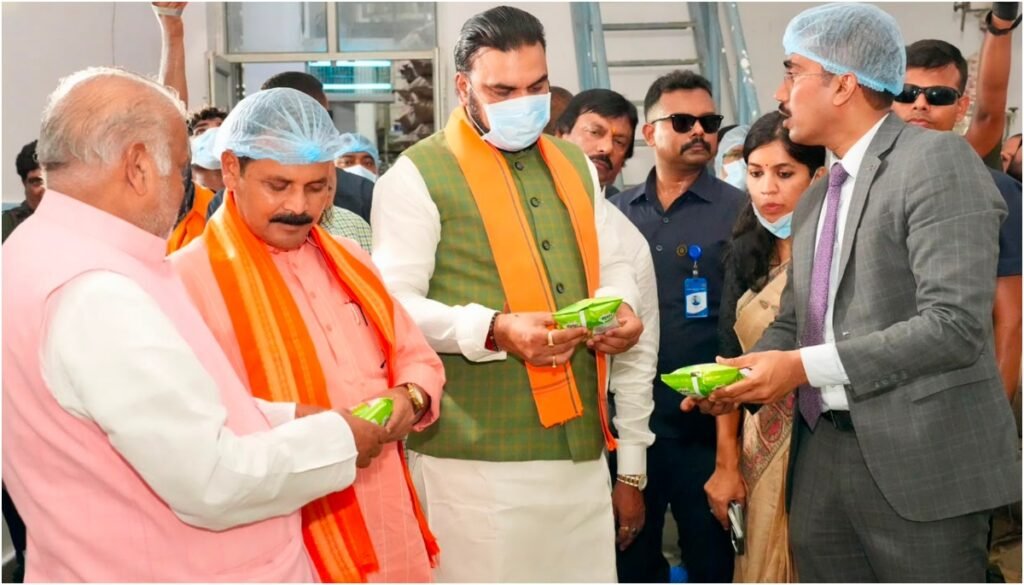
Bihar has announced an ambitious dairy development target of increasing its daily milk production from approximately 48 lakh litres to one crore litres by 2030. The announcement was made by Chief Minister Samrat Choudhary during the National Milk Day 2026 celebrations held at Bapu Sabhagar in Patna on 26 November.
The programme was jointly inaugurated by Chief Minister Samrat Choudhary and Union Minister for Fisheries, Animal Husbandry and Dairying and Panchayati Raj Rajiv Ranjan Singh, popularly known as Lalan Singh. The event brought together representatives from the Central and Bihar governments, dairy institutions, livestock organisations and milk producer communities.
Addressing the gathering, the Chief Minister highlighted the importance of milk production in strengthening Bihar’s rural economy, improving farmers’ incomes and promoting women’s economic empowerment. He stated that the state government aims to make Bihar self-reliant in milk production and establish it among India’s leading milk-producing states.
According to the Chief Minister, strengthening animal husbandry, dairy development and milk collection infrastructure will be central to achieving the 2030 production target.
Dairy Infrastructure and Farmer Support to Drive Production Growth
To support the expansion of milk production, the Bihar government is focusing on improving livestock productivity and strengthening dairy infrastructure. Under the Mukhyamantri Godhan Vikas Loan Scheme, financial assistance is being provided to livestock farmers for purchasing quality cows and buffaloes, with the objective of improving milk production and creating additional livelihood opportunities.
The government is also working to expand the reach of dairy cooperatives and improve milk collection and processing facilities. The Bihar State Milk Cooperative Federation (COMFED), which markets dairy products under the Sudha brand, was recognised during the programme for its growing operations.
According to the Ministry of Fisheries, Animal Husbandry and Dairying, COMFED’s daily milk procurement has reached 23.97 lakh kg, while daily sales stand at 18.41 lakh litres. These figures reflect the scale of organised dairy procurement and marketing operations in the state.
The Chief Minister also highlighted Sudha’s expanding presence beyond Bihar. The federation has established a milk processing unit with a capacity of one lakh litres per day in Assam, while another unit of similar capacity is planned in West Bengal. These facilities are expected to provide wider market access for Bihar’s milk producers and support the expansion of its dairy business.
Goat Milk and Value-Added Dairy Products Gain Attention
Alongside conventional cattle and buffalo-based dairy farming, Bihar is planning to promote goat rearing as an additional source of rural income. The state has envisaged a target of collecting and marketing one lakh litres of goat milk daily through Sudha.
The initiative is intended to diversify livestock-based livelihoods and create additional opportunities for rural households. The government is also preparing Pashu Sakhis to provide livestock owners with guidance and assistance, while encouraging greater participation of women in animal husbandry activities.
Expanding the market for traditional and value-added dairy products is another area of focus. During National Milk Day, Sudha introduced Makhana Kheer and Rabri, highlighting efforts to combine regional food products with dairy processing and marketing.
The distribution of Sudha sales outlet keys was also part of the programme, aimed at expanding the brand’s market reach and improving access to dairy products.
New Investments in Dairy Processing and Livestock Infrastructure
Several dairy and livestock infrastructure projects were inaugurated or dedicated during the National Milk Day celebrations.
These included Data Processing and Milk Collection Units for dairy cooperative societies under the National Programme for Dairy Development (NPDD), Mineral Mixture Plants at VPMU, Patna and TIMUL, Muzaffarpur, and an Effluent Treatment Plant at Mithila Milk Union in Samastipur.
The event also marked the dedication of Namaste India’s milk processing plant at Sikandarpur, Bihta, Patna. Established with assistance under the Animal Husbandry Infrastructure Development Fund (AHIDF), the facility has a processing capacity of two lakh litres per day.
Additionally, certificates were distributed for Veterinary Medicine Sales Centres sanctioned under the Livestock Health and Disease Control Programme to strengthen access to animal healthcare services.
The government also introduced standard operating procedures and an online portal for rating and grading dairy cooperatives and milk producer organisations. A Climate-Resilient Roadmap for India’s Livestock and Dairy Sector towards Viksit Bharat 2047 was also launched.
Strengthening Bihar’s Position in India’s Dairy Industry
Union Minister Rajiv Ranjan Singh highlighted India’s contribution to global milk production, noting that the country accounts for approximately one-fourth of worldwide output. He also referred to the growth of Bihar’s dairy sector, with milk production increasing from 7.19 million metric tonnes in 2013–14 to 13.76 million metric tonnes in 2025–26.
The celebrations also included the presentation of the National Gopal Ratna Awards 2026, recognising contributions to indigenous cattle and buffalo breed conservation, dairy development and livestock productivity.
With its focus on higher milk production, cooperative expansion, processing infrastructure, animal healthcare and diversified livestock activities, Bihar is seeking to strengthen its position in India’s dairy industry. Achieving the one-crore-litre daily production target by 2030 will depend on sustained investment, improved animal productivity, stronger milk collection networks and greater participation of dairy farmers, particularly women, across the state.