


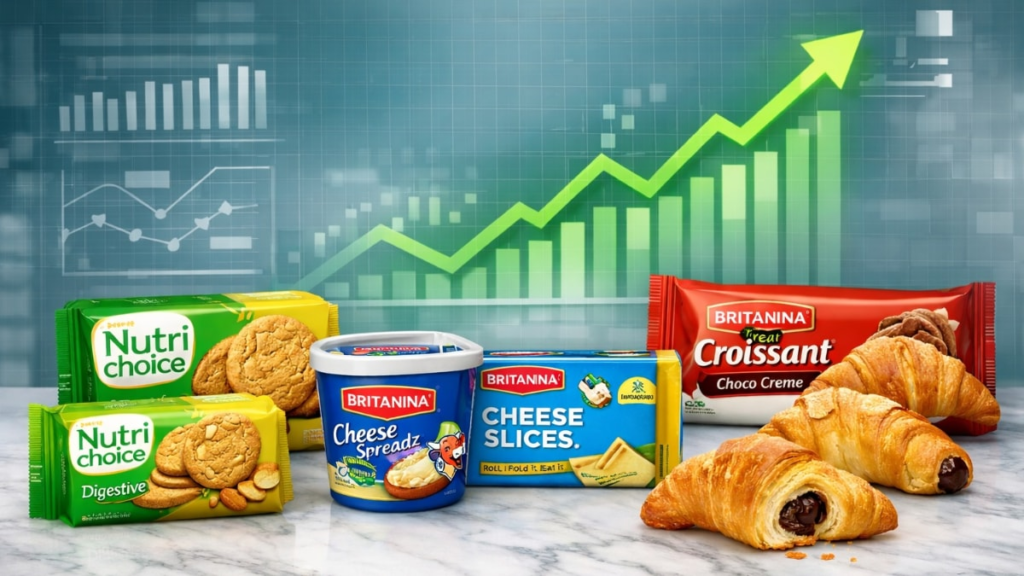
Britannia Industries is accelerating its diversification beyond biscuits as it expands its presence in dairy products, croissants and other value-added food categories. The strategy reflects the company’s efforts to sustain growth in India’s increasingly competitive packaged food market.
A recent report by Antique Stock Broking has initiated coverage on Britannia with a ‘Buy’ rating and a target price of ₹7,000, suggesting an upside potential of around 18% from current levels. The brokerage attributes the positive outlook to the company’s premiumisation strategy, expansion into adjacent categories and strengthening distribution network.
Premium biscuits remain the core business
Despite diversification, biscuits continue to remain the backbone of Britannia’s business. The report noted that premium biscuit products now contribute nearly 65–70% of the company’s overall sales, a significantly higher proportion compared with several competitors.
This shift has been driven by value-added offerings and product innovation under brands such as NutriChoice and Pure Magic.
At the same time, Britannia has expanded the use of low unit packs (LUPs) priced between ₹5 and ₹10. These smaller packs make premium products more accessible to price-sensitive consumers. According to the report, LUPs now account for around 60% of total sales, compared with about 40% in 2019.
Expansion into adjacent food categories
The company has steadily expanded its portfolio into adjacent segments such as dairy products, cakes, croissants, wafers and rusk. These categories currently contribute about 25% of Britannia’s total revenue, although management aims to increase their share to around 50% over the medium term.
Many of these segments remain relatively underpenetrated and fragmented in India, offering long-term opportunities for organised and branded players.
For instance, Britannia has built a significant presence in the wafer cream segment, which was estimated at roughly ₹10 billion in FY24 and continues to grow at around 25% annually. Croissants, developed through a partnership with Chipita, have also gained nationwide consumer traction.
Dairy segment gaining traction
Britannia’s dairy business has also expanded steadily through its beverage and cheese portfolio. The company’s dairy brand Winkin’ Cow has grown rapidly since its launch, helping Britannia establish a presence in milk-based beverages and dairy snacks.
According to the brokerage report, the company’s dairy segment generated revenue of around ₹5.25 billion in FY25, representing approximately 3% of consolidated sales.
Although the share remains relatively small, analysts see the segment as a potential long-term growth driver as demand for value-added dairy products increases in urban markets.
Distribution expansion, strengthening market reach
Another major contributor to Britannia’s growth has been the expansion of its distribution network. The company’s direct retail reach has increased from around 0.7 million outlets in FY14 to approximately 2.9 million outlets in FY25.
Britannia has also expanded its Rural Preferred Dealer (RPD) network, which focuses on smaller towns and villages. The number of such dealers has grown from around 7,000 in FY15 to nearly 31,000 in FY25.
However, analysts note that there remains considerable scope for expansion in the Hindi-speaking belt, which accounts for nearly 35% of industry volumes but only around 15% of Britannia’s sales.
Manufacturing scale and operational efficiency
The report further highlights Britannia’s efforts to strengthen manufacturing capabilities. The company has increased its in-house production share to around 65% in FY25, compared with 25% in FY11. It plans to raise this further to around 70%, reducing dependence on contract manufacturing.
Large facilities, including mega food parks such as the Ranjangaon plant in Maharashtra, have significantly improved production efficiency and scale. As a result, average factory output has increased to around 20,000 tonnes per month, compared with roughly 1,800 tonnes earlier.
At the same time, supply chains have become more efficient. The average distribution distance has reduced from around 650 km to nearly 320 km, improving product freshness and lowering logistics costs.
Growth outlook and potential risks
Britannia’s revenue has grown at a compound annual growth rate of about 8% between FY15 and FY25. Analysts expect this momentum to continue, projecting annual revenue growth of around 9–10% between FY25 and FY28.
The brokerage also forecasts improvements in profitability, with operating margins expected to remain in the range of 18–19% during FY26–FY28.
However, the report also highlights several risks, including volatile raw material prices, intense competition from national and regional brands, and potential demand slowdown due to constrained household budgets. Changes in food regulations, taxation policies and supply chain disruptions could also impact future performance.