


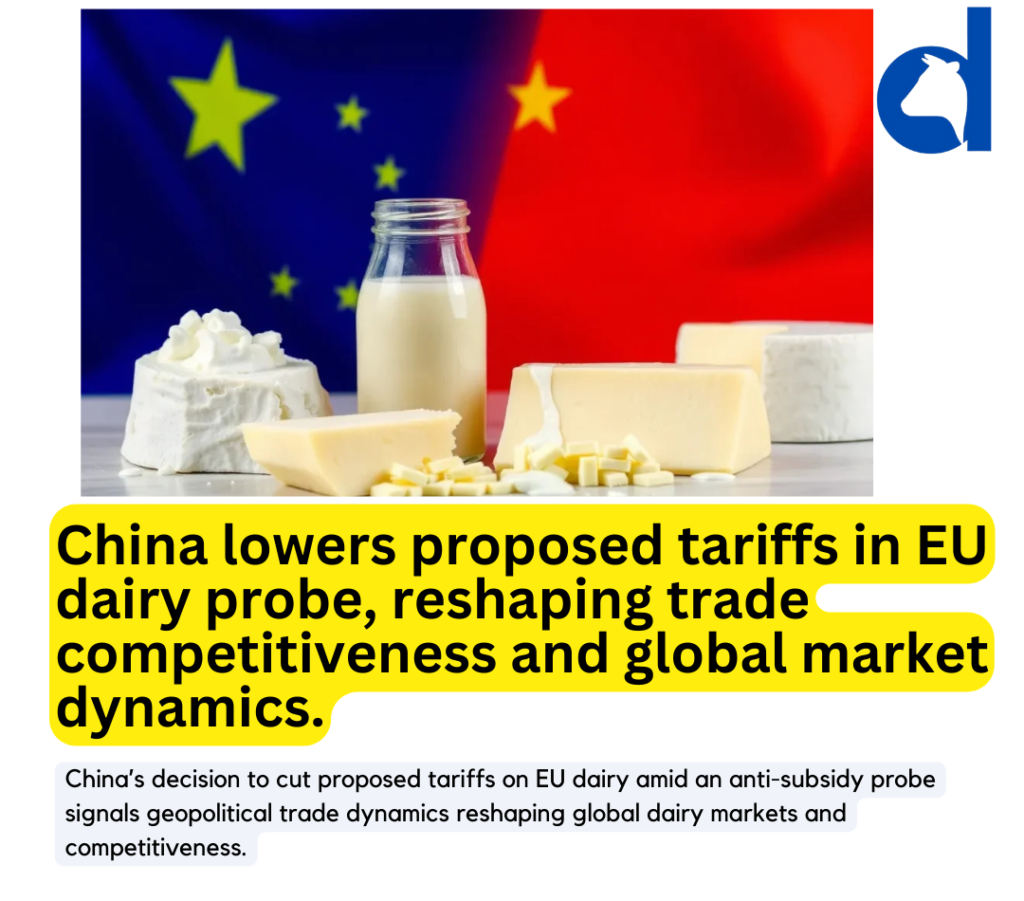
China has revised downwards the punitive tariffs it plans to impose on European Union dairy products following an anti-subsidy investigation, according to statements from the European Dairy Association (EDA) and Eucolait. The adjustment, which reduces the maximum duty from a proposed 42.7% to 11.7% on certain products, including cheese and cream, marks a significant, albeit highly strategic, shift in the ongoing trade dispute between Beijing and Brussels.
While lower than initially announced, the final tariffs most commonly cited around 9.5% for many exporters are likely to continue distorting trade flows and price competitiveness for EU dairy in one of the world’s most important emerging markets.
Strategic Retaliation or Tactical De-Escalation?
The anti-subsidy investigation into EU dairy is widely viewed by industry observers as a retaliatory action in response to European levies on Chinese electric vehicles. This tit-for-tat dynamic illustrates how diplomatic and geopolitical tensions increasingly influence agricultural trade policy, with dairy products often caught between industrial sectors with greater political leverage.
From a strategic perspective, China’s reduction of proposed tariffs may reflect a calibrated attempt to avoid severe disruption to essential food supply chains while still signalling a firm stance. Maintaining duties in the low double digits preserves a significant cost burden on EU exporters but lessens the immediate shock to bilateral trade relations.
Competitive Repercussions for EU Exporters
Although the tariff cuts might be interpreted as a concession, European dairy associations remain sceptical about their impact. According to the EDA, even the finalised 11.7% tariff ceiling will make it difficult for EU dairy products to compete effectively in China’s domestic market. The historic scale of imports of approximately $589 million of EU dairy products covered by the probe in 2024 underpins the importance of China as a destination for European cheese, cream and other value-added dairy categories.
The current tariff structure effectively preserves an advantage for key competitors such as New Zealand, whose exporters may benefit from comparatively lower trade barriers. In highly price-sensitive segments, even modest tariff differentials can materially skew market share over time, particularly for commodity and mass-market dairy products.
Domestic Market Relief for Chinese Producers
Tariff increases on EU imports may also serve Beijing’s broader objective of protecting domestic dairy producers who are contending with a surplus of milk and downward pressure on farm-gate prices amid weak demand. Higher duties on imported cheese and cream could divert market share back to local processors and help stabilise rural dairy economies at least in the short term.
Broader Implications for the Global Dairy Sector
China’s revised tariff rates underscore a broader trend in which trade policy becomes an extension of industrial diplomacy, with implications far beyond bilateral relations:
- Market access and predictability: Dairy exporters require stable, transparent tariff frameworks to make long-term investment decisions. Fluctuating duties tied to broader trade conflicts increase commercial risk.
- Diversification of export markets: The evolving tariff landscape may accelerate EU dairy producers’ strategic diversification into alternative high-growth regions, such as the Middle East and Southeast Asia.
- Trade diplomacy: The case highlights the importance of sustained diplomatic engagement to resolve tariff disputes in ways that support global dairy trade stability rather than entrench protectionism.
Conclusion
China’s decision to lower proposed tariffs on EU dairy products is best understood as a tactical recalibration, not full de-escalation. While the reduced rates mitigate some immediate disruption, they sustain a notable competitive disadvantage for European dairy exports. In a global market where supply chain resilience and market access are increasingly shaped by geopolitical forces, exporters and policymakers alike must navigate complex interdependencies that extend far beyond traditional agricultural negotiations.