


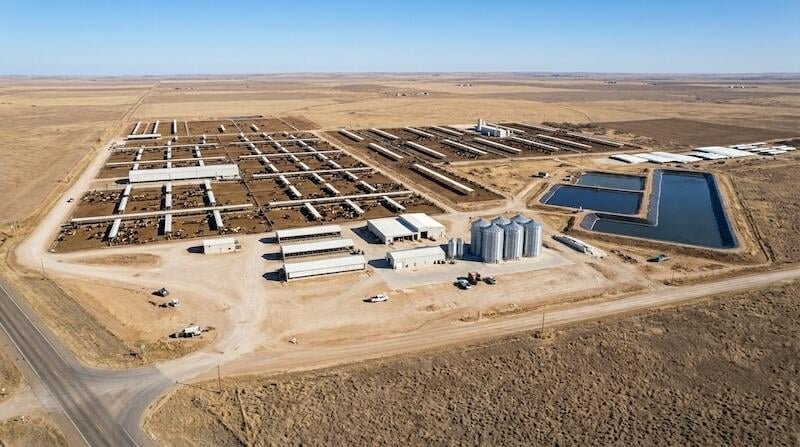
The growing demand for sustainable aviation fuel (SAF) is creating new opportunities for the dairy industry, particularly through technologies that convert livestock waste into renewable energy. Circularity Fuels, a US-based renewable fuels company, has secured $7 million in seed funding to accelerate the commercial development of its technology for converting biogas generated from dairy manure into sustainable aviation fuel.
The funding round was led by Trucks Venture Capital and DCVC, with participation from Sum Ventures and Automotive Ventures. The investment will support an 18-month development programme aimed at moving the company’s technology from laboratory validation towards commercial-scale production.
The development represents an important advancement for dairy farmers, as it demonstrates how manure management systems can potentially generate additional revenue while contributing to the decarbonisation of the aviation and transportation sectors.
Dairy Manure Emerges as a Valuable Renewable Fuel Resource
Large-scale dairy and livestock operations generate substantial quantities of manure, which can release methane during decomposition. Through anaerobic digestion, this organic waste can be converted into biogas, primarily consisting of methane and carbon dioxide.
Although biogas is increasingly being used for electricity generation, heating and renewable natural gas production, its potential as a feedstock for sustainable aviation fuel remains relatively underdeveloped.
Circularity Fuels aims to address this opportunity by developing modular systems that convert raw biogas from dairy manure into liquid transportation fuels directly at agricultural production sites.
The company estimates that large US livestock operations generate nearly one trillion pounds of manure annually, while fewer than 6% capture the resulting biogas. By converting this underutilised resource into higher-value fuels, the technology could provide dairy farmers with an additional income stream while improving the economic viability of manure management infrastructure.
$7 Million Investment to Accelerate Commercial Development
The newly secured seed funding will support three major objectives over the next 18 months.
First, Circularity plans to construct and operate a demonstration plant capable of producing jet fuel from biogas on a daily basis. Second, the company will complete the engineering design for a commercial facility with a production capacity of 75 barrels per day.
The third objective involves securing fuel supply agreements with airlines, an essential step towards establishing the company’s first commercial production facility.
Circularity will also begin licensing its proprietary Ouro reactor technology to interested partners, potentially enabling additional facilities to adopt the process without relying exclusively on company-owned plants.
According to founder and CEO Dr. Stephen Beaton, the investment will help demonstrate the technology at a larger scale and establish the foundation for commercial operations.
Technology Converts Raw Dairy Biogas into Aviation Fuel
In June 2026, Circularity Fuels announced the successful end-to-end conversion of raw biogas from dairy manure into sustainable aviation fuel meeting ASTM D7566 Annex A1 specifications.
The achievement was validated through a six-month pilot programme conducted at a dairy farm near Madera, California.
The company’s technology combines two specialised reactor systems. Its electrified Ouro reforming reactor processes the biogas, while the compact Aion Fischer-Tropsch synthesis reactor converts the resulting intermediate products into liquid fuels.
This modular approach is designed to enable fuel production close to the original feedstock source, potentially reducing the need to transport large volumes of raw agricultural waste.
Circularity estimates that its commercial facilities could achieve capital costs approximately one-fifth of those associated with jet fuel plants currently under construction in Europe.
Sustainable Aviation Fuel Market Creates New Opportunities for Dairy Farmers
The investment comes amid growing pressure on airlines to reduce carbon emissions and diversify their fuel supplies. According to the company, US jet fuel prices increased by 75% during 2026 following the outbreak of conflict in the Middle East, highlighting the aviation industry’s exposure to energy market disruptions.
Despite increasing interest in SAF, the fuel currently accounts for less than 1% of global aviation fuel demand. Limited supplies of used cooking oil, a major feedstock for US SAF production, have also created challenges for expanding production.
Dairy manure-derived biogas could provide an alternative feedstock by using an agricultural waste resource that is already generated in substantial quantities.
The US Department of Agriculture has also advanced Circularity’s application to Phase 2 of its review for a loan guarantee under the Section 9003 Biorefinery, Renewable Chemical and Biobased Product Manufacturing Assistance Program.
Dairy Industry’s Role in the Renewable Energy Transition
Circularity Fuels has raised approximately $17 million in total funding, including nearly $7 million in grants from organisations such as ARPA-E and the National Science Foundation.
For the dairy industry, the development highlights the expanding commercial potential of manure management and anaerobic digestion technologies. Instead of treating manure exclusively as an agricultural waste management challenge, dairy farms could increasingly view it as a resource for renewable fuel production.
If the planned demonstration and commercial facilities achieve their objectives, the technology could create additional opportunities for dairy producers to participate in the renewable energy supply chain.
The initiative also demonstrates how collaboration between agricultural producers, technology developers, investors and aviation companies could help establish new markets for agricultural by-products while supporting broader sustainability goals.