




At a milk collection centre in rural Maharashtra, the diesel generator used to start twice each day to keep freshly collected milk chilled until the tanker arrived. During the summer months, it often ran for several hours—not to power machinery, but simply to maintain the required storage temperature. Over time, diesel became one of the centre’s largest operating expenses.
In early 2026, the centre retrofitted its conventional bulk milk cooler with a thermal-storage system. According to operational records collected after commissioning, generator use declined significantly, milk cooling time was reduced, and diesel consumption fell by approximately 80%. Based on the observed performance, the centre expects annual operating savings of around INR 2 lakh.
While this represents a single installation, it illustrates how thermal-storage refrigeration can address one of the most persistent challenges in rural dairy infrastructure: dependable milk chilling where electricity supply is limited or unreliable.
The Bigger Picture
Across India, village-level milk collection centres form the first link in the dairy cold chain. At these centres, bulk milk coolers (BMCs) rapidly reduce milk temperature after collection, helping preserve quality until transportation.
Conventional BMCs, however, depend on a reliable electricity supply. In many rural areas, frequent power interruptions mean diesel generators are routinely used to maintain cooling. Although effective, generator operation adds recurring fuel, maintenance, and servicing costs that can substantially increase the overall cost of milk chilling.
Thermal storage-based refrigeration offers an alternative approach. Instead of relying entirely on real-time electricity, the system stores cooling energy when grid power—or solar power—is available and releases it when required. This allows cooling to continue during power interruptions while reducing dependence on diesel generators.
The technology also offers quality benefits. By reducing the time required to cool milk from approximately 35°C to 4°C, thermal-storage systems can limit bacterial growth during the critical post-collection period, helping maintain better microbiological quality and improved methylene blue reduction time (MBRT).
The Diesel Challenge
For decades, direct-expansion bulk milk coolers have been the standard equipment used at milk collection centres. Although reliable under stable power conditions, they require continuous electricity throughout the cooling cycle.
Where grid reliability is poor, diesel generators become essential. During power outages, fuel consumption becomes an unavoidable part of the cooling process, increasing operating costs while also introducing maintenance requirements and the risk of equipment downtime.
Cooling performance is another consideration. Conventional systems generally require around three hours to reduce milk temperature to the recommended storage level. Higher ambient temperatures during summer can further increase cooling time, extending the period during which bacterial growth may occur.
A typical 2,000-litre collection centre operating primarily on generator power may consume approximately 200–300 litres of diesel each month. When fuel, servicing, and equipment maintenance are considered together, diesel often becomes one of the largest recurring expenses associated with milk collection.
Thermal Storage-Based Milk Cooling
Thermal storage-based bulk milk cooling combines conventional refrigeration with a thermal energy storage system. During periods when electricity is available, the refrigeration unit charges the thermal storage. The stored cooling energy is then used to chill milk during collection, including periods when grid power is unavailable.
Under suitable operating conditions, a fully charged system can support two milk collection shifts before recharging, with recharge typically requiring approximately 8–9 hours of electricity.
Typical operating characteristics include:
- Cooling milk from approximately 35°C to 4°C in less than two hours.
- Thermal storage capacity sufficient for two collection shifts.
- Charging from either grid electricity or solar photovoltaic systems.
- Reduced dependence on diesel generators during routine operation.
An important advantage of this approach is that thermal-storage systems can often be retrofitted to existing bulk milk coolers. Rather than replacing installed equipment, collection centres can upgrade their existing cooling infrastructure, reducing both capital expenditure and implementation time.
When integrated with appropriately sized solar photovoltaic systems and battery storage, thermal-storage refrigeration can further reduce dependence on both diesel generators and the electrical grid.
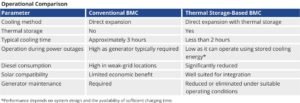

A 2,000-litre milk collection centre in Maharashtra evaluated thermal-storage refrigeration by comparing operating performance before and after retrofitting its existing bulk milk cooler.
Reported observations included:
- Diesel consumption reduced from approximately 200–250 litres per month to 40–50 litres per month.
- Cooling time maintained below two hours despite summer operating conditions.
- Approximately 80% reduction in diesel use.
- Estimated annual operating savings of around INR 2 lakh.
- Reduced generator operation for milk chilling and associated pumping equipment through the use of an inverter-battery system.
Although results will vary depending on local operating conditions, electricity availability, diesel prices, and utilisation patterns, the case demonstrates the potential for thermal-storage refrigeration to reduce operating costs while maintaining cooling performance.
Economic Perspective
Based on the observed annual operating savings of around ₹2 lakh, a thermal-storage retrofit may achieve a payback period of approximately 2–3 years, depending on site-specific operating conditions. Thereafter, the reduction in fuel and operating costs can provide ongoing financial benefits while maintaining milk quality.
Looking Ahead
As dairy collection networks continue to expand into regions with constrained electrical infrastructure, improving the efficiency and reliability of milk chilling will remain a priority. Thermal-storage refrigeration represents one approach to addressing this challenge by reducing dependence on diesel generators, improving energy resilience, and enabling greater use of renewable energy.
For collection centres operating in areas with intermittent grid supply, the technology has the potential to lower operating costs while supporting consistent milk quality. As adoption increases and additional field data become available, thermal-storage refrigeration may become an increasingly important component of sustainable dairy cold-chain infrastructure.
Disclaimer: This article features Prompt Milkochiller and includes a case study based on operational data shared by the company. The information is presented for educational and industry discussion purposes. Actual performance and economic outcomes may vary depending on installation, operating conditions, and site-specific factors.
By Dr. Sudhindra Tatti, CEO, Prompt Innovations
Known in the industry as the man who pushed for QUALITY in Indian dairy, Dr. Sudhindra Tatti, CEO of Prompt Innovations, is a rare leader who combines deep tech expertise with a grassroots understanding of agriculture. Under his leadership, Prompt has redefined what’s possible for India’s fragmented dairy supply chain, placing transparency, sustainability, and farmer empowerment at the core of dairy transformation.