


A long-overlooked aspect of coffee science, foam stability at high brewing temperatures, has culminated in a significant technology transfer between India’s premier public research institution and one of the country’s leading FMCG players.
Nearly a decade of research at CSIR-CFTRI has resulted in the development of an indigenous technology capable of producing stable coffee foam and golden crema in espresso-style beverages without milk. The innovation addresses a complex thermodynamic challenge: maintaining the stability of gas-infused foam at temperatures approaching 95 °C, where bubble collapse is typically rapid and unavoidable.
Revisiting a Neglected Scientific Challenge
Foam formation in coffee is not merely aesthetic; it plays a critical role in aroma retention, mouthfeel and overall sensory perception. While gas infusion is central to crema formation, high-temperature conditions create instability due to increased molecular motion and weakened interfacial films. As a result, non-dairy crema solutions have remained technologically elusive, particularly for large-scale commercial applications.
The research trajectory gained new momentum following a scientific–industry interaction at CSIR-NIIST, where Mr Devender Reddy Kalva from Tata Coffee posed a direct question: could stable espresso crema be achieved without milk under real brewing conditions?
From Curiosity to Commercial Relevance
What began as academic curiosity evolved into a robust, application-oriented technology. The CSIR team successfully engineered a system that enhances crema stability while preserving the volatile aromatic compounds essential to premium coffee experiences. The solution is particularly relevant in the context of rising demand for black coffee, plant-forward beverages and clean-label formulations.
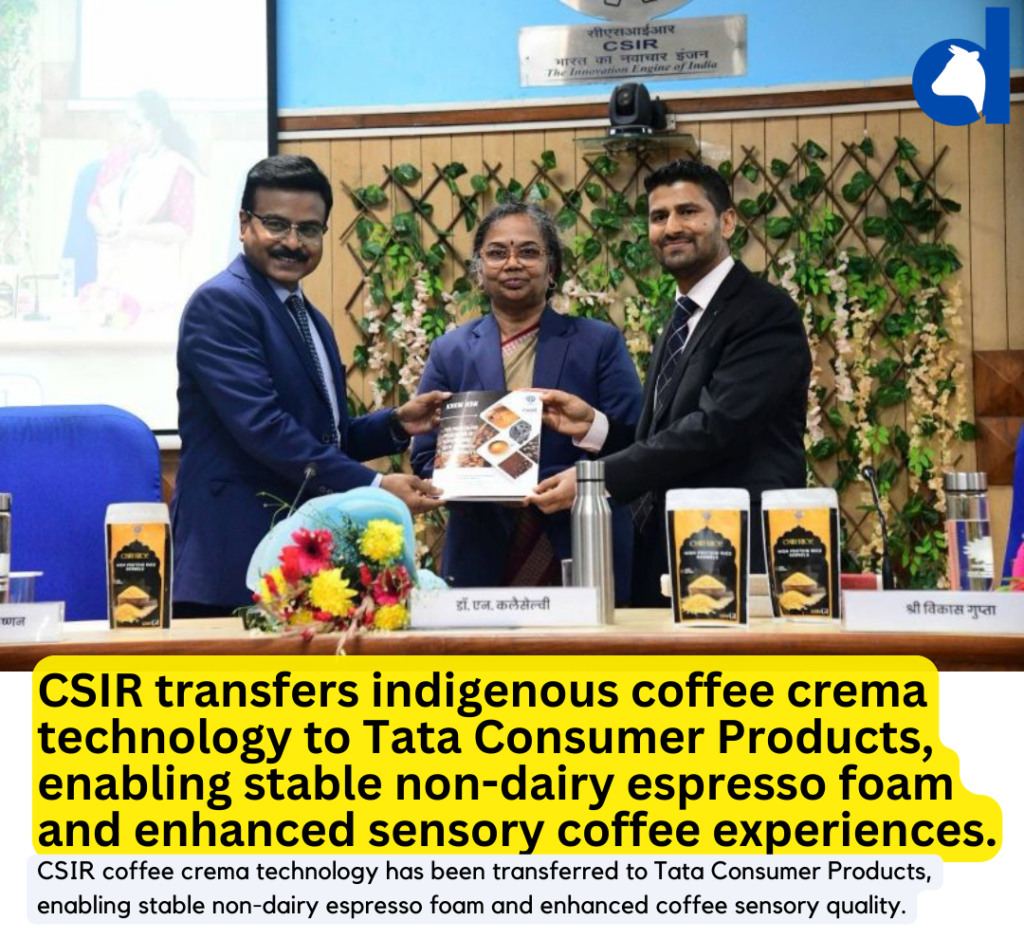
On 18 February in New Delhi, the technology was formally transferred to Tata Consumer Products Ltd, marking a significant milestone in public–private collaboration. The event took place in the presence of Dr N. Kalaiselvi, Director General of CSIR, and Vikas Gupta, Global Head – R&D, Tata Consumer Products.
Implications for the Beverage Industry
For Tata Consumer Products, the technology offers strategic advantages across multiple beverage formats. Improved foam stability enhances perceived quality, supports premium positioning and enables greater consistency in both out-of-home and packaged coffee solutions. Beyond espresso, the innovation holds potential for ready-to-drink beverages, instant coffee systems and future functional formulations.
From an industry perspective, the development underscores the growing importance of process innovation in beverage science, where texture, aroma delivery and sensory engineering increasingly differentiate brands in competitive markets.
Strengthening Industry–Research Synergy
This technology transfer exemplifies how long-term scientific persistence, when aligned with industry needs, can unlock commercially viable solutions. It also reinforces CSIR’s role in translating fundamental food science into scalable technologies that strengthen India’s agri-food and beverage ecosystem.
In many ways, the success lies in revisiting what the industry had long overlooked, a “neglected bubble” that now carries significant commercial promise.