


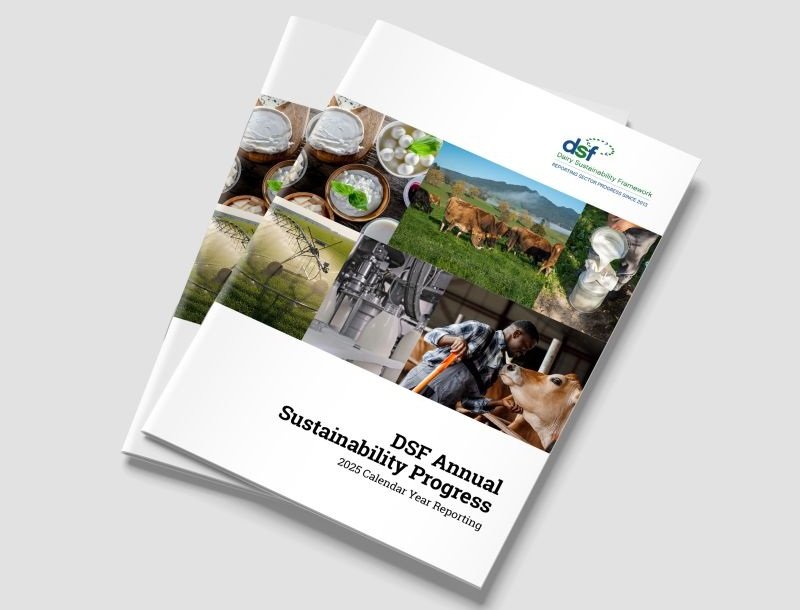
The Dairy Sustainability Framework (DSF) has released its 2025 Annual Sustainability Progress Report, highlighting the continued expansion of sustainability initiatives across the global dairy industry. The report outlines progress in animal health and welfare, biodiversity, soil and nutrient management, and greenhouse gas emissions, while reflecting the growing participation of dairy organisations across different regions.
According to the report, the DSF now represents 52% of the world’s formal dairy milk market that is actively implementing focused sustainability programmes. Its reporting network comprises 1,374 organisations, collectively covering 273 billion litres of milk. These figures demonstrate the increasing involvement of dairy businesses and industry stakeholders in measuring and improving their environmental, social and economic sustainability performance.
The expansion of the framework also reflects the growing importance of standardised sustainability reporting in the dairy value chain. As producers, processors and other industry participants face increasing expectations around responsible production, measurable indicators are becoming essential for tracking progress and identifying areas requiring further attention.
Animal Care Remains the Highest-Prioritised Sustainability Criterion
Animal care continues to be the most highly prioritised of the DSF’s 11 Sustainability Criteria, accounting for nearly 98% of the milk volume represented by DSF members. This highlights the importance placed on animal health, welfare and responsible livestock management across participating dairy organisations.
An important development outlined in the report concerns the measurement of animal welfare performance. From 2027 onwards, the framework’s Animal Care indicator metric will transition from Somatic Cell Count (SCC) to the implementation of an Animal Health and Welfare Plan.
Somatic Cell Count has traditionally been used as an indicator associated with udder health and milk quality, particularly in monitoring mastitis-related concerns. The introduction of Animal Health and Welfare Plans represents a broader approach to monitoring livestock well-being through structured management practices. Such plans can support more systematic attention to animal health, disease prevention, welfare conditions and farm-level management.
This transition also signals an evolving approach to sustainability measurement, moving towards indicators that assess the implementation of comprehensive animal welfare practices rather than relying on a single measurement.
Environmental Management and Greenhouse Gas Performance
Beyond animal welfare, the report identifies continued growth in the adoption of proactive biodiversity, nutrient and soil management plans. These areas are increasingly relevant to dairy farming, where land management, feed production, manure handling and resource efficiency influence the environmental performance of milk production.
Biodiversity management can help dairy farms protect natural habitats and maintain ecological balance around agricultural land. Similarly, nutrient management plans support more efficient use of fertilisers and manure, while soil management practices can contribute to long-term land productivity and improved resource management.
Greenhouse gas emissions remain another important area of assessment. The DSF’s analysis indicates that global dairy cattle milk output has increased by 53% since 2005, while the overall increase in greenhouse gas emissions was limited to 22%.
This difference highlights the role of declining emissions intensity in managing the environmental impact of expanding milk production. Emissions intensity measures greenhouse gas emissions relative to the quantity of milk produced. A reduction in this measure indicates that the sector has been able to increase output without experiencing an equivalent proportional rise in emissions.
The findings underline the importance of improving production efficiency, feed management, herd productivity and farm-level resource utilisation as the dairy industry works to address its environmental footprint. However, the reported figures also highlight that absolute emissions and emissions intensity are different measures and should be considered separately when evaluating sector-wide sustainability performance.
Five-Year Trends and Growing Asian Participation
The 2025 report introduces new five-year trendlines, providing a longer-term perspective on sustainability performance across the framework’s participating organisations. These trendlines are intended to offer a clearer picture of how sustainability indicators have evolved over time, helping stakeholders assess progress beyond individual reporting periods.
Another notable addition is the cow and buffalo milk production breakdown. This reflects the increasing participation of organisations from across Asia, where buffalo milk plays an important role in the dairy economy. Countries such as India, Pakistan and Nepal have significant buffalo populations, making species-specific reporting particularly relevant to understanding regional dairy production systems.
Recognising both cow and buffalo milk production also allows the framework to represent a wider range of livestock systems and production practices. This is particularly important as sustainability strategies need to account for differences in animal management, feeding systems, farm structures and regional production conditions.
Strengthening Sustainability Across the Dairy Value Chain
The expansion of DSF membership and reporting coverage highlights the growing importance of collaborative sustainability initiatives throughout the global dairy value chain. With 1,374 participating organisations and 273 billion litres of milk represented, the framework provides a platform for monitoring sustainability priorities across a substantial share of the formal dairy market.
The report’s findings point towards several interconnected priorities for the industry: strengthening animal health and welfare programmes, improving soil and nutrient management, protecting biodiversity and reducing greenhouse gas emissions per unit of milk produced.
For dairy farmers, processors and industry organisations, these developments reinforce the need to integrate sustainability into everyday production and operational decisions. Continued monitoring, transparent reporting and the adoption of measurable improvement plans will remain important in supporting the sector’s long-term development.
As the DSF prepares for the introduction of its revised Animal Care indicator in 2027, the 2025 progress report provides an updated picture of the industry’s sustainability efforts and the direction of future reporting. Its expanded geographical representation and longer-term performance indicators also offer a broader perspective on the challenges and opportunities shaping sustainable dairy production worldwide.