


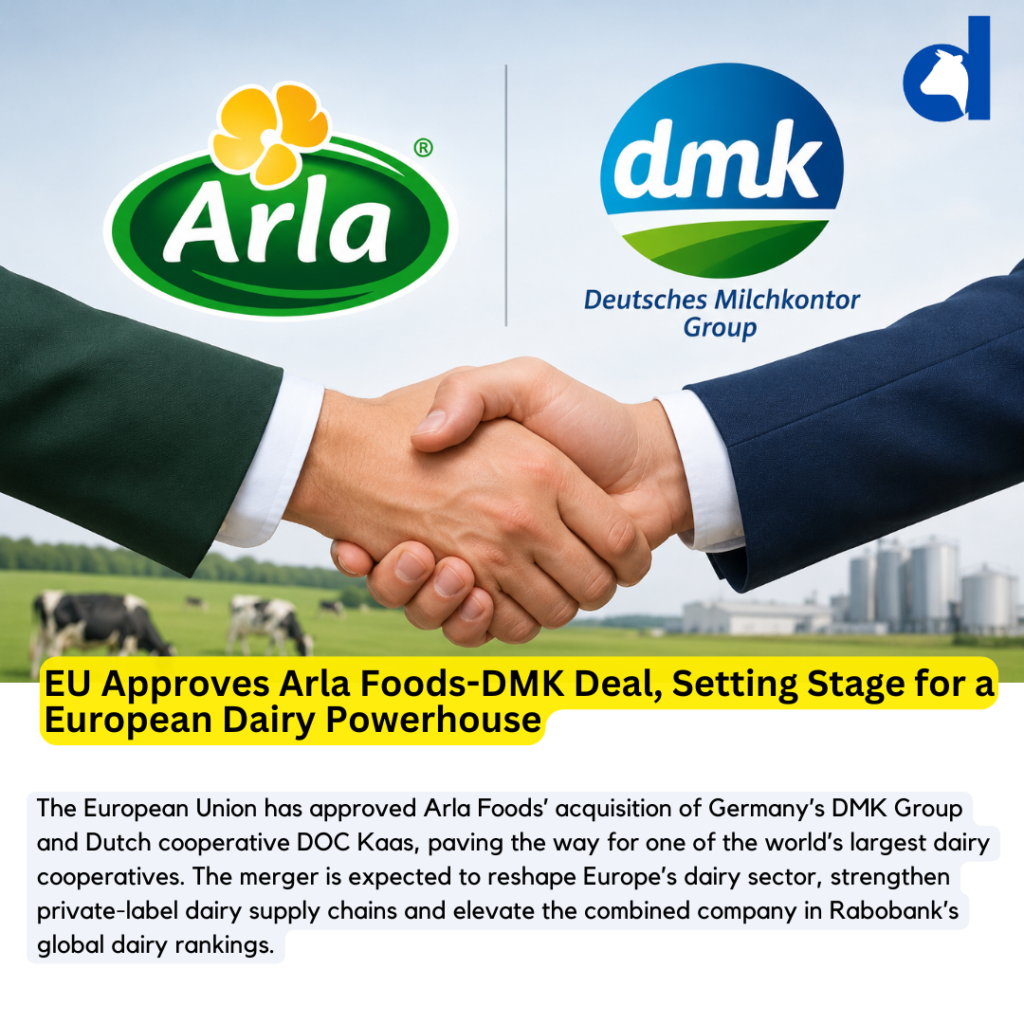
The European Union has formally approved Arla Foods’ proposed acquisition of Germany’s DMK Group and Dutch cooperative DOC Kaas without imposing any conditions, marking one of the most significant consolidations in the global dairy industry in recent years.
Following a detailed investigation, the European Commission concluded that the transaction would not significantly reduce competition in raw milk procurement or dairy product supply across the European Economic Area (EEA). Importantly, regulators also determined that the merger would not negatively impact the market for private-label dairy products supplied to major retailers throughout northern Europe.
The decision effectively clears the path for the formation of a dairy cooperative giant with expanded processing capabilities, stronger export reach and increased bargaining power in global dairy trade.
Why the Deal Matters
The merger between Denmark-based Arla Foods and Germany’s DMK Group is strategically important because it combines two of Europe’s largest dairy cooperatives at a time when the global dairy industry is facing mounting pressure from volatile milk prices, sustainability regulations, inflationary costs and changing consumer demand.
Arla Foods is globally recognised for brands such as Lurpak, Castello and Arla, while DMK Group is Germany’s largest dairy cooperative with a strong footprint in cheese, ingredients, infant nutrition and private-label dairy products. DOC Kaas, based in the Netherlands, is closely integrated into DMK’s operations and strengthens the milk pool and cheese-processing business.
Together, the companies will create a cooperative structure representing thousands of dairy farmers across northern Europe, with substantial scale in milk collection, processing and value-added dairy production.
The combined entity is expected to process more than 19 billion kilograms of milk annually, placing it among the largest dairy processors globally.
A New Giant in the Global Dairy Industry
Industry analysts believe the merger is primarily about scale, efficiency and long-term competitiveness.
Europe’s dairy sector has become increasingly fragmented compared to global rivals in New Zealand, the United States and China. Large-scale consolidation is now being viewed as essential for maintaining competitiveness in exports, innovation and sustainability investments.
The combined company is expected to benefit from:
- Larger milk procurement volumes
- Improved operational efficiency
- Better utilisation of processing facilities
- Stronger private-label manufacturing capabilities
- Expanded cheese and ingredients portfolio
- Greater export competitiveness
- Enhanced negotiating power with retailers
The merger also strengthens Arla’s position in key growth categories including whey proteins, mozzarella, infant nutrition ingredients and value-added dairy products.
Implications for the European Dairy Sector
1. Stronger Cooperative Model
The approval reinforces the continued relevance of the cooperative dairy structure in Europe. At a time when investor-backed food companies are rapidly expanding, the merger demonstrates that farmer-owned organisations can still scale aggressively through strategic consolidation.
The enlarged cooperative will represent more than 12,000 dairy farmers across multiple European countries, creating a stronger platform for milk pricing stability and long-term farmer participation.
2. Increased Pressure on Smaller Dairy Players
The formation of a larger dairy entity could intensify competitive pressure on mid-sized processors across Germany, the Netherlands and neighbouring European markets.
Retailers are increasingly favouring suppliers capable of ensuring scale, price competitiveness, supply consistency and sustainability compliance. Smaller dairy companies may now face higher pressure to consolidate or specialise in premium niches.
3. Private-Label Dairy Competition Will Intensify
One of the European Commission’s key findings was that competition in private-label dairy products would remain healthy despite the merger.
However, the enlarged company is expected to become an even more influential supplier of retailer brands across Europe, particularly in categories such as cheese, butter, milk powders and yoghurts.
This could further accelerate consolidation within Europe’s retail dairy supply chains.
4. Sustainability and Climate Investments
The dairy industry across Europe is under increasing scrutiny over dairy methane emissions, carbon footprints and sustainable dairy farming practices.
Larger dairy companies possess greater financial capacity to invest in:
- Green dairy practices
- Methane reduction technologies
- Renewable energy
- Sustainable packaging
- Precision dairy farming
- Dairy waste management
Arla has already established itself as a leader in climate-focused dairy initiatives, and the merger could accelerate broader sustainability adoption across the cooperative network.
Impact on Global Dairy Trade
The merger is also expected to influence global dairy trade flows.
The combined company will have stronger export capabilities in:
- Cheese
- Milk powders
- Whey ingredients
- Functional dairy proteins
- Foodservice dairy solutions
This could intensify competition in international dairy markets, particularly in Asia, the Middle East and Africa, where European dairy exporters compete aggressively with players from New Zealand and the United States.
For India and other emerging dairy economies, the rise of larger global dairy processors highlights the growing importance of scale, processing efficiency and value-added dairy production in maintaining export competitiveness.
How the Combined Company Could Rank in Rabobank’s Global Dairy Top 20
Rabobank’s annual Global Dairy Top 20 ranking is widely regarded as the benchmark for measuring the world’s largest dairy companies by annual turnover.
Arla Foods has consistently ranked among the top global dairy processors, typically positioned between 7th and 9th place globally. DMK Group has independently ranked within the broader global dairy league due to its sizeable turnover and processing operations.
Based on recent turnover estimates:
- Arla Foods annual revenue: approximately €13-14 billion
- DMK Group annual revenue: approximately €5-6 billion
The combined entity could generate annual revenues approaching €19-20 billion, potentially elevating the merged cooperative into the global top five dairy companies depending on currency movements and yearly market performance.
Likely Position in Rabobank Global Dairy Rankings
The merged company could compete alongside:
- Lactalis (France)
- Nestlé Dairy Division (Switzerland)
- Dairy Farmers of America (USA)
- Fonterra (New Zealand)
- Arla-DMK Combined Entity (Europe)
This would significantly strengthen Europe’s representation among the world’s largest dairy processors.
What Comes Next
Although regulatory approval has now been secured, integration will remain a complex process involving:
- Operational restructuring
- Farmer governance alignment
- Brand portfolio optimisation
- Factory rationalisation
- Procurement integration
- Sustainability target alignment
Industry observers expect the combined company to focus heavily on efficiency gains while maintaining strong farmer ownership principles.
The transaction also signals a broader trend of consolidation sweeping through the global dairy industry as processors seek greater resilience against economic volatility, climate challenges and changing consumer demand.
For the international dairy sector, the Arla-DMK merger may ultimately become a defining moment that reshapes how cooperative dairy businesses compete on a global scale.