


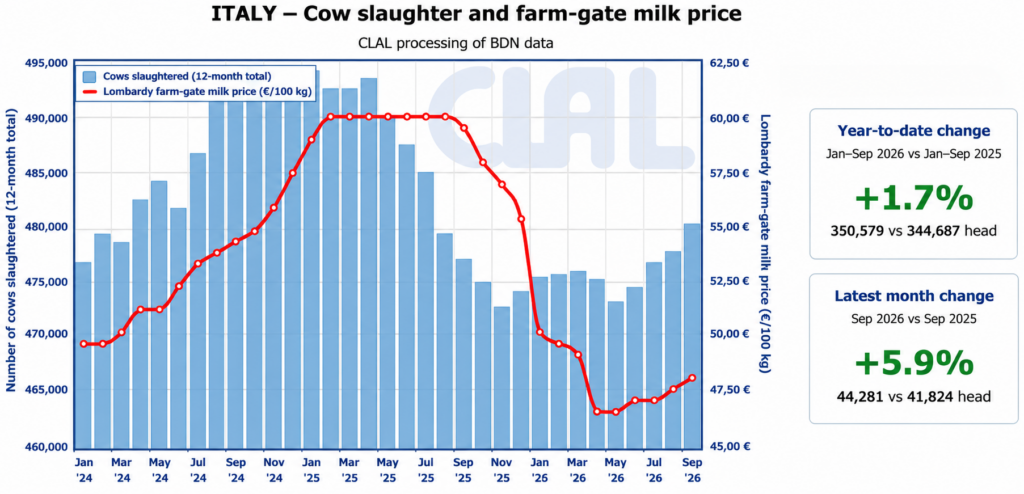
European dairy farming is showing signs of potential structural adjustment as declining milk profitability and reduced forage availability put additional pressure on producers. Following the exceptionally hot summer of 2026, cow slaughter figures across several major European markets are showing different trends, raising questions about whether dairy farmers are beginning to reduce herd sizes to manage production costs and improve farm efficiency.
According to market analysis published by CLAL.it, Germany recorded a 7% decline in cow slaughter over the past four weeks, while France experienced a smaller reduction of 1.4%. In contrast, the Netherlands reported a 7% increase in cow slaughter since the beginning of 2026. Italy has also recorded an upward movement, suggesting that changes in livestock numbers are becoming an important development to monitor across the European dairy sector.
Italy records acceleration in cow slaughter
Italy is showing particularly notable changes in slaughter activity. According to figures from the National Livestock Database (BDN), cow slaughter increased by 1.7% during the first nine months of 2026 compared with the corresponding period of the previous year.
The increase became more pronounced in September, when slaughter numbers were 5.9% higher than in September 2025.
This acceleration could indicate that dairy farmers are reassessing herd composition in response to weaker financial returns and increasing operational challenges.
Rather than maintaining larger herds regardless of productivity, some producers may be choosing to remove less productive cows and concentrate available resources on animals with stronger production performance.
Different slaughter trends across European dairy markets
The latest figures demonstrate that cow slaughter patterns are not moving uniformly across Europe.
Germany and France have recorded recent declines, whereas the Netherlands and Italy have experienced increases over their respective reporting periods.
These differences may reflect variations in national milk markets, farm economics, herd management strategies and local production conditions.
| Country | Reported slaughter trend | Reporting period |
|---|---|---|
| Germany | -7% | Past four weeks |
| France | -1.4% | Past four weeks |
| Netherlands | +7% | Since beginning of 2026 |
| Italy | +1.7% | First nine months of 2026 |
| Italy | +5.9% | September year-on-year |
The reporting periods differ, so these figures should not be interpreted as a direct comparison of annual slaughter rates across all countries.
Summer heat and forage shortages add pressure
The exceptionally hot summer of 2026 has created additional challenges for European dairy producers. Reduced forage availability can increase dependence on purchased feed, raising production expenses at a time when milk profitability is already under pressure.
Feed costs are particularly important in dairy operations because nutrition directly influences milk yield, animal health and reproductive performance.
When producers face higher feeding expenses and weaker farmgate milk returns, maintaining less productive animals can become increasingly difficult to justify economically.
Selective culling can therefore form part of a broader herd-management strategy, allowing farmers to concentrate feed, labour and other resources on higher-performing dairy cows.
However, increased slaughter figures alone do not establish that declining milk profitability is the direct cause. Changes in herd age, replacement rates, disease management and wider livestock market conditions can also influence slaughter activity.
Potential implications for European milk production
Changes in dairy cow numbers could have implications for European milk production in the coming months.
If higher slaughter activity reflects sustained herd reductions, the available milking population could gradually decrease, potentially moderating milk supply. However, the final impact will also depend on milk yield per cow, replacement heifer availability and farm-level productivity.
For dairy processors, traders and market participants, monitoring slaughter statistics alongside milk deliveries and farmgate prices will be important for understanding future supply conditions.
The latest figures from Germany, France, the Netherlands and Italy provide an early indication of changing herd-management patterns, although further data will be required to establish whether these developments represent a broader European trend.
As the dairy industry enters the final months of 2026, the relationship between milk profitability, feed availability and livestock numbers will remain an important factor influencing production decisions and the European dairy market outlook.