


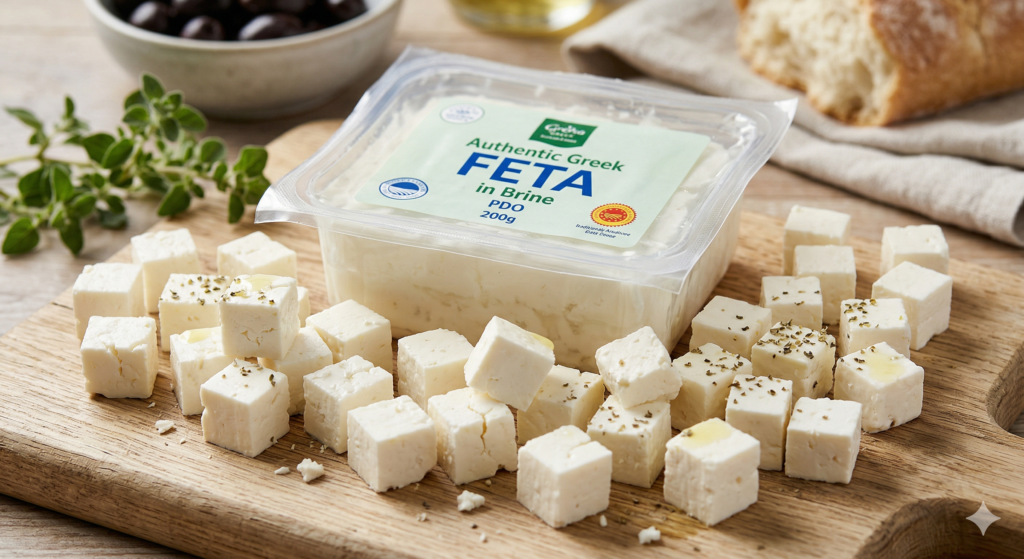
The ongoing dispute over Feta cheese has escalated from a regional trademark disagreement into a central pillar of international trade volatility. As the United States weaponises 50% tariff threats to dismantle the European Union’s Protected Designation of Origin (PDO) framework, the dairy sector is witnessing a shift where political leverage often outweighs supply-demand fundamentals. For the European Union, the challenge lies in defending its cultural heritage—and the premium pricing it commands—while navigating a $3 billion dairy trade deficit with the U.S. and retaliatory duties from China.
The Leverage of Trademarks
At the heart of the friction is the legal definition of “Feta.” While Greece has held exclusive rights to the name within the EU since 2002, the U.S. National Milk Producers’ Federation argues that such geographical indications (GIs) act as non-tariff barriers. The U.S. maintains that names like Feta and Parmesan have transitioned into generic terms. To force a policy shift, Washington is prepared to impose substantial duties, a move that would devastate Greek cooperatives. For instance, the Kalavrita cooperative, which exports 8% of its 140,000-tonne annual production to the U.S., warns that these tariffs could halve their export volumes overnight.
Strategic Pivots and Concessions
To mitigate Western pressure, Brussels is aggressively diversifying its trade portfolio. The recent EU-Australia trade agreement is a cornerstone of this “de-risking” strategy, with projections suggesting a 33% increase in EU export volumes. However, this expansion comes at a cost. To secure the deal, the EU has reportedly softened its stance on GIs, potentially allowing Australian producers to continue using European cheese names. This creates a dangerous precedent: the EU is effectively trading away its heritage protections to maintain economic resilience in a fragmented global market.
The India Context: A Growing GI Ambition
For the Indian dairy industry, the Feta dispute serves as a critical case study in the value of Intellectual Property. India is increasingly focused on securing its own GIs—such as for Dharwad Pedha or Srivilliputtur Palkova—to elevate local specialities to the global stage. However, as India negotiates its own Free Trade Agreements (FTAs) with the UK and the EU, the “Feta precedent” suggests that dairy protections are often the first chips to be traded away.
Furthermore, the global trend of “dairy protectionism”—highlighted by China’s recent 42.7% retaliatory duties on EU cheeses—creates a vacuum in international markets. As European exporters face hurdles in the U.S. and China, India may see an influx of high-quality European dairy solids at competitive prices, potentially pressuring domestic farm-gate prices if import regimes are liberalised.
Strategic Implications for Processors and Investors
The weaponisation of dairy trade means that commodity prices are no longer dictated solely by milk pools or feed costs, but by geopolitical posturing.
- For Exporters: Diversification is no longer optional. Relying on a single premium market (like the U.S.) leaves processors vulnerable to sudden tariff hikes.
- For Investors: Portfolio companies with high exposure to PDO products face significant regulatory risk. The “genericisation” of premium terms could lead to immediate margin erosion.
Forward-Looking Insight
The resolution of the Feta conflict will likely define the next decade of agricultural trade. If the EU yields to the U.S., the era of premium “heritage” pricing for mass-marketed dairy may come to an abrupt end. Conversely, if Brussels stands firm, we should expect a period of “Dairy Decoupling,” where the world splits into trade blocs with vastly different labelling standards and pricing tiers. In this environment, agility in supply chain sourcing will be the primary driver of profitability.