


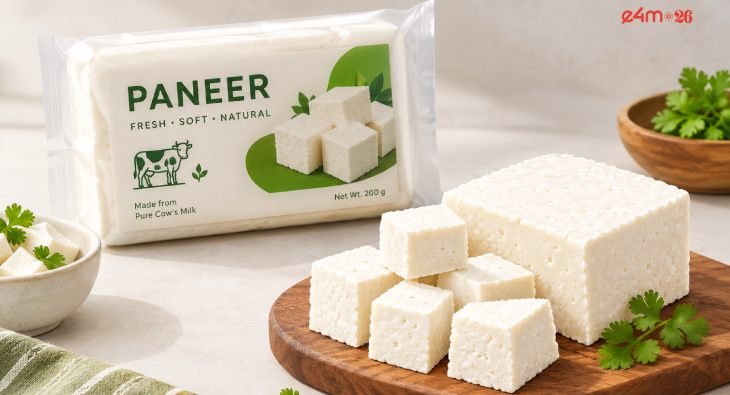
The Food Safety and Standards Authority of India (FSSAI) has proposed tighter restrictions on the use of the term “paneer” for analogue products made partly or entirely with non-milk ingredients. The draft amendment, notified on September 22 and published in the Gazette of India on September 23, 2026, aims to prevent consumers from being misled about the nature and composition of products sold as paneer.
The proposal would amend the Food Safety and Standards (Prohibition and Restrictions on Sales) Regulations, 2011. If finalised, products made with constituents not derived from milk would no longer be permitted to use “paneer” in their nomenclature, labelling or marketing.
FSSAI Seeks Greater Clarity on Dairy Analogues
Under FSSAI’s definition, a dairy analogue is a product in which non-milk ingredients replace some or all of the constituents of a conventional milk product while retaining a similar appearance, taste or function.
Common substitutions include vegetable oils or fats replacing milk fat and vegetable proteins replacing milk proteins. Such products are not recognised as conventional dairy products under the existing regulatory framework.
FSSAI’s dairy analogue guidance also distinguishes these products from modified dairy products. Skimmed, toned, lactose-free and fortified milk are not considered analogues because non-milk ingredients are not substituted for milk constituents. Products such as coconut milk and peanut butter, despite their traditional names, are also outside the analogue category because they are entirely non-dairy products.
Existing Rules Already Restrict Dairy Terminology
Analogue products are already subject to several labelling requirements. Dairy terms such as milk, cream, cheese, butter and dahi are generally reserved for products made from milk. Analogue products cannot carry the mandatory Milk logo used for standardised dairy products.
Where an analogue does not have a standardised identity, it must identify itself as an “Analogue” and display the relevant food category number. Products in which milk fat or protein has been partially replaced must also disclose the relevant constituent and its source.
However, the proposed amendment specifically names paneer and seeks to bring its use for non-milk analogues within restrictions on sale. This would provide greater clarity for manufacturers, retailers and consumers.
The move follows concerns raised by FSSAI’s West Region, which issued a public notice in April 2026 stating that selling cheese analogue products as paneer violated food safety and labelling requirements.
States Have Already Taken Regulatory Action
The proposed national approach follows regulatory measures introduced by individual states. Maharashtra prohibited analogue or non-dairy paneer in July 2026, while Karnataka imposed a one-year ban in August. Gujarat and Chhattisgarh have also taken action against the sale of such products.
FSSAI Chief Rajit Punhani has indicated that several states have already restricted analogue paneer and that a nationwide measure could be considered after receiving feedback from states and reaching broader consensus.
Consumer protection is a central concern because paneer is widely consumed in India and is an important source of protein. The regulator’s position is that consumers should receive a milk-based product when they purchase or order something described as paneer.
Price Difference Adds to the Challenge
Price has also contributed to the growth of analogue products. Earlier market estimates placed conventional paneer at around ₹450 per kilogram, while analogue products could cost approximately ₹200–₹250 per kilogram. Although these figures may vary by market and product, the significant price difference creates an incentive for some food businesses to use substitutes.
The broader paneer market is also substantial. Industry estimates have pointed to strong growth in both organised and unorganised segments, creating opportunities for branded dairy companies as regulatory enforcement becomes stricter.
Brands and Restaurants May Need to Review Labelling
The proposed rules could have implications across the food industry. Dairy brands may benefit from clearer differentiation between milk-based paneer and substitutes, while agencies could need to reassess packaging claims, product descriptions and advertising campaigns.
Analogue manufacturers, meanwhile, may need to develop product names that clearly communicate the composition of their products without creating confusion with paneer.
Restaurants, hotels, caterers and food-delivery businesses could also need to review menus, online listings and promotional material if they currently use “paneer” to describe products containing non-milk substitutes. A shift towards milk-based paneer could also increase input costs for some businesses.
60-Day Consultation Period to Determine Next Steps
The draft amendment is not yet a final nationwide ban. FSSAI has opened a 60-day consultation period during which stakeholders can submit objections and suggestions.
Dairy cooperatives, food manufacturers, restaurant associations, analogue producers and other stakeholders can participate in the consultation process. FSSAI will consider the feedback before deciding whether to finalise the amendment.
If notified in its proposed form, the regulation would establish a clearer principle for the market: products sold under the name “paneer” would need to meet the applicable milk-based identity requirements, strengthening transparency and consumer confidence in India’s dairy sector.