


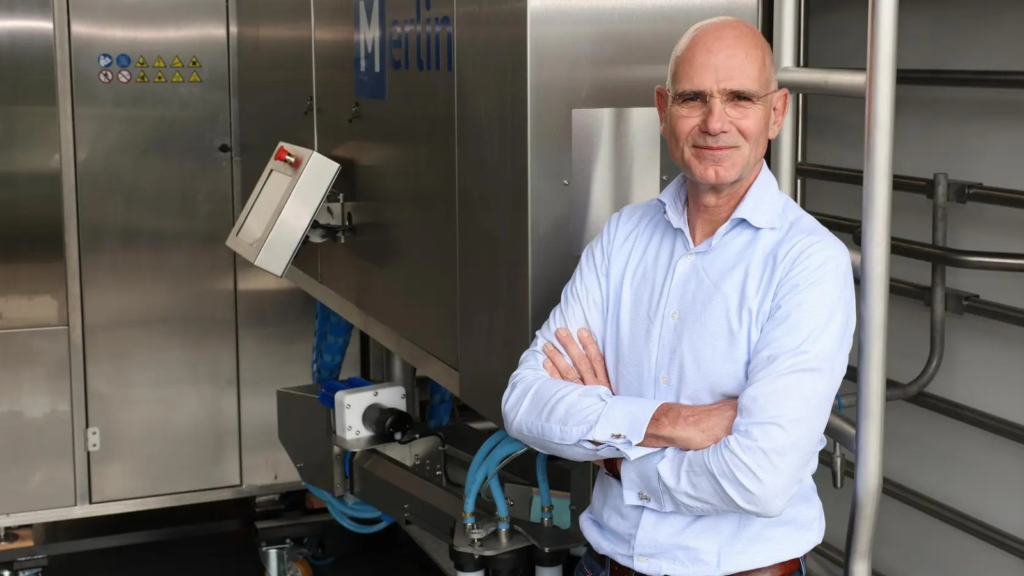
Fullwood JOZ is strengthening its position in the global dairy automation market by improving manufacturing efficiency, expanding production capacity and investing in advanced milking technology. Under the leadership of CEO Maarten van Raaij, the company is focusing on making its Merlin robotic milking systems more reliable, cost-effective and adaptable to the changing needs of dairy farmers.
The company has recovered from operational difficulties following the relocation of its manufacturing operations from England to Middenmeer in the Netherlands in 2024. The transition involved significant changes to production processes and the integration of Fullwood and JOZ, which initially created manufacturing instability and delivery challenges.
Manufacturing Recovery Supports Growing Demand for Robotic Milking Systems
Fullwood’s manufacturing strategy has undergone a major transformation. Previously, the Merlin milking robot was welded together as a complete unit in England. Production in Middenmeer now relies on assembling components manufactured by external suppliers, with more than 100 sub-frames bolted together to create a complete machine.
According to van Raaij, this approach has improved production efficiency and reduced manufacturing costs. The company has also significantly improved its delivery timelines. Current lead times stand at approximately 8–12 weeks, compared with 6–9 months when he first joined the business.
Fullwood is approaching annual deliveries of 700 robotic milking units and currently has additional manufacturing capacity available to accommodate increased demand.
Merlin 2+ Introduces Improvements in Dairy Automation
After several turbulent years for its robotics division, Fullwood has increased investment in developing its Merlin milking technology. The latest development is the launch of the Merlin 2+, featuring a completely overhauled control system.
Further upgrades are planned for 2027 to strengthen the robot’s performance and competitiveness.
The company’s design philosophy focuses on reliability, straightforward installation and easy maintenance. Unlike systems that may require highly specialised technical support for relatively simple repairs, Merlin robots are designed to allow farmers and technicians to replace components such as cables and hoses without complicated procedures.
Fullwood also highlights the long operational lifespan of its equipment, stating that its machines are designed to operate reliably for at least 15 years. Older installations, including systems that have been operating for 10–15 years, continue to receive software support.
AI and Image Recognition to Transform Dairy Farm Management
Beyond robotic milking, Fullwood JOZ is exploring artificial intelligence and image recognition to improve livestock monitoring and farm management.
Rather than developing another feeding robot, the company is prioritising technologies that can identify unusual animal behaviour and detect potential health problems earlier.
By analysing movement patterns and behavioural changes, image recognition systems could help farmers identify cows showing early signs of illness before changes become visible in milk quality or production parameters.
The company is also exploring digital twin and smart farming technologies that combine information from existing Merlin systems, cloud-based data and additional sensors.
These developments could provide farmers with more actionable insights into animal health, production efficiency and farm economics.
Large-Scale Dairy Farms Create New Market Opportunities
Fullwood JOZ sees significant opportunities in international dairy markets, although requirements vary considerably between regions.
In Western Europe, many dairy farms operate with approximately 100–250 cows, typically using two to four Merlin units. Meanwhile, emerging large-scale dairy operations in Southern and Eastern Europe, alongside the United States, are generating demand for robotic solutions capable of supporting farms with more than 1,000 cows.
The company is therefore working to address both smaller family-operated dairy businesses and larger commercial farms.
One example highlighted by van Raaij is an Italian dairy operation managing approximately 1,500 cows with just two employees. Such examples demonstrate the potential of automation and efficient batch milking systems to improve labour productivity.
Financial Stability and Lower Ownership Costs Remain Priorities
Fullwood JOZ reports annual revenue exceeding €100 million and a solvency ratio of approximately 40%, reflecting an improved financial position.
The company also identifies Total Cost of Ownership (TCO) as a major competitive advantage. Although farmers frequently prioritise initial purchase prices when comparing robotic milking systems, maintenance expenses, replacement parts, software support and equipment lifespan can significantly influence long-term profitability.
Van Raaij believes Fullwood’s lower maintenance and spare-parts costs contribute to a competitive lifetime operating cost.
The company acknowledges that publishing more detailed maintenance-cost comparisons could help communicate this advantage to potential customers.
A Technology-Led Future for Dairy Farming
Fullwood JOZ is positioning its future around reliable robotic milking, artificial intelligence, image recognition and data-driven farm management. While the company does not intend to replace farmers with automation, it sees technology as a tool that can support better decisions and improve operational efficiency.
With manufacturing operations stabilised, production capacity available and further Merlin upgrades planned, Fullwood JOZ aims to strengthen its presence in the increasingly competitive global dairy automation market.