


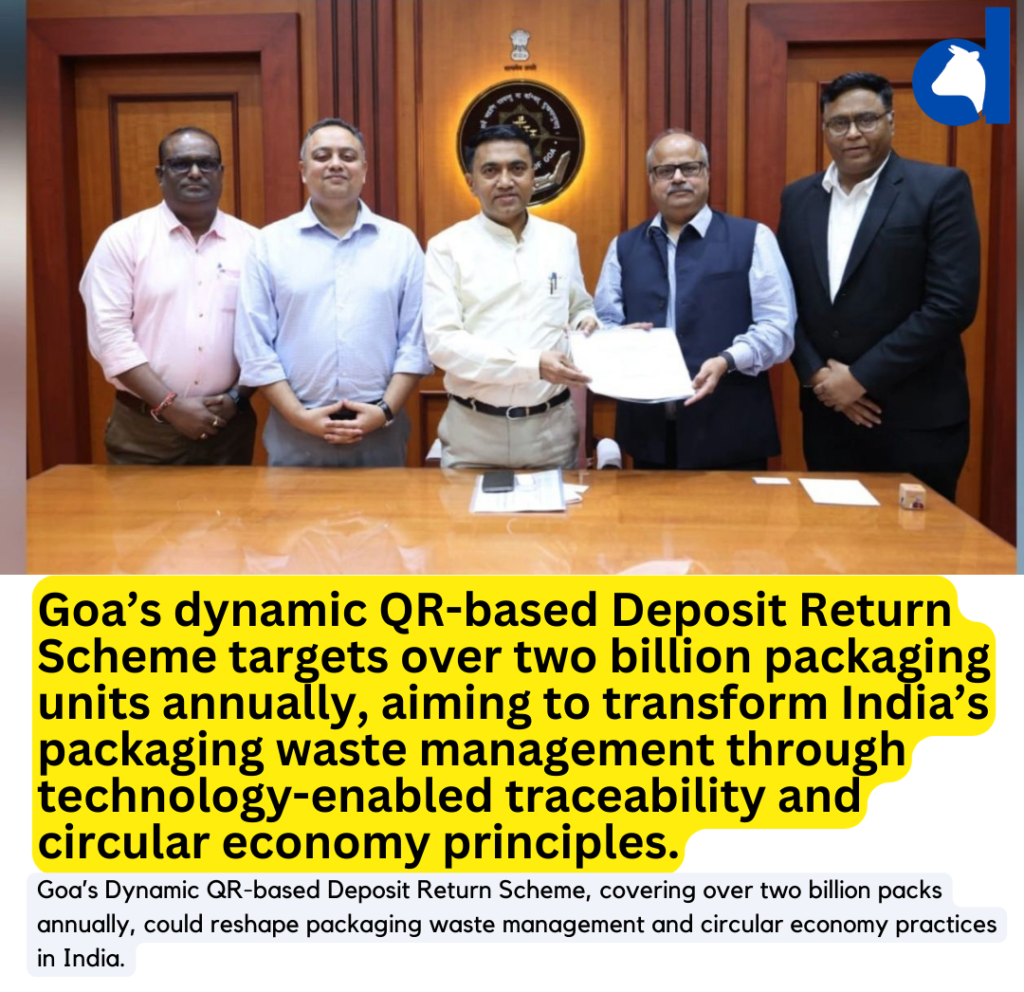
The Goa Government has launched what is being positioned as the world’s largest Dynamic QR-based Deposit Return Scheme (DRS), covering more than two billion packaging units annually. Scheduled to become operational this April, the initiative represents a significant shift in India’s approach to packaging waste management, traceability, and extended producer responsibility (EPR).
An Unusually Broad Material Scope
Unlike traditional deposit return systems, which typically focus on limited packaging types such as PET bottles or aluminium cans, Goa’s DRS adopts a material-agnostic framework. The scheme encompasses glass, PET, cans, multilayer packaging (MLP), beverage cartons, flexible packaging, and all rigid plastic formats. This wide coverage reflects an ambition to address systemic inefficiencies in packaging recovery rather than pursuing incremental material-specific solutions.
For the dairy and beverage sectors where diverse packaging formats coexist, this approach could reshape compliance strategies and recovery economics.
Technology-Driven Behavioural Change
At the core of the Goa DRS is dynamic QR code technology, enabling unit-level identification and traceability of packaging throughout its lifecycle. By modifying how consumers return used packaging and linking deposits digitally, the system has the potential to influence disposal behaviour at scale.
More importantly, the integration of technology disrupts the entire value chain:
manufacturers, distributors, retailers, consumers, waste pickers, aggregators, municipalities, and recyclers are all repositioned within a more transparent and accountable ecosystem. If implemented effectively, this could improve material quality at source and reduce leakage across collection and recycling stages.
Global Context, Indian Reality
Globally, EAN/UPC barcode-based DRS systems operate in nearly 60 countries, largely in regions lacking informal waste collection networks. India presents a contrasting reality, with a deeply entrenched informal waste picker ecosystem that plays a critical role in material recovery.
Goa’s DRS is notable for attempting to integrate informal waste pickers through technology rather than displacing them. This inclusive design could offer a scalable template for other Indian states, provided operational and economic challenges are addressed pragmatically.
Manufacturing and Operational Challenges
From an industry perspective, one of the most significant challenges lies in manufacturing integration. Printing unique QR codes within milliseconds on high-speed packaging and filling lines without compromising efficiency or increasing costs remains a complex technical task, particularly for high-volume dairy and beverage processors.
Industry stakeholders have highlighted the need for end-to-end trials across packaging formats, supported by a Joint Working Group (JWG) involving brand owners, technology providers, recyclers, and policymakers. Structured trials and phased implementation will be essential to ensure scalability, cost neutrality, and operational feasibility.
Cost Sensitivity and Consumer Impact
The long-term success of the Goa DRS will depend on whether it can achieve its sustainability objectives without increasing manufacturing costs or placing an undue burden on consumers and intermediaries. In price-sensitive categories such as milk and dairy beverages, even marginal cost escalations can have market-wide implications.
Implications for Dairy and Beverage Companies
For dairy processors, the scheme represents both a compliance challenge and a strategic opportunity. While investments in packaging innovation, labelling, and digital systems may be required, the DRS also offers a pathway to stronger EPR compliance, improved material recovery rates, and enhanced sustainability credentials.
As regulatory scrutiny on packaging waste intensifies, Goa’s model may serve as a reference point for future national or state-level frameworks.
A Collaborative Path Forward
Encouragingly, the Goa Government has engaged constructively with industry stakeholders, including brand owners and associations, allowing space for dialogue on operational constraints and implementation timelines. Continued collaboration will be critical in aligning environmental ambition with economic and technical realities.
Conclusion
Goa’s Dynamic QR-based Deposit Return Scheme represents a bold experiment in technology-enabled circular economy design. If supported by adequate trials, stakeholder cooperation, and cost-sensitive implementation, it could redefine how India approaches packaging waste, particularly for high-volume sectors such as dairy and beverages.