


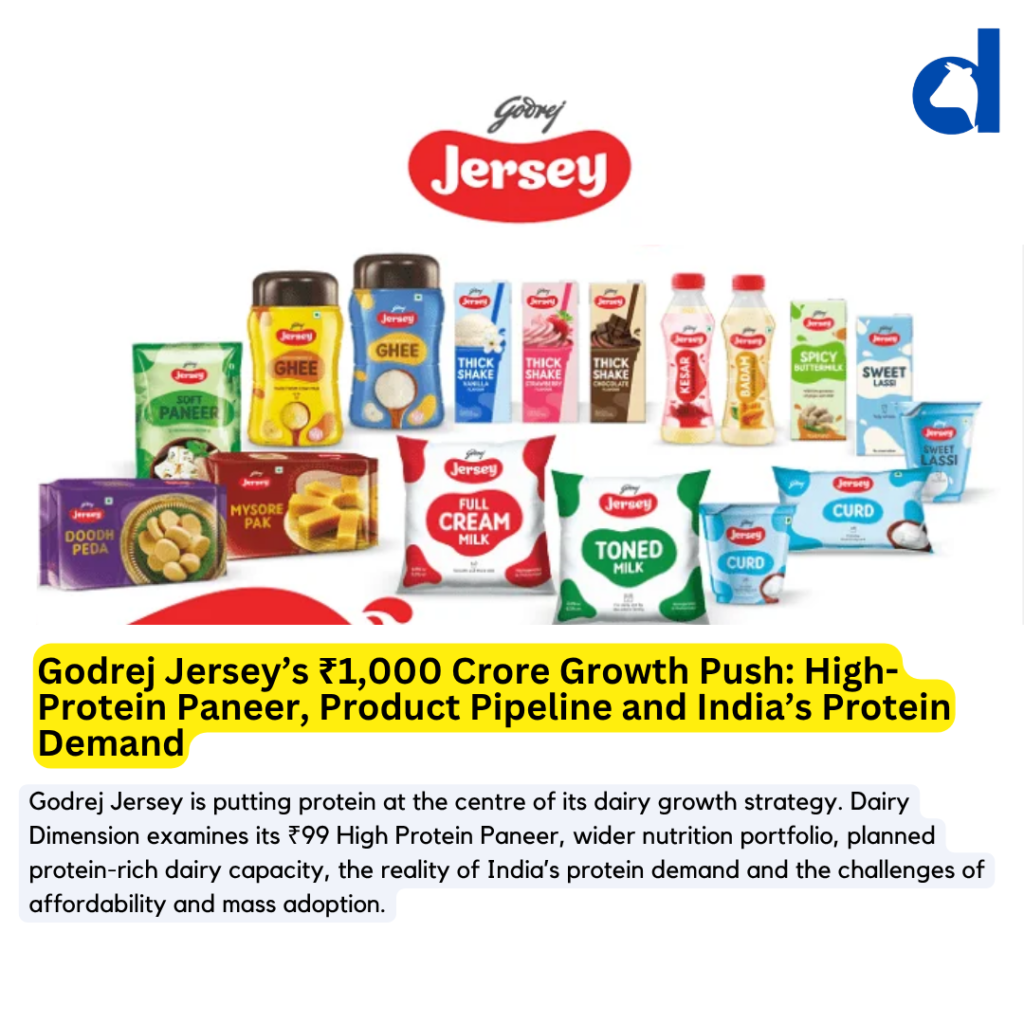
Godrej Jersey is placing protein and functional nutrition at the heart of its next phase of growth, reflecting a broader transformation underway across the Indian dairy industry. However, a closer examination suggests that the company’s ₹1,000 crore ambition is not simply a bet on specialised high-protein products. It is a broader attempt to premiumise everyday dairy categories, including paneer, milk beverages, and curd, by giving them a stronger nutrition-led proposition.
The strategy comes as protein moves beyond gyms and sports nutrition into mainstream Indian food consumption. Dairy companies are increasingly positioning milk, paneer, yoghurt and dairy beverages as convenient sources of quality protein for families, working professionals and younger consumers.
For Godrej Jersey, the central strategic question is whether it can convert the growing conversation around protein into regular, high-frequency dairy consumption.
What has Godrej Jersey actually launched in the protein segment?
The clearest dedicated high-protein product is Godrej Jersey High Protein Paneer, introduced in December 2025 at a reported price of ₹99 per pack.
The product offers 30 grams of protein per pack and has been positioned as an affordable everyday nutrition product rather than a niche fitness food. The company has also partnered with regional food creators to demonstrate how paneer can be incorporated into familiar South Indian meals, an important approach in markets where paneer consumption is still developing compared with parts of North India.
Commenting at the time of the launch, Shantanu Raj, Head of Marketing at Godrej Jersey, said: “India is at the centre of a protein transformation, and dairy is becoming the easiest and most trusted way for families to meet their daily nutrition needs.”
The significance of the launch lies as much in its pricing as in its protein claim. High-protein foods in India have traditionally been associated with powders, nutrition bars and premium urban consumption. By using paneer, a familiar dairy format, Godrej Jersey is attempting to reduce the behavioural barrier to protein consumption.
Alongside paneer, the company is expanding its wider nutrition-led dairy beverage portfolio. In early 2026, it introduced a 110 ml Badam Milk pack at ₹20, designed to bring the flavoured dairy drink to a lower entry price point. This is not a dedicated high-protein product in the same category as High Protein Paneer. Still, it fits into the company’s broader effort to link convenient dairy consumption with nutrition and affordability.
Godrej Jersey’s official product portfolio also includes flavoured milk, lassi, buttermilk, Jersey Recharge, curd, fruit yoghurt, paneer and Paneer Lite, demonstrating that the company already has a sizeable platform from which to build more differentiated nutrition-led products.
What is in the protein pipeline?
The important point for the dairy industry is that Godrej Jersey has not publicly disclosed a detailed SKU-by-SKU pipeline of future high-protein launches.
Public statements indicate an intention to develop more protein-rich dairy products, but exact formats, nutritional specifications and launch dates remain undisclosed.
The strongest evidence of a longer-term pipeline is Godrej Agrovet’s December 2025 disclosure relating to a proposed dairy processing facility in Telangana. The company said the facility would manufacture innovative, protein-rich dairy products designed around evolving consumer nutrition needs.
Therefore, while products such as high-protein milk, Greek-style yoghurt, protein beverages or other functional dairy formats may be logical areas for future development, they should not be presented as confirmed Godrej Jersey launches until formally announced.
The company’s immediate direction appears to involve three connected elements: improving the nutritional positioning of existing dairy categories, launching selected high-protein variants where consumers can easily understand the benefit, and creating processing capacity for more sophisticated protein-rich dairy innovation.
The ₹1,000 crore headline needs context.
The ₹1,000 crore growth narrative has attracted attention because of its association with the protein opportunity. Yet, the figure needs careful interpretation.
Earlier reports on Godrej Jersey’s market strategy linked the ₹1,000 crore objective to its broader value-added dairy products business in Andhra Pradesh and Telangana, with emphasis on categories such as badam milk, paneer and curd.
More recent communications have placed protein at the centre of the company’s broader growth narrative and described an ambition to cross the ₹1,000 crore mark by increasing access to protein-rich dairy products.
For industry observers, the distinction matters. The opportunity is larger than a portfolio of products carrying a “high protein” claim on the label. Godrej Jersey appears to be betting on protein as a category-repositioning tool, capable of increasing household penetration, encouraging consumers to trade up, and giving value-added dairy products a stronger reason to consume regularly.
That may prove to be more commercially significant than launching a long list of niche protein products.
India’s protein challenge is more complicated than the deficiency headline
The Indian protein conversation requires more nuance than the frequently repeated claim that a large majority of Indians are protein deficient.
A major 2025 analysis by the Council on Energy, Environment and Water, based on the 2023-24 Household Consumption Expenditure Survey, found that India’s average at-home protein intake was about 55.6 grams per person per day. The study argued that the deeper concern was protein quality and dietary diversity: nearly half of the protein consumed at home came from cereals, while pulses, dairy, eggs, fish, and meat remained comparatively underconsumed.
The same analysis found sharp inequalities in access to quality protein. The richest expenditure decile consumed around 1.5 times as much protein as the poorest, while milk intake among the lowest rural expenditure group was only 28 per cent of the recommended level.
This distinction is crucial to the dairy sector’s growth story in India.
The market opportunity is not merely to persuade already affluent urban consumers to buy more expensive protein products. The greater challenge is to improve access to affordable, digestible, and convenient sources of high-quality protein across income groups and regions.
Dairy has an inherent advantage in this environment. Milk and dairy products are culturally established across much of India, and dairy proteins provide a more complete amino acid profile than cereal-heavy diets. CEEW’s analysis found that milk and milk products accounted for approximately 11 per cent of at-home protein intake and identified greater dietary diversity as essential to improving protein quality.
Why the Godrej Jersey strategy makes commercial sense
From a market perspective, Godrej Jersey’s approach has several strengths.
First, it is working with familiar foods rather than asking consumers to adopt entirely new habits. A household may hesitate to purchase a protein supplement, but paneer, curd and milk drinks already have established consumption occasions.
Second, affordability has been built into recent launches. The ₹99 High Protein Paneer and ₹20 Badam Milk pack indicate that the company is exploring price points below the top end of the premium nutrition market.
Third, Godrej Jersey already has an established presence across Telangana, Andhra Pradesh, Tamil Nadu, Karnataka and Maharashtra. Its ability to use an existing cold chain and dairy distribution system could become an important competitive advantage as the protein opportunity expands beyond major metropolitan consumers.
Fourth, the company’s strategy aligns with the wider direction of the Indian dairy market. Other dairy processors are also expanding into protein-enhanced products. Reuters reported in February 2026 that Milky Mist was targeting growth through products including Greek yoghurt and protein-enhanced cottage cheese, with plans for high-protein milk as health-focused consumption grows in India.
The contest for the protein consumer is therefore becoming a serious area of dairy market growth rather than a passing wellness trend.
The critique: Protein claims alone will not guarantee scale
Despite the opportunity, Godrej Jersey faces several challenges.
Affordability remains the biggest test.
A ₹99 price point may be competitive within the premium paneer segment, but the larger protein-access challenge in India is concentrated among consumers with much tighter food budgets.
For the strategy to achieve mass-market scale, dairy processors will need to manage a difficult equation involving milk procurement prices, processing costs, protein concentration, cold-chain expenses and retail margins.
Premiumisation can improve dairy company margins, but genuine nutrition-led growth requires products that consumers can purchase frequently rather than occasionally.
High protein must not become only a marketing badge
India’s nutrition problem cannot be solved by putting more protein claims on premium packaged food.
The CEEW findings indicate that diet quality, diversity and inequality are central to the protein challenge.
For dairy companies, long-term credibility will depend on transparent nutritional information, meaningful protein quantities, sensible serving sizes and products that improve overall diet quality. The strongest brands will need to demonstrate the actual nutritional value delivered per rupee, not merely the prominence of the word “protein” on the packaging.
Consumer education must connect nutrition with normal meals
The South Indian market presents a particularly interesting opportunity. Paneer is growing, but it competes with established regional protein sources and deeply rooted eating patterns.
Godrej Jersey’s use of regional recipe communication is therefore strategically important. The growth opportunity lies in showing consumers where a product belongs in breakfast, lunch, snacks and family meals rather than presenting protein only in the language of muscle gain and fitness.
The pipeline needs greater clarity.
A dedicated new facility for innovative protein-rich dairy products is a significant sign. Still, investors, distributors and the dairy industry will watch closely for greater clarity on product formats, target consumer groups and route-to-market strategy.
The Indian market is already seeing growing activity around protein milk, Greek yoghurt, fortified dairy beverages, protein shakes and higher-protein paneer. Godrej Jersey’s eventual portfolio choices will determine whether its protein strategy develops into a broad-category leadership platform or remains concentrated on a few successful products.
Dairy could serve as a bridge between India’s protein awareness and daily consumption.
Godrej Jersey’s strategy captures an important shift inIndia’sa dairy trends. The next phase of value-added dairy growth may not be built only around indulgence, flavour or convenience. Nutrition is becoming an increasingly powerful reason for consumers to pay more for dairy products.
The company’s High Protein Paneer is currently the most clearly identifiable dedicated protein product in the portfolio. At the same time, affordable milk beverages and investment in future protein-rich dairy processing suggest a wider platform is under development.
The larger opportunity, however, is not to turn every dairy product into a sports nutrition product.
It is to make quality protein easier to understand, easier to consume and, most importantly, affordable enough to become part of the everyday Indian diet.
That is where the real test of Godrej Jersey’s ₹1,000 crore growth vision will lie. The company is entering the protein race at a favourable moment, but the winners in India’s next dairy growth cycle will be decided by more than protein grams alone. Taste, trust, affordability, distribution and repeat consumption will ultimately determine whether the protein boom can move from urban awareness to mass-market scale.