


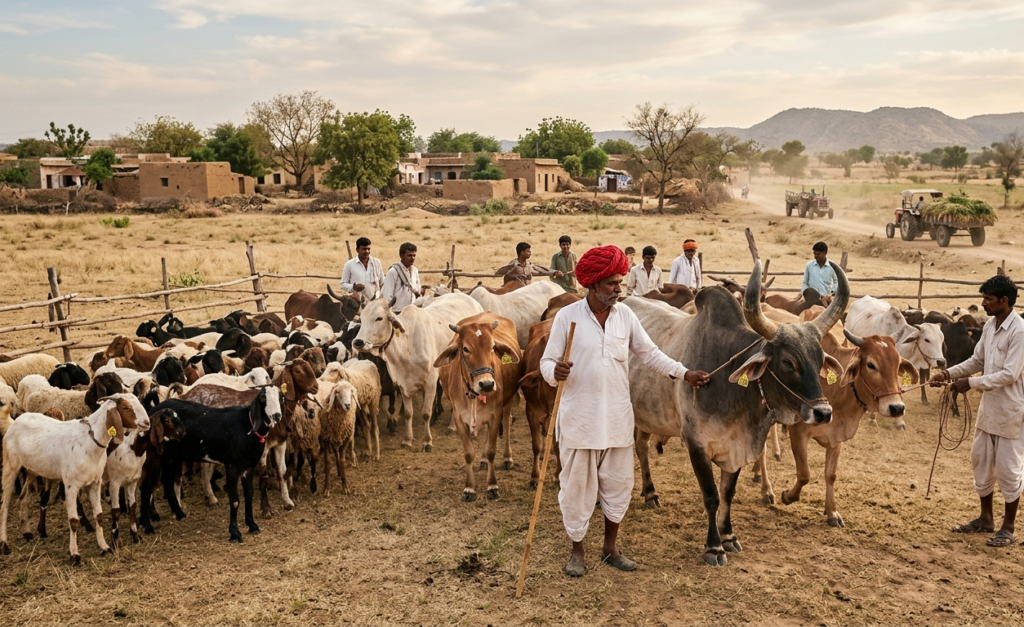
Government Strengthens Livestock and Dairy Sector Through Infrastructure, Productivity and Animal Health Initiatives
New Delhi | August 2026 – The Government of India is continuing to strengthen the country’s livestock and dairy sectors through a series of targeted programmes focused on improving dairy productivity, enhancing animal health, supporting scientific breeding, expanding infrastructure, and promoting rural entrepreneurship.
Speaking in the Rajya Sabha, Union Minister for Fisheries, Animal Husbandry and Dairying Rajiv Ranjan Singh, popularly known as Lalan Singh, highlighted the progress achieved under flagship schemes, including the National Livestock Mission (NLM), Animal Husbandry Infrastructure Development Fund (AHIDF), Rashtriya Gokul Mission (RGM), and the Livestock Health & Disease Control Programme (LHDCP).
Government Expands Livestock Infrastructure
The Minister said the government is supporting modern livestock infrastructure, entrepreneurship, and scientific breeding across the country.
In Assam, financial assistance has been extended under the National Livestock Mission and AHIDF to establish modern pig breeding farms and pork processing facilities. During the past three years, subsidies of ₹4.98 crore were released for 50 livestock projects, including 23 pig breeding farms, while ₹1.44 crore in interest subvention was provided for eight AHIDF-supported projects.
To strengthen pig genetics, the government has also sanctioned ₹1.80 crore for establishing a Pig Semen Collection and Processing Laboratory in Assam, alongside free Classical Swine Fever vaccinations covering nearly 9.93 lakh animals.
Dairy Productivity Continues to Improve
The Minister informed the House that India’s average bovine milk productivity has increased significantly over the past decade.
Average milk productivity has risen from 1,648 kg per animal per year in 2014–15 to 2,251 kg in 2024–25, while national milk production has increased by approximately 70%, reaching 248 million metric tonnes, compared with 146 million metric tonnes in 2014–15.
The growth reflects continued investment in scientific breeding, improved animal nutrition, and better dairy management practices.
Focus on Fodder Security
To address fodder shortages and improve livestock nutrition, the government is implementing multiple initiatives under the National Livestock Mission.
Over the last five years:
- ₹1,152.40 crore has been released for fodder development.
- Around 1.6 lakh tonnes of quality fodder seed have been produced.
- 204 fodder-related projects have been approved under the NLM Entrepreneurship Development Programme.
- AHIDF has supported 174 animal feed plants, with investments totaling ₹3,602.47 crore.
The initiatives aim to improve feed availability, livestock productivity, and long-term sustainability.
NDDB and ICAR Support Farmers
The Minister also highlighted complementary efforts by the National Dairy Development Board and the Indian Council of Agricultural Research.
NDDB has established 100 Fodder-Plus Farmer Producer Organisations (FPOs) to strengthen fodder supply chains, while the ICAR–Indian Grassland and Fodder Research Institute has developed improved forage varieties, prepared state-specific fodder development plans, and trained over 10 lakh farmers.
Strengthening Animal Health
The Government continues to expand disease prevention under the Livestock Health & Disease Control Programme.
Under the National Animal Disease Control Programme, states receive 100% Central assistance for vaccination against Foot and Mouth Disease (FMD) and Brucellosis, helping improve livestock health, productivity, and farmer incomes.
Additionally, the government has issued heatwave management guidelines for states and union territories and is promoting climate-resilient indigenous cattle breeds. Farmers are also receiving digital advisory services through the 1962 Farmers App under Bharat Pashudhan, supporting scientific feeding and ration balancing.
Driving Sustainable Dairy Growth
The government’s integrated approach combines infrastructure investment, scientific breeding, disease control, fodder development, and digital advisory services to strengthen India’s dairy and livestock sectors.
These initiatives are expected to improve productivity, enhance farmer incomes, generate rural employment, and reinforce India’s position as the world’s largest milk producer.