


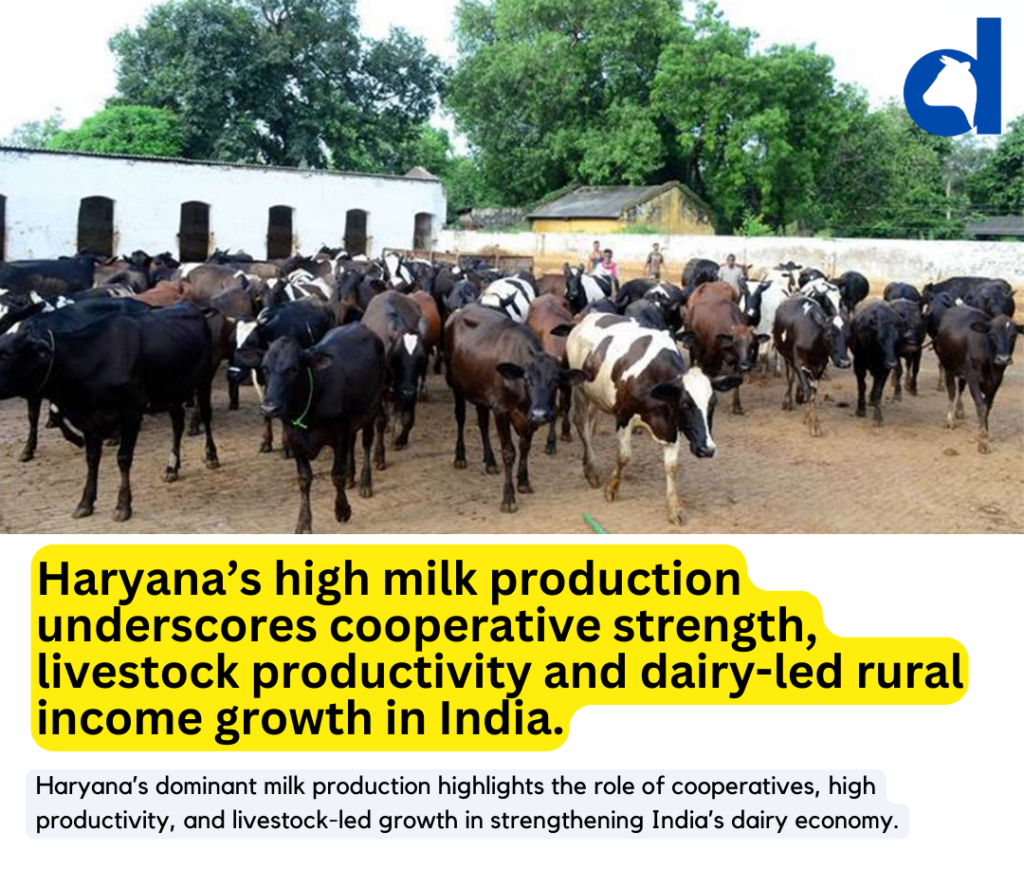
Haryana’s emergence as one of India’s most productive dairy states has once again drawn national attention, with Union ministers highlighting that the state alone contributes around 36 percent of India’s milk output, a figure that underscores the centrality of livestock to rural incomes and agrarian resilience.
The statement, made at the Kurukshetra Livestock Mela, positions Haryana as a cornerstone of India’s dairy economy, despite its relatively small geographical footprint. The achievement reflects decades of investment in animal genetics, cooperative infrastructure, and farmer-centric extension systems.
Productivity Over Geography
Haryana’s dairy success is not driven by scale, but by productivity efficiency. High-yield cattle breeds, improved fodder management, and strong veterinary outreach have enabled farmers to extract greater value per animal compared to national averages. The state’s proximity to large urban consumption centres such as Delhi-NCR has further strengthened its milk marketing ecosystem, reducing logistics costs and post-harvest losses.
Cooperatives As Economic Anchors
At the heart of Haryana’s dairy performance lies a dense network of village-level milk cooperatives, which aggregate farmers’ produce, ensure assured procurement, and stabilise farmgate prices. Union ministers used the Kurukshetra platform to urge further strengthening of cooperative institutions, particularly to support value addition, exports, and branded dairy products. Experts note that cooperative-led models offer greater transparency and traceability than fragmented private procurement, especially as food safety and quality compliance gain prominence in domestic and export markets.
Livestock As Income Insurance
With crop incomes increasingly exposed to climatic volatility, dairy has emerged as a critical income stabiliser for Haryana’s rural households. Regular milk payments provide liquidity, while allied activities such as fodder cultivation, animal healthcare, and breeding services generate secondary employment. The focus on livestock aligns with national policy priorities aimed at doubling farmer incomes through diversification rather than acreage expansion.
Export Ambitions And Quality Challenges
While Haryana’s milk volumes are impressive, industry observers caution that export competitiveness will hinge on quality compliance, cold-chain integration, and adherence to international residue and hygiene standards.
The state’s future growth trajectory will therefore depend on:
- Modernisation of milk testing infrastructure
- Expansion of processing and value-added dairy segments
- Integration of digital traceability systems
- Continued genetic upgradation and fodder security
Strategic Implications For India’s Dairy Sector
Haryana’s experience reinforces a broader lesson for India’s dairy economy: productivity-led growth, backed by cooperatives and institutional support, delivers more sustainable outcomes than volume expansion alone. As India seeks to consolidate its position as the world’s largest milk producer while scaling exports, Haryana’s model offers a replicable blueprint provided quality, sustainability, and farmer equity remain at the centre of policy design.