


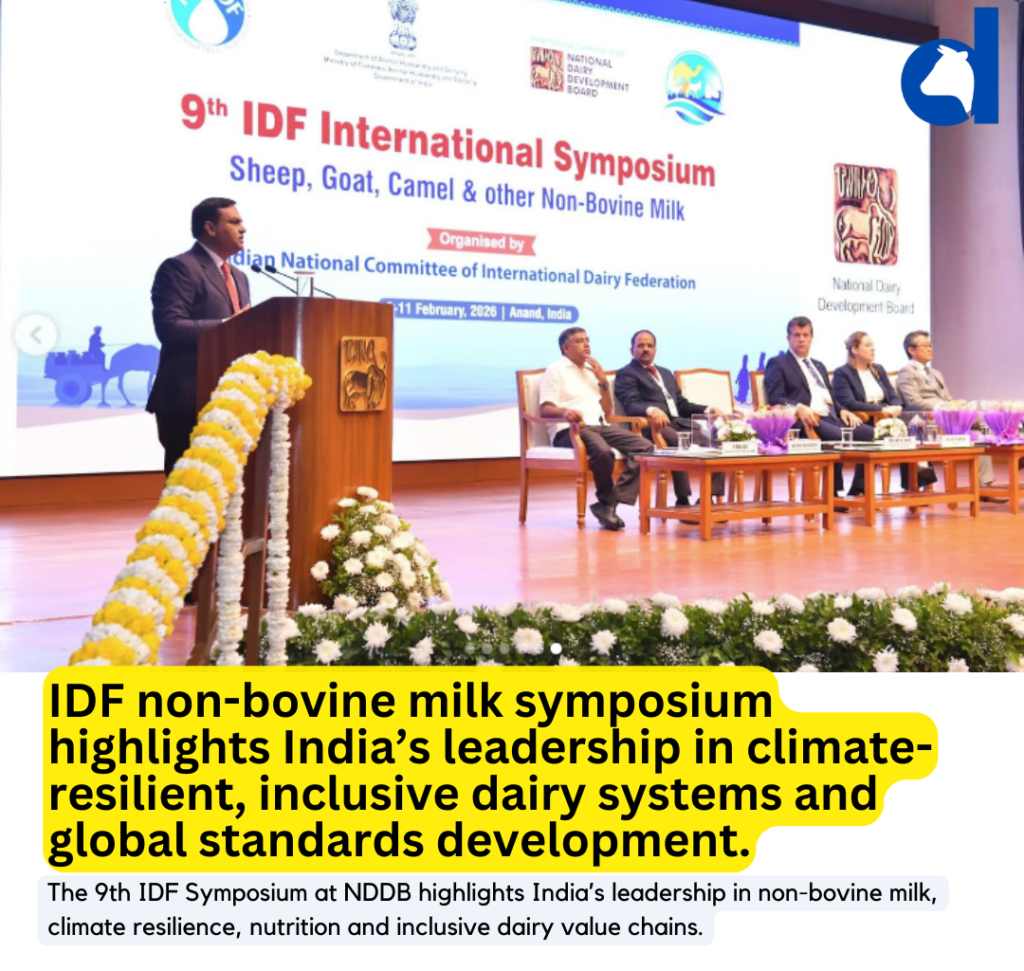
The 9th IDF Symposium on Sheep, Goat, Camel and Other Non-Bovine Milk commenced at the National Dairy Development Board (NDDB), Anand, on 9 February 2026. Organised by the Indian National Committee of the International Dairy Federation (INC-IDF), the three-day event places India at the centre of global discussions on diversified and climate-resilient dairy systems.
Importantly, the symposium reflects a broader shift in global dairy priorities. As climate pressures intensify, non-bovine milk is increasingly viewed as a strategic solution rather than a niche segment.
Global Institutions Emphasise Sustainability and Standards
During the inaugural session, IDF President Gilles Froment highlighted the resilience of goat, sheep and camel milk systems in arid and semi-arid regions. He emphasised that these species align closely with global priorities on environmental sustainability, animal welfare and inclusive nutrition.
Moreover, Froment stressed that long-term expansion of non-bovine dairy depends on innovation, robust nutrition data and strict adherence to international standards. Without these elements, market acceptance and scalability remain limited.
India’s Policy and Institutional Perspective
NDDB Chairman and INC-IDF Secretary Dr Meenesh Shah placed non-bovine milk within India’s larger dairy transformation narrative. He noted that India’s journey from milk scarcity to self-sufficiency now offers valuable lessons for climate adaptation and livelihood diversification.
Additionally, Dr Shah highlighted NDDB initiatives in disease control, advanced breeding and goat artificial insemination. He also pointed to Amul’s Sarhad Dairy as a successful model for organised camel milk marketing, calling for similar scale-up across regions.
Building Resilient Value Chains Through Science
From a regulatory standpoint, Animal Husbandry Commissioner Dr Naveena B. Maheswarappa underlined the need for science-led, cluster-based development models. According to her, traceability and biosecurity are essential to building resilient non-bovine dairy value chains.
As a result, she advocated for integrated disease management, quality assurance and market linkage strategies. These, she argued, are critical for aligning non-bovine milk production with domestic and export requirements.
FAO Sees Opportunity in Regional Success Models
Meanwhile, FAO Representative Takayuki Hagiwara acknowledged India’s progress in promoting goat, sheep and camel milk. He cited successful initiatives in Rajasthan and Kutch as examples of how traditional systems can be modernised. However, he noted that further research investment and stronger value-chain integration are required to unlock the sector’s full potential.
From Niche to Strategic Dairy Segment
Across seven technical sessions, delegates discussed emerging markets, consumer trends, farm management and processing technologies. Notably, discussions reflected growing global interest in non-bovine milk for specialised nutrition, functional foods and premium segments. At the same time, speakers recognised ongoing challenges related to scale, standardisation and consumer awareness.
India’s Expanding Role in Global Non-Bovine Dairy
Overall, the symposium reinforced India’s rising influence in shaping the global non-bovine dairy agenda. As nutrition security, climate resilience and sustainability become central to dairy policy, diversified milk systems are moving into the mainstream. Consequently, India is well positioned to lead innovation, standards development and inclusive growth in the non-bovine dairy segment globally.