


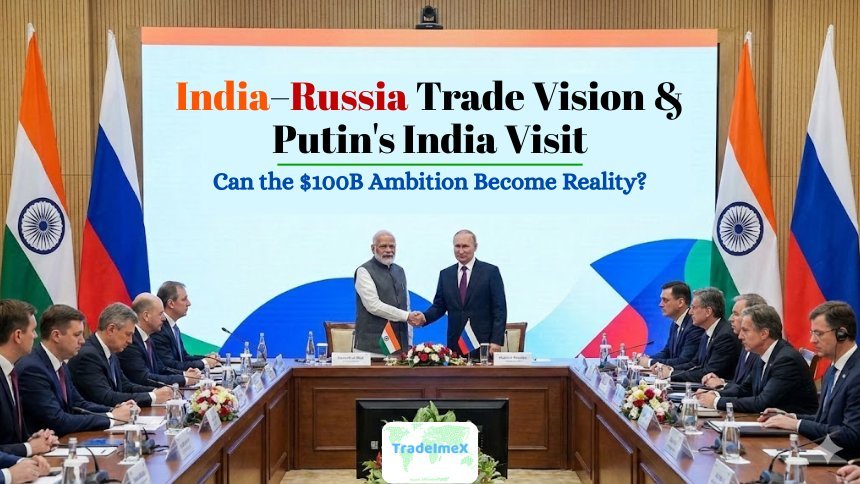
India’s trade with Russia has grown fast in recent years. Total trade now stands near $70 billion. However, most of this value comes from India’s oil imports. India exported only $4.9 billion in FY2025 but imported $63.8 billion, leaving a trade deficit of $58.9 billion. Crude oil alone formed $50.3 billion of these imports. As a result, the partnership depends more on oil than on a balanced flow of goods.
During President Vladimir Putin’s recent visit, Russia repeated its target of lifting trade to $100 billion by 2030. Moscow also said it wants to buy more Indian goods. For India, this creates a chance to widen its export base and reduce the trade gap.
Large Gaps in Agriculture Trade
According to the Global Trade Research Initiative (GTRI), India has strong export potential in several areas. GTRI used mirror data from the WITS database, since Russia no longer releases full trade figures. In 2024, Russia imported $202.6 billion worth of goods, but India supplied only 2.4% of these imports.
Agriculture offers the biggest opportunity. Russia imports large volumes of fruits, nuts, vegetables, oilseeds, meat and dairy. Yet India supplies only a small share. For example, Russia imported $4.34 billion of fruits and nuts, but India sold only $38.8 million. A similar pattern appears in oilseeds, edible oils and vegetables. This gap is surprising because India ranks among the world’s major exporters in many of these categories.
Processed Food and Consumer Goods Show Potential
The gap is even wider in processed food. Russia bought $689 million of cereal-based foods and $1.15 billion of processed fruits and vegetables. India supplied only $0.6 million and $42.7 million, respectively. India also exported small amounts of perfumery, essential oils, soaps and inorganic chemicals, even though it performs strongly in global markets. These numbers show clear room for expansion.
Payments and Logistics Remain Key Barriers
To grow exports, India must fix several practical problems. The largest barrier is the payment system. Many Russian banks cannot use SWIFT, which slows down transactions. Exporters often face delays and uncertainty. A stronger rupee–rouble settlement system, supported by reliable banks, could reduce these issues.
India also needs more trade missions, buyer–seller meetings and direct business links. These efforts can help exporters understand Russian rules, packaging needs and market demand. Better support can also help firms handle certification, quality checks and logistics routes.
A Path to a Balanced Partnership
India has the capacity to supply many of the products that Russia already imports in large volumes. If payment issues are reduced and market access improves, agricultural and processed food exports can grow quickly. A more balanced partnership will emerge only when Indian goods gain a stronger presence in Russian markets, not only when Russian crude arrives at Indian ports.