


India’s demand for high-protein whey products continues to expand, while availability in the main producing regions remains constrained. The European Union and the United States are supplying a growing market at a time when domestic demand, committed production and limited spot availability are keeping whey protein markets tight. This analysis examines how these dynamics are shaping trade flows, prices and India’s sourcing position in 2026.
Demand for high-protein whey products in India is expanding rapidly, supported by fitness trends and the increased adoption of GLP-1 drugs. The country imported 21,156 tonnes of whey protein concentrate with 80% protein (WPC80) and whey protein isolate with 90% protein (WPI90) in 2025, up 17.2% compared with the previous year. Indian expenditure on these products increased even more rapidly. Import value rose by 64.4% to USD $269.35 million over the same period, supported by a 40.3% increase in average import prices.
The trend continued into 2026. Through April, India imported 8,107 tonnes of WPC80 and WPI90, valued at USD $114.76 million. This represented a year-on-year increase of 32.2% in volume and 63.1% in value, indicating that average import prices remained above year-earlier levels during the first four months of 2026.
Despite being the world’s largest milk producer, India is not a major producer of whey protein ingredients. Whey production largely results from cheese manufacturing and requires significant investment in ultrafiltration, microfiltration and drying capacity. With relatively limited production capacity in both cheese and whey processing, India depends primarily on imports to cover its demand for whey protein.
The European Union and the United States are currently the most important producers globally and represent the main origins of the whey protein consumed in India. Both regions have recorded notable increases in whey protein prices, affecting domestic and international markets. This article examines the factors behind these increases and their impact on international trade, with particular attention to India.
European prices increased amid stronger domestic and export demand
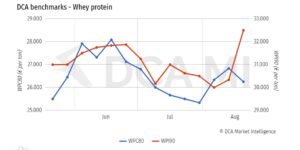
Whey protein prices increased sharply in the EU. According to DCA Market Intelligence benchmarks, WPC80 rose by 36.0% to EUR €26,250 per tonne between 24 March and 19 August, while WPI90 increased by 30.0% to EUR €32,500 per tonne over the same period. Prices accelerated particularly during May and have since remained comparatively stable while fluctuating at elevated levels.

Consistent with reports of robust demand, EU deliveries to the global market increased. EU exports of WPC80 and WPI90 rose by 5.5% year on year to 30,198 tonnes through June 2026. Export value increased more strongly, by 35.0% to EUR €467.32 million over the same period, alongside a 28.1% increase in average export prices. This represented a notable acceleration from 2025, when physical exports increased by 0.2% and export value by 25.2%.
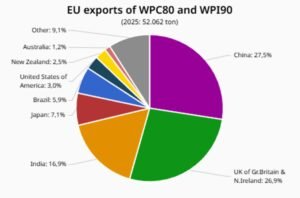

Trade within the EU therefore outpaced the increase in shipments to international markets, pointing to stronger demand within the region. This internal pull reduces the volume potentially available for other destinations when production is already largely committed.
Strong whey protein prices have also coincided with higher prices for other whey products, including whey powder. According to DCA Market Intelligence, food-grade whey powder averaged EUR €1,815 per tonne in August, up 66.7% from the previous year and a record for that month.
EU production data for whey protein are not publicly available in sufficient detail. However, industry sources indicate that demand for high-protein products is absorbing a substantial share of available whey solids. This reduces the amount of whey solids available for standard whey powder production and contributes to the tightness observed in that segment.
US increasingly directs whey solids towards high-protein production
High-protein ingredients have also taken priority in the US processing mix. Production of WPC80 and WPI90 increased by 8.6% year on year to 172,624 tonnes in 2025, while production of WPC34 and whey powder declined by 15.1% and 1.0%, respectively. Growth in high-protein production moderated in 2026, with output rising by 4.0% year on year to 88,986 tonnes through June.
According to the United States Department of Agriculture (USDA), WPC80 prices remained strong at USD $12 to $13 per pound, equivalent to approximately EUR €22,369 to €24,788 per tonne. WPI90 prices were firmer still at around USD $14 per pound, or approximately EUR €26,664 per tonne. More detailed market reports indicate that WPC34 prices increased by 33.8% to USD $2.11 per pound, equivalent to approximately EUR €3,960 per tonne, with constrained availability cited as an important market factor.
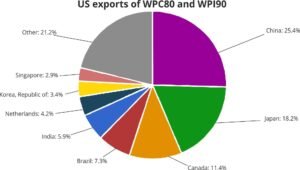

Despite higher production and lower exports, the elevated pricing of WPC80 and WPI90 in the US indicates strong competition for available product between domestic and export markets. This has limited the amount of additional product moving into export channels while maintaining high price levels in both markets.
Stocks have also declined. Average inventories during the first half of 2026 were 4.6% below the previous year. Taken together, production, export and stock data indicate that demand for high-protein whey is absorbing a large share of available industry capacity across domestic and international markets.
EU covers most of India’s whey protein needs in 2026
The EU and the US, the main global producers of high-protein whey ingredients, have shown a broadly similar pattern over the past year. Strong demand across domestic and export markets has coincided with increasingly limited availability. Under these conditions, buyers across several regions are competing for access to available product, while average transaction and export values have increased.
India is part of this trend. Despite relatively limited growth in total EU exports, EU shipments of WPC80 and WPI90 to India increased by 16.4% year on year to 5,893 tonnes through June 2026. This was slightly below the 18.5% increase recorded in 2025.
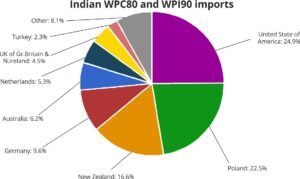

At the same time, the decline in US WPC80 and WPI90 exports was more pronounced in trade with India. Shipments fell by 24.0% year on year to 3,498 tonnes through June. Export value nevertheless increased by 14.1%, alongside a 50.2% increase in average export prices.
Overall, the shift meant that the EU supplied the majority of India’s WPC80 and WPI90 imports from these two main origins in 2026. Although producers in both regions are increasingly serving strong domestic demand, the EU continued to expand shipments to international markets. For India, the increase in average import prices from the EU was also less pronounced than the increase recorded for US-origin product.
Current market conditions remain characterised by strong demand and constrained availability. A material change in this balance would require additional processing capacity, changes in demand, or the emergence of new suppliers.
In this context, a clear wave of announced and ongoing investment in production capacity is already visible. The US represents the largest cluster of announced projects, with additional investments reported in the EU, including Germany, the Netherlands and Ireland, as well as New Zealand and Brazil.
Examples include a new WPI plant from Wisconsin Whey Protein, operational since 2026 and adding 5,896 tonnes of annual capacity; a EUR €90 million investment programme by FrieslandCampina focused on advanced whey proteins; and a new EUR €26 million investment in a WPC plant reported by DMK. Many of the announced projects are scheduled for completion by 2027. Until this additional capacity becomes operational, existing supply conditions remain the main reference point for the market.
India is also gradually increasing its participation in whey protein production through investments in integrated cheese and whey processing. Examples include Parag Milk Foods, which announced an INR 1.05 billion investment to double cheese capacity, and Milky Mist, which has announced a new WPC production line.
By Santiago Morales Hilarión, Dairy Market Analyst DCA Market Intelligence