


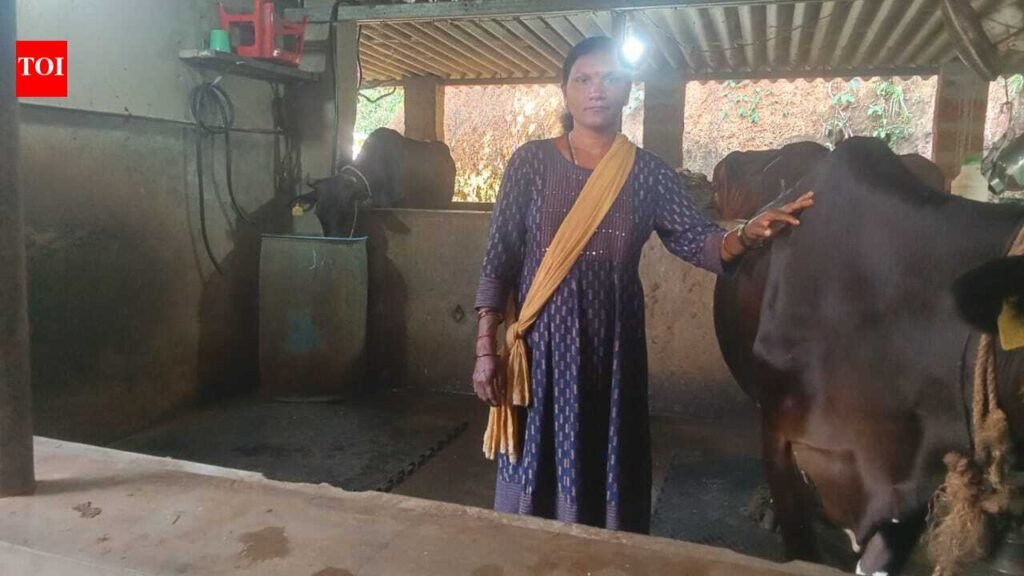
Sundari, a resident of Badinaru in Kodimbady village of Puttur taluk, Karnataka, has built a growing dairy enterprise by saving and reinvesting financial assistance received under the state government’s Gruhalakshmi scheme.
A mother of two, Sundari had spent several years primarily at home without an independent source of income. Her family largely depended on her husband’s daily wage of around Rs 400, which was used to meet household expenses.
The monthly assistance provided through the Gruhalakshmi scheme became an opportunity for Sundari to begin building her own source of livelihood.
Savings Help Launch Dairy Enterprise
Under the Gruhalakshmi scheme, women beneficiaries receive monthly financial assistance of Rs 2,000. Sundari saved Rs 4,000 from her first two instalments and used the money to purchase her first calf.
Rather than using the assistance for immediate household expenses, she gradually reinvested the income generated from dairy activities into expanding her enterprise.
Her initial investment eventually developed into a larger dairy operation, giving her an independent source of income while also contributing to her family’s financial stability.
From One Calf to Five Cattle
Sundari gradually expanded her herd through careful reinvestment of her earnings. She now owns five cattle and supplies between 55 and 60 litres of milk every day to the local cooperative society.
The growth of her dairy operation has also required improvements in transportation and farm management.
Delivering milk on foot across the hilly terrain of Puttur became increasingly difficult. To address the challenge, Sundari combined Rs 10,000 from her savings with financial support from her husband and a loan from her mother to purchase a second-hand scooter for Rs 40,000.
The vehicle enabled her to transport milk more efficiently and continue supplying the local cooperative.
Diversifying Her Agricultural Activities
Alongside dairy farming, Sundari has also invested in agriculture. She has planted 300 arecanut saplings on joint family property, adding another activity to the family’s rural livelihood.
Her experience demonstrates how small amounts of financial assistance, when saved and reinvested, can contribute to the development of a productive rural enterprise.
Recognition for Women’s Economic Participation
Sundari’s journey attracted the attention of state officials, and she was felicitated on September 10 at Vidhana Soudha in Bengaluru during the state-level Gruhalakshmi Sadhaki programme.
She credited Puttur MLA Ashok Kumar Rai and former Kodimbady gram panchayat vice-president Jayaprakash Badinaru for their encouragement and assistance.
They supported her in obtaining essential dairy equipment, including rubber mats for the cattle and a grass-cutting machine.
Dairy Farming Creates Independent Income
Sundari said the financial assistance gave her an opportunity to move beyond depending solely on the family’s limited income. By saving the payments and investing in livestock, she was able to gradually build a dairy enterprise.
Her current milk supply of 55–60 litres per day represents a substantial expansion from the single calf purchased with her initial savings.
Her experience highlights the potential for small-scale dairy farming to support household incomes when combined with reinvestment, access to local milk collection systems and appropriate farm equipment.
For rural women, dairy enterprises can provide a recurring income source while allowing livestock and farm assets to be expanded progressively.