


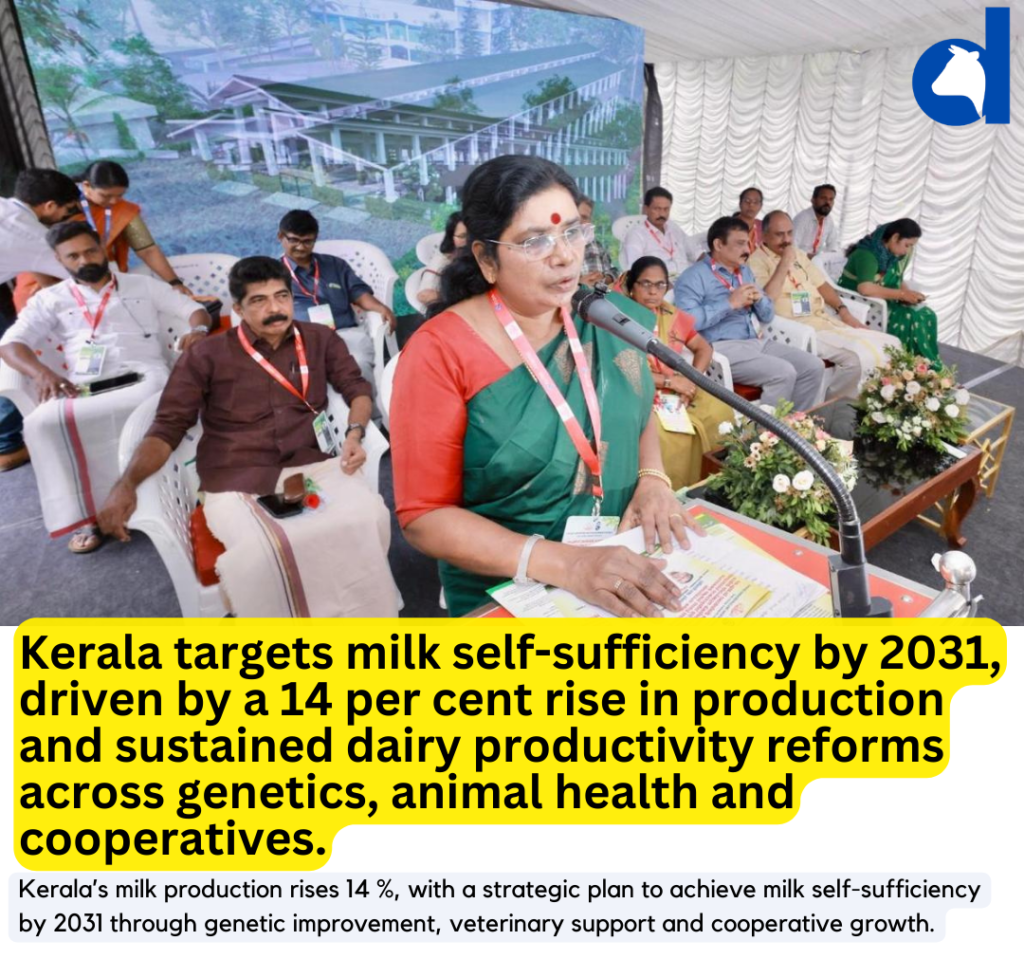
Kerala has recorded a 14 per cent increase in milk production, raising annual output to around 25.27 lakh metric tonnes, as part of its broader strategy to achieve milk self-sufficiency by 2031, according to the State’s Minister for Animal Husbandry and Dairy Development.
Growth Amid Structural Challenges
While Kerala’s milk production has grown, the state still faces a structural deficit relative to its internal demand. According to official statistics, production in recent years has hovered between 25.2 and 25.8 lakh metric tonnes annually, while the estimated requirement exceeded 31.7 lakh metric tonnes in 2023–24, underscoring a shortfall of roughly 20 per cent.
This gap reflects long-standing issues such as limited herd sizes, reliance on crossbred rather than high-yield indigenous cattle, and lower per-capita output relative to major producing states. Despite the challenges, Kerala’s average yield per crossbred cow remains above the national average, offering a foundation for further productivity gains.
Policy Interventions and Productivity Enhancements
To bridge the production shortfall and move towards self-sufficiency, the State government has outlined a multifaceted plan:
- Genetic improvement: Modern breeding technologies, including sex-sorted semen and in-vitro embryo production, are to be made available at subsidised rates to enhance herd quality.
- Veterinary support: Block-level veterinary ambulances and expanded health services aim to reduce livestock mortality and improve animal productivity.
- Infrastructure and research: A Centre of Excellence for Advanced Technologies in Bovine Production and Research, with facilities for embryo transfer (ET) and IVF services, is being established to reduce dependence on imported inputs.
- Sustainable feeds and supplements: The introduction of anti-methanogenic feed additives developed by the Indian Council of Agricultural Research is intended to improve both productivity and environmental sustainability.
These measures reflect a holistic strategy, combining genetics, animal health, infrastructure and sustainability to enhance productivity across the dairy value chain.
Cooperative Sector and Market Dynamics
Kerala’s cooperative sector, led by organisations such as the Kerala Co-operative Milk Marketing Federation (Milma), underpins much of the state’s dairy activity. Milma’s procurement networks and incentive structures have contributed to increased milk flows from farmers, and recent reports highlight a 14 per cent surge in procurement echoed across the cooperative system.
Cooperative models that link farmers to stable markets, quality control services and value-added product lines form the backbone of Kerala’s dairy ecosystem, reinforcing both economic resilience and rural livelihoods.
Implications for Dairy Self-Reliance
Kerala’s drive towards self-sufficiency by 2031 represents a significant policy commitment at a time when national dairy dynamics are also shifting. While the state currently remains below full self-sufficiency, gains in productivity and institutional capacity suggest a plausible trajectory toward that goal. Incremental growth supported by targeted public interventions and cooperative engagement may yield long-term dividends for smallholder dairy producers and the broader economy.