


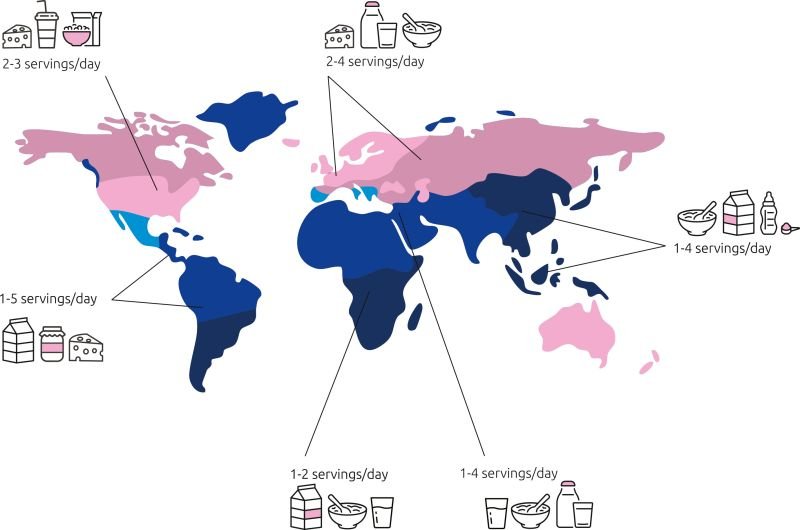
A new scientific review published in Advances in Nutrition examines the distinction between lactose maldigestion and lactose intolerance, highlighting why dairy products should remain part of dietary guidelines even in populations where lactase activity commonly declines after childhood.
The article, titled Lactose, Lactose Maldigestion and Lactose Intolerance: Definitions, Misunderstandings, Mechanisms, and Public Health Implications, was highlighted by Stephan Peters, Manager of Dairy, Nutrition, Health and Sustainability at the Dutch Dairy Association and Chief Editor of Voeding Magazine.
The research addresses a longstanding misunderstanding in nutrition science: the assumption that people who have reduced lactase activity necessarily experience symptoms when consuming dairy products. According to the authors, these two conditions are not interchangeable, and confusing them can lead to inappropriate dietary recommendations.
Understanding the Difference Between Lactose Maldigestion and Lactose Intolerance
Lactose is a naturally occurring sugar found in milk and dairy products. Its digestion requires lactase, an enzyme produced in the small intestine that breaks lactose into glucose and galactose for absorption.
However, lactase activity commonly decreases after childhood in many populations, a condition known as lactase non-persistence. This can result in lactose maldigestion, where the body does not completely digest lactose.
The researchers emphasise that lactose maldigestion does not automatically indicate lactose intolerance.
While lactose maldigestion describes the incomplete digestion of lactose, lactose intolerance refers to the gastrointestinal symptoms experienced by certain individuals after consuming lactose-containing foods. These symptoms may include bloating, abdominal discomfort, gas and diarrhoea.
The distinction is important because many individuals with lactose maldigestion can consume moderate quantities of dairy without experiencing significant symptoms.
According to the review, treating reduced lactase activity as an automatic reason to avoid dairy can unnecessarily restrict access to important dietary nutrients.
Why Dairy Remains Important in Dietary Guidelines
The review also examines why dairy products continue to feature in food-based dietary guidelines across different regions, including countries where lactase non-persistence is relatively common.
Milk and dairy products provide several essential nutrients, including high-quality protein, calcium, vitamin B12, phosphorus and other important micronutrients. Their nutritional contribution makes them valuable components of balanced diets.
Furthermore, the authors highlight evidence associating dairy consumption with beneficial health outcomes, including lower risks of colorectal cancer and type 2 diabetes.
Dietary recommendations, therefore, should consider the nutritional benefits of dairy alongside individual digestive tolerance rather than relying exclusively on the prevalence of reduced lactase activity.
The research suggests that population-wide recommendations to avoid dairy based solely on lactase non-persistence could overlook the ability of many individuals to tolerate moderate dairy consumption.
Implications for Dairy Industry and Public Health Policy
The findings have important implications for the dairy industry, nutrition professionals and policymakers.
For the dairy sector, the distinction provides an opportunity to strengthen consumer education around lactose digestion and the nutritional value of dairy products. Misconceptions surrounding lactose intolerance can influence purchasing decisions and discourage consumers from including milk, yoghurt, cheese and other dairy products in their diets.
The research also supports a more individualised approach to dietary guidance. Rather than recommending broad dairy restrictions, policymakers should consider actual symptoms, individual tolerance and the nutritional requirements of different populations.
Dairy products with naturally lower lactose content or suitable lactose-free alternatives can also provide options for individuals who experience symptoms.
The authors’ findings reinforce the importance of evidence-based communication between the dairy industry, healthcare professionals and consumers.
A More Evidence-Based Approach to Dairy Consumption
The review highlights that reduced lactase activity and lactose intolerance represent different physiological and clinical concepts. Recognising this difference is essential for developing dietary recommendations that balance digestive comfort with nutritional adequacy.
By distinguishing lactose maldigestion from symptomatic lactose intolerance, the researchers provide a stronger scientific foundation for understanding dairy consumption across diverse populations.
The research was conducted by Stephan Peters, Jan Geurts, Bruno Pot, Karen Knipping and Mandy Braat, whose collaborative work aims to improve scientific understanding of lactose digestion and its wider public health implications.
As dairy consumption continues to be evaluated across different population groups, the findings underline the importance of avoiding generalisations about lactose intolerance and ensuring that dietary guidelines reflect scientific evidence, individual tolerance and the nutritional value of dairy products.