


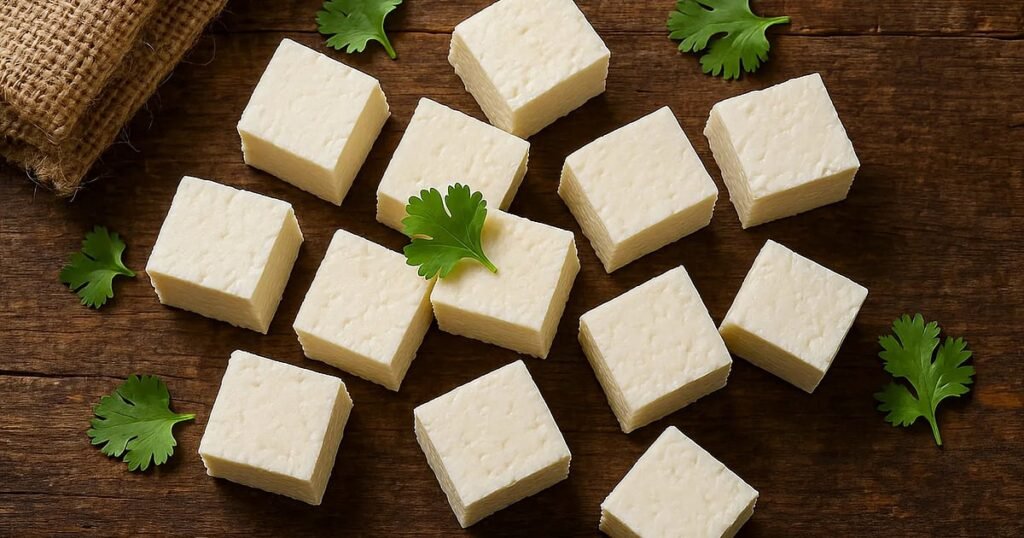
Madhya Pradesh has become the fourth Indian state to prohibit analogue paneer, following similar restrictions introduced by Chhattisgarh, Maharashtra and Gujarat amid growing concerns over food safety, product transparency and consumer protection.
Chhattisgarh First to Ban Analogue Paneer
Chhattisgarh was the first state to introduce restrictions on analogue paneer.
On August 1, the state government ordered an immediate restriction on the manufacture, sale and use of analogue paneer, cream and butter across markets and eateries.
The move marked an early state-level response to concerns surrounding the sale and use of non-dairy substitutes in products traditionally associated with milk.
Maharashtra Introduces One-Year Ban
Four days later, on August 5, Maharashtra imposed a one-year statewide prohibition on the manufacture, processing, storage, distribution and retail sale of non-dairy paneer under the Food Safety and Standards Act, 2006.
The decision significantly expanded regulatory scrutiny of products being marketed or used as paneer despite not being made entirely from milk.
Gujarat Expands Restrictions
On the same day, neighbouring Gujarat announced a comprehensive statewide ban covering the production, storage, transportation and distribution of analogue paneer, cheese and butter.
The measures across the three states came amid increasing attention to the composition and labelling of dairy-like products.
What Is Analogue Paneer?
Analogue paneer is a paneer-like product that is not made entirely from milk.
Instead of relying solely on milk fat and milk protein, manufacturers may use ingredients such as:
- Vegetable oil or fat
- Starch
- Vegetable protein
- Emulsifiers
- Other non-milk ingredients
According to the Food Safety and Standards Authority of India (FSSAI), a dairy analogue is a product where non-milk ingredients replace milk constituents while the finished product resembles a conventional milk product.
Therefore, the existence of dairy analogues itself is not necessarily the central regulatory issue. The concern arises when such products are sold or served as ordinary paneer without clearly communicating their nature to consumers.
Why Is the Labelling Important?
FSSAI stated in April 2026 that selling a cheese analogue as “paneer” constitutes a serious violation and directed food businesses to use accurate and unambiguous product names.
Clear labelling is particularly important because consumers may purchase paneer expecting the nutritional characteristics associated with a milk-based product.
Depending on its formulation, an analogue can have a significantly different fat, protein and calorie profile from conventional dairy paneer.
For example, a consumer purchasing paneer specifically as a source of dairy protein could unknowingly purchase a product with a substantially different nutritional composition if the product is not properly identified.
Growing Regulatory Focus on Dairy Products
The restrictions introduced across Chhattisgarh, Maharashtra, Gujarat and Madhya Pradesh indicate increasing regulatory attention toward dairy substitutes, food labelling and consumer transparency.
The developments could also have implications for dairy manufacturers, food-service businesses, restaurants and retailers, particularly those using paneer and other dairy products at scale.
As enforcement expands, businesses will need to pay closer attention to ingredient composition, product classification, labelling and compliance with food safety regulations.