


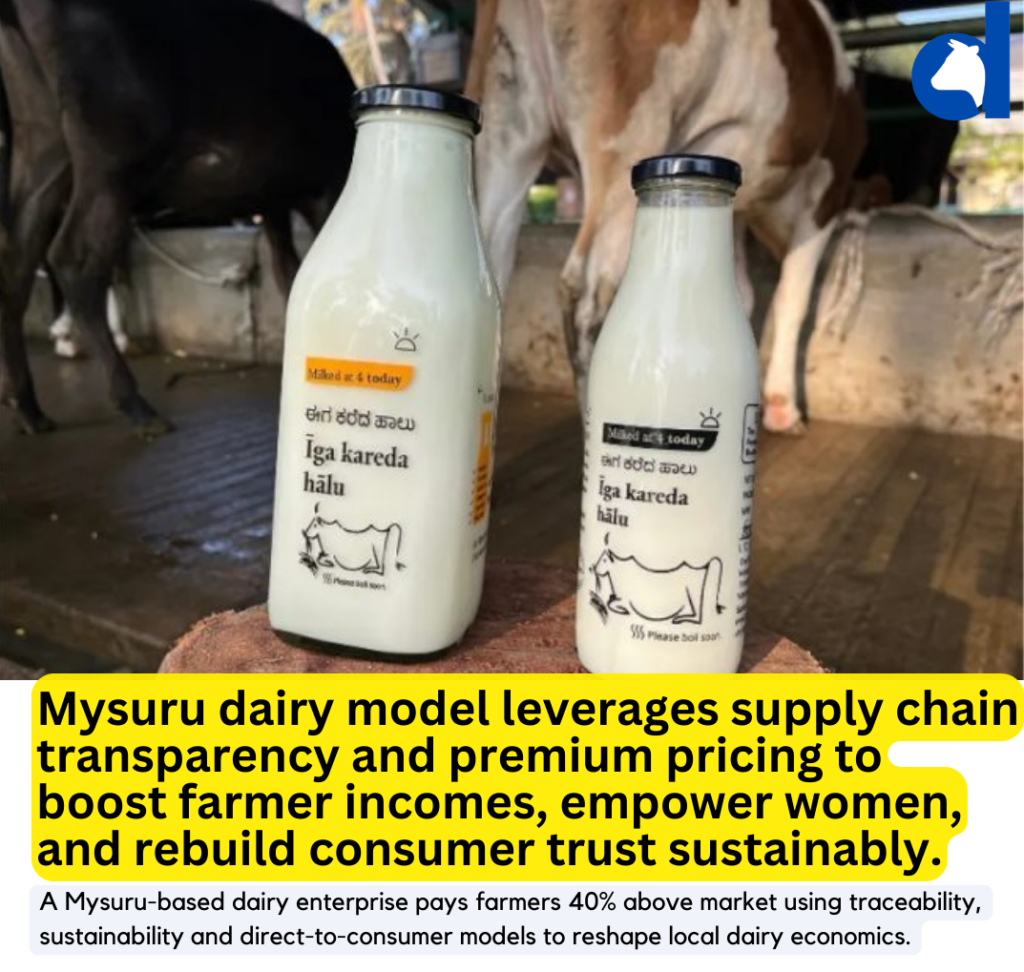
A technology-driven dairy enterprise near Mysuru is challenging India’s traditional milk procurement economics by combining premium pricing, traceability and sustainability to rebalance value distribution in favour of farmers, particularly women.
Founded in 2022 by engineer-turned-entrepreneur Kamalesh Mandya, The Farming Buddha began commercial operations in mid-2023 with a clear proposition: pay dairy farmers up to 40% above prevailing market prices while delivering fully traceable milk directly to urban consumers. The initiative currently procures over 500 litres of milk daily from villages surrounding Mysuru, positioning itself as an alternative to opaque cooperative and private procurement systems.
Premium Pricing as an Economic Intervention
Rising feed, veterinary and labour costs have steadily eroded farm-level margins across India’s dairy sector. In this context, the Farming Buddha’s pricing strategy functions not merely as an incentive but as an economic stabiliser. After initial hesitation, farmer participation accelerated through word-of-mouth, driven by transparent pricing and reliable payments.
Today, the enterprise works with more than 50 farmers, including 38 women, with an additional 150 applicants on a waiting list. Crucially, higher and predictable income has enabled women farmers to reinvest in education, livestock expansion and household assets, reinforcing dairy’s role as a livelihood anchor in rural economies.
Traceability Reshaping Trust
Beyond pricing, the model’s distinguishing feature is supply chain transparency. Milk is digitally tracked and tested at every stage using IoT-enabled systems, while consumers receive daily quality reports. This approach directly addresses long-standing concerns around adulteration and inconsistent quality, strengthening trust between producers and urban subscribers.
As a result, traceability shifts from being a compliance tool to a value-creation mechanism, allowing consumers to justify premium pricing while ensuring farmers capture a greater share of end-market value.
Sustainability and Local Value Creation
Operational sustainability is embedded in the business model. Milk is delivered in reusable glass bottles, biogas from cattle waste powers parts of dairy processing, and a women-managed café creates supplementary employment. In parallel, partnerships with BAIF support cattle health, nutrition and preventive care, improving long-term productivity.
Looking ahead, the enterprise plans to expand into mixed farm baskets and village-level value-added products. If scaled carefully, this integrated approach could offer a replicable blueprint for decentralised, farmer-centric dairy systems in India.