


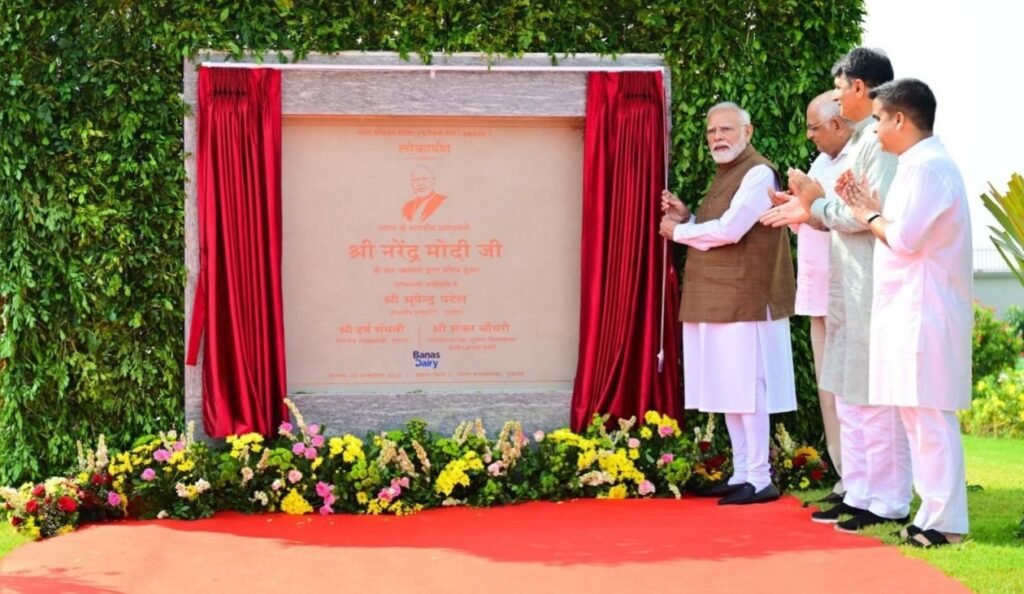
Prime Minister Narendra Modi inaugurated the Centre of Excellence – Bharat Bovine Breeding & Research Centre (CoE-BBBRC) at Banas Dairy, Bhildi, in Gujarat’s Banaskantha district. The state-of-the-art facility is expected to strengthen India’s indigenous bovine breeding programme by accelerating the multiplication of superior indigenous germplasm and supporting improvements in livestock genetics.
The centre has been developed with technical support from the National Dairy Development Board (NDDB) and financial assistance under the Rashtriya Gokul Mission, a Central Sector Scheme implemented by the Department of Animal Husbandry and Dairying (DAHD).
The inauguration marks an important development in India’s efforts to strengthen indigenous cattle and buffalo breeding capabilities, improve genetic resources and enhance the productivity of the dairy sector.
The CoE-BBBRC is designed to support the multiplication and wider availability of superior indigenous germplasm, which plays an important role in improving the genetic potential of bovine populations. Access to quality breeding resources can help dairy farmers improve herd productivity, reproductive performance and the overall efficiency of milk production.
Strengthening Indigenous Germplasm and Bovine Genetics
Genetic improvement is a critical component of India’s long-term dairy development strategy. Indigenous cattle and buffalo breeds possess valuable characteristics, including adaptability to local climatic conditions and resilience under different farming systems.
However, improving the productivity of these breeds requires systematic breeding programmes, quality germplasm, scientific reproductive technologies and effective delivery mechanisms.
The establishment of CoE-BBBRC is expected to contribute to these objectives by strengthening the infrastructure required for indigenous germplasm multiplication and research.
The initiative also aligns with the objectives of the Rashtriya Gokul Mission, which focuses on the development and conservation of indigenous bovine breeds, genetic upgradation and increasing the productivity of India’s bovine population.
Through improved access to superior genetic material, the facility could support breeding programmes and help dairy farmers gradually develop more productive and genetically improved herds.
Senior Government and Dairy Industry Leaders Attend Inauguration
Several prominent government representatives and dairy industry leaders attended the inauguration ceremony, highlighting the importance of collaboration between government institutions, dairy cooperatives and research organisations in advancing India’s livestock sector.
The dignitaries present included Gujarat Chief Minister Bhupendrabhai Patel, Deputy Chief Minister Harshbhai Sanghavi, and Speaker of the Gujarat Legislative Assembly and Banas Dairy Chairman Shankarbhai Chaudhry.
Other attendees included Gujarat Minister for Agriculture and Farmers Welfare, Cooperation, Animal Husbandry, Cow Breeding and Fisheries Jitubhai Vaghani; Secretary, Department of Animal Husbandry and Dairying, Naresh Pal Gangwar; NDDB Chairman Dr. Meenesh Shah; Additional Secretary, DAHD, Varsha Joshi; and Amul Dairy Managing Director Jayen Mehta.
The participation of senior representatives from government, NDDB and leading dairy institutions reflects the strategic importance of strengthening India’s livestock breeding ecosystem.
Supporting India’s Long-Term Dairy Sector Growth
India’s dairy industry depends heavily on the productivity and genetic quality of its bovine population. Improvements in breeding infrastructure and access to superior germplasm can contribute to increased milk production, better herd management and improved farm-level economic outcomes.
The Centre of Excellence at Banas Dairy represents an investment in the scientific and technological capabilities required to support these improvements.
Beyond increasing the availability of superior indigenous germplasm, such initiatives can strengthen the connection between livestock research, breeding programmes and dairy farmers.
With support from NDDB and the Rashtriya Gokul Mission, CoE-BBBRC is expected to become an important part of India’s efforts to advance indigenous bovine genetics and build a more productive and sustainable dairy sector.
The initiative reinforces the importance of scientific breeding, institutional collaboration and investment in livestock infrastructure in shaping the future of India’s dairy industry.