


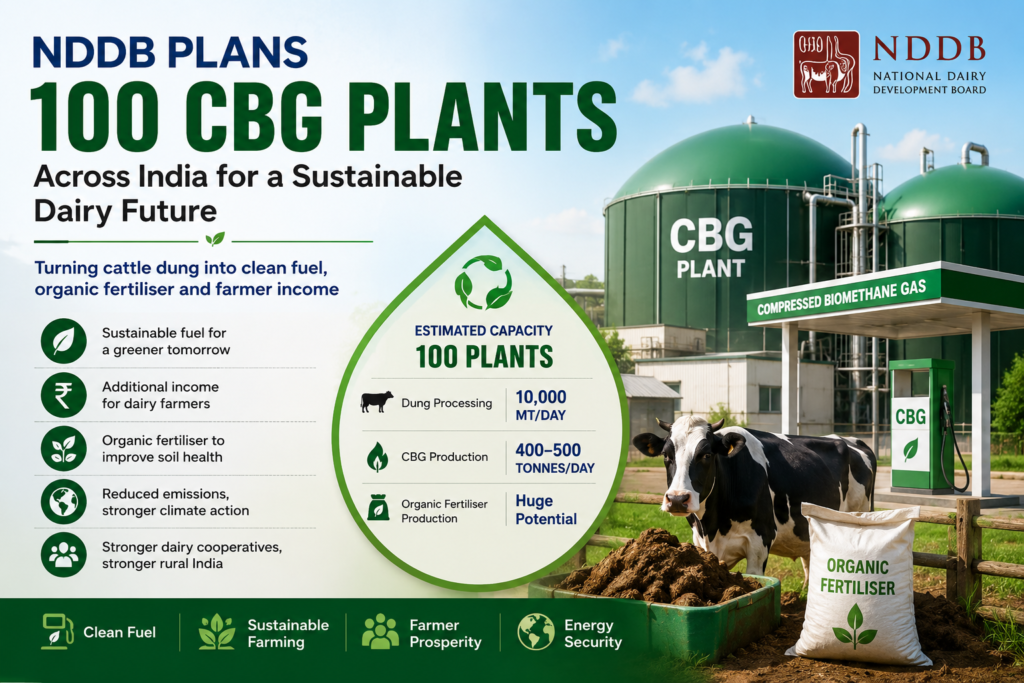
The National Dairy Development Board (NDDB) has unveiled an ambitious plan to support the establishment of 100 Compressed Biomethane Gas (CBG) plants across India, marking a significant step towards sustainable dairy farming, renewable energy production, and enhanced farmer livelihoods.
The initiative comes at a crucial time, as global geopolitical tensions continue to affect energy markets, leading to fuel supply uncertainties and rising prices. Against this backdrop, dung-based CBG is emerging as a viable alternative to conventional fossil fuels and compressed natural gas (CNG), while simultaneously creating additional revenue streams for dairy farmers.
According to NDDB Chairman Meenesh Shah, the organisation’s long-term vision is to scale up the collection and productive utilisation of cattle dung through biogas infrastructure that supports clean energy generation and organic fertiliser production.
Speaking about the initiative, Shah said that NDDB’s objective is to facilitate the establishment of at least 100 CBG plants in the initial phase to maximise dung utilisation for biogas generation and convert the resulting slurry into valuable organic fertilisers.
The strategy builds upon the successful implementation of a pioneering project in Gujarat’s Banaskantha district. The project was launched through a tripartite collaboration involving NDDB, Suzuki R&D Centre India, and Banas Dairy, one of India’s leading dairy cooperatives under the Gujarat Cooperative Milk Marketing Federation (GCMMF), known for the Amul brand.
The model focuses on centralised biogas production facilities that aggregate substantial volumes of cattle dung. Once biogas is generated, it undergoes advanced purification to achieve methane purity levels exceeding 95 per cent, enabling its conversion into compressed biomethane gas suitable for automotive applications.
Shah highlighted that purified CBG offers performance comparable to conventional CNG while delivering stronger sustainability benefits. The initiative aligns with broader national objectives related to renewable energy adoption, circular economy practices, and climate-friendly agricultural development.
In September 2023, NDDB, Suzuki and Banas Dairy formalised their partnership to establish four dung-based biogas plants in Banaskantha. Under the arrangement, Suzuki provides financial support for infrastructure development, NDDB oversees plant establishment, and Banas Dairy supplies land and operational management.
The integrated project extends beyond clean fuel production. Dedicated CBG dispensing stations are planned to support vehicle usage, while nutrient-rich slurry generated during the biogas process will be processed into organic fertilisers. This approach is expected to reduce dependence on imported chemical fertilisers and promote sustainable dairy farming practices across rural India.
The initiative has already gained momentum. NDDB has established three additional plants in Banaskantha, each with a processing capacity of 100 metric tonnes of dung per day. Two more facilities are currently under construction and are expected to become operational soon.
Shah also indicated that memoranda of understanding have been signed with multiple dairy cooperatives, supported by funding arrangements that will accelerate the nationwide expansion of CBG infrastructure.
As India’s dairy sector increasingly focuses on sustainability, resource efficiency and climate resilience, the proposed network of 100 CBG plants could become a transformative model for converting dairy waste into clean energy, supporting dairy market growth, strengthening rural economies and advancing India’s renewable energy ambitions.
Potential Capacity and Sectoral Impact
While NDDB has not disclosed the total projected output from its proposed network of 100 CBG plants, estimates based on the Banaskantha model indicate significant potential for renewable energy generation and dairy waste utilisation.
With each plant designed to process approximately 100 metric tonnes of cattle dung per day, the planned network could collectively handle nearly 10,000 metric tonnes of dung daily, translating into around 3.65 million metric tonnes annually.
Industry estimates suggest that a 100-tonne dung-based biogas facility can generate approximately 4-5 tonnes of compressed biomethane gas (CBG) per day. If replicated across all 100 facilities, the network could produce between 400 and 500 tonnes of CBG daily, making it one of the largest dairy-linked renewable energy initiatives in the country.
Beyond clean fuel production, the initiative is expected to deliver multiple benefits to the Indian dairy industry. Farmers could earn additional income from dung sales, while dairy cooperatives would gain new revenue streams from biogas and organic fertiliser production. The nutrient-rich slurry generated during the process can also help reduce dependence on chemical fertilisers, supporting sustainable dairy farming and environmentally responsible agricultural practices.
The programme is further expected to contribute to India’s climate goals by reducing methane emissions from unmanaged cattle waste, promoting circular economy principles, strengthening rural livelihoods, and enhancing the country’s energy security through greater use of domestically produced renewable fuel.