


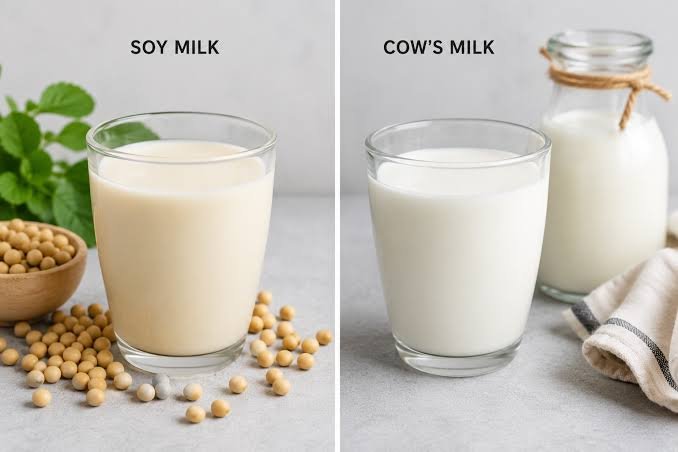
A new study comparing the nutrient profiles of hundreds of foods highlights why protein content alone is not enough to determine whether two foods are nutritionally interchangeable. Published in Nutrients, the 2026 research by Cardinaals and colleagues uses cosine similarity to compare foods based on multiple essential nutrients, offering a quantitative way to assess nutritional similarities and differences.
The findings have implications for dairy products, plant-based alternatives and the wider food industry, particularly as consumers increasingly consider replacing traditional animal-based foods with plant-based options.
Comparing Foods Beyond Protein Content
Foods are often grouped according to their primary nutrient or their place in a dietary category. However, foods that provide similar amounts of protein can differ considerably in their wider nutritional composition.
Milk, for example, supplies protein alongside nutrients such as calcium, vitamin B12, riboflavin and other components that contribute to its overall nutritional profile. Plant-based drinks vary in their composition depending on their ingredients, manufacturing processes and fortification.
Consequently, comparing milk and a soy drink solely by their protein content may overlook important nutritional differences. A more comprehensive assessment considers the complete nutrient profile rather than relying on one nutrient or a broad food classification.
According to the study summary shared by the researchers, the analysis examined 927 foods using up to 21 essential nutrients.
How Cosine Similarity Measures Nutritional Similarity
The researchers applied cosine similarity, a mathematical method used to assess how closely two sets of values resemble one another. In this study, the method was used to compare food nutrient profiles.
The resulting score ranges from zero to one, with higher values indicating greater similarity in the nutrient data being compared. A score of one represents identical profile direction under the mathematical measure, while a score near zero indicates little similarity.
The reported examples demonstrate how the method distinguishes between foods that appear comparable and those with more substantial nutritional differences.
| Food comparison | Reported cosine similarity |
|---|---|
| Peanut butter and almonds | 0.94 |
| Mozzarella and egg | 0.89 |
| Milk and mozzarella | 0.80 |
| Peanut butter and brown beans | 0.34 |
| Milk and soy drink | 0.27 |
| Chicken fillet and salami | 0.39 |
These scores provide a structured way to compare nutrient profiles. However, similarity scores should not automatically be interpreted as an overall measure of healthfulness, dietary suitability or equivalence in every serving size.
What the Findings Mean for Dairy and Plant-Based Alternatives
The reported milk–soy drink score of 0.27 indicates relatively low similarity under the study’s selected nutrient-profile comparison. This challenges the assumption that two products can be considered nutritional substitutes simply because both are consumed as drinks or provide protein.
Nevertheless, the result does not mean that every soy drink is nutritionally inadequate or that all soy drinks have the same composition. Products can differ in protein levels, calcium and vitamin fortification, added sugar and other nutritional characteristics. Their nutritional value should therefore be assessed using product-specific information.
For dairy producers, food manufacturers and nutrition professionals, such comparisons could help identify which nutrients need particular attention when developing alternatives. They may also support clearer communication about the differences between dairy milk and plant-based beverages.
For consumers, the practical lesson is to compare nutrition labels and consider dietary requirements rather than assuming that all products within a broad category are interchangeable.
Meat Replacers Also Differ in Nutritional Composition
The study’s comparisons extend beyond dairy. The reported similarity score between chicken fillet and salami was 0.39, illustrating that two meat products can also have substantially different nutrient profiles.
Likewise, the relatively low score for peanut butter and brown beans suggests that foods commonly associated with plant protein are not necessarily nutritionally alike.
This matters because food substitutions can change more than protein intake. Depending on the products involved, they may also affect the intake of fats, minerals, vitamins and other nutrients.
Neither plant-based foods nor animal-based foods should be treated as nutritionally uniform categories. Individual ingredients, processing methods and product formulations all influence their composition.
A Tool for More Informed Food Comparisons
The research offers a quantitative approach to nutritional comparison that could contribute to food product development, dietary analysis and consumer education. By examining multiple nutrients simultaneously, cosine similarity provides a broader perspective than protein-based comparisons alone.
However, nutrient-profile similarity is only one part of evaluating a food replacement. Serving sizes, bioavailability, fortification, overall dietary patterns, affordability and individual nutritional needs also matter.
For the dairy sector, the study reinforces the importance of communicating milk’s complete nutritional profile while recognizing that different foods can serve different roles in a balanced diet. Ultimately, effective food substitution requires looking beyond labels and protein claims to understand the wider nutritional package each product provides.