


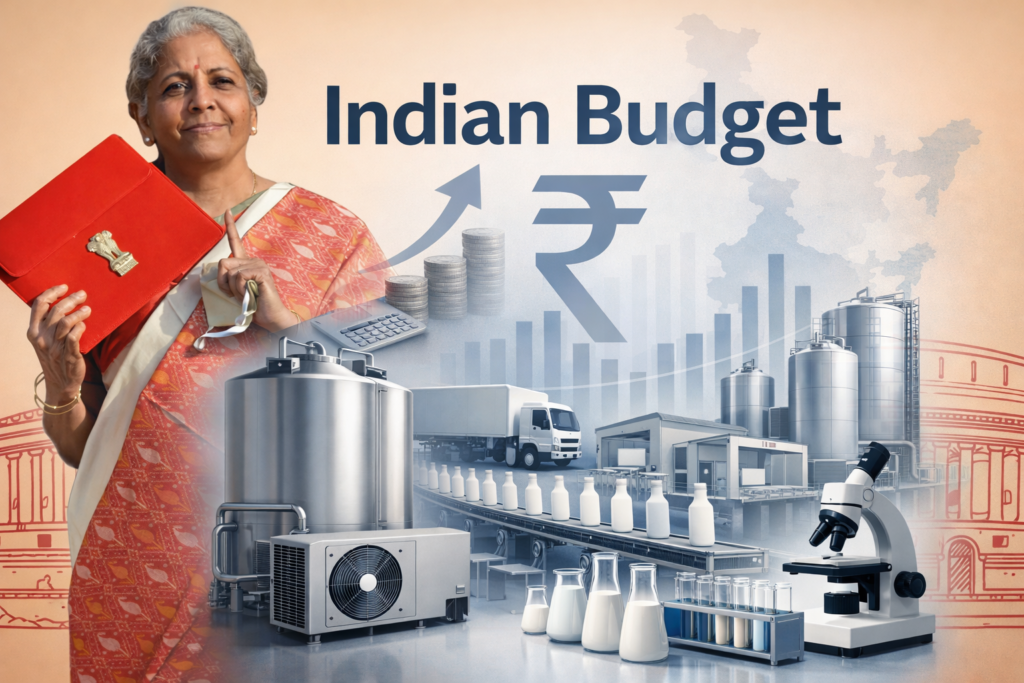
With Union Budget 2026–27 approaching, the dairy industry’s wish list is becoming sharper and more operational. After four budgets where the Centre steadily prioritised animal health, cooperative-led capacity building, and blended infrastructure finance, the conversation has shifted from “support dairy” to “reduce friction in the value chain”.
The ask is no longer just about more money. It is about tax treatment of critical inputs, cheaper long-tenor credit for cold-chain and processing, and targeted incentives that improve milk quality, productivity, and logistics efficiency.
The market backdrop behind the asks
Two forces are shaping expectations:
- Cost pressure is structural: packaging, refrigeration equipment, animal feed, veterinary services and logistics are now major determinants of unit economics for organised dairy and value-added products. Industry executives are explicitly flagging GST on these inputs as a competitiveness issue.
- Quality and supply tightness are back on the agenda: after supply disruptions and procurement cost firmness, companies are increasingly leaning on value-added product mix and efficiency to protect margins.
What dairy expects from Budget 2026–27
What the dairy sector is now watching in Budget 2026–27
1. Easier and cheaper access to long-term capital
With GST largely settled, the primary expectation from Budget 2026–27 is better credit economics for dairy infrastructure. This includes:
- deeper interest subvention for processing and cold-chain assets
- longer repayment tenors aligned with dairy project cash flows
- simplified access to institutional finance for mid-sized processors and cooperatives
Rather than new schemes, the industry expects scaling and fine-tuning of existing infrastructure finance mechanisms, which have already demonstrated traction in dairy processing and chilling investments.
2. Cold-chain, testing and quality infrastructure
Milk losses and quality degradation continue to be strongly linked to gaps in chilling, storage and testing infrastructure, especially in interior procurement regions. Budget expectations therefore include:
- higher support for village- and cluster-level chilling infrastructure
- expansion of milk testing and quality assurance capacity
- incentives for automation that improves hygiene, traceability and efficiency
This aligns with the government’s broader shift from volume expansion to quality-led dairy development.
3. Productivity-led upstream support
Industry leaders increasingly argue that dairy resilience begins upstream. Budget 2026–27 is expected to reinforce:
- access to quality cattle feed and fodder systems
- productivity enhancement through genetics and breeding interventions
- veterinary capacity expansion and last-mile service delivery
- targeted support for small, women-led and youth-driven dairy enterprises
These interventions are now viewed less as subsidies and more as risk-management tools that stabilise farmer incomes and reduce supply volatility.
4. A stronger focus on “clean and consistent milk”
Recent policy signals suggest a gradual shift towards clean milk ecosystems, supported by testing, institutional capacity building and cooperative strengthening. The dairy industry expects Budget 2026–27 to reinforce this trajectory, particularly through programme-led investments that reward quality compliance and traceability.
What the last 3–4 Budgets prioritised for dairy (2022–23 to 2025–26)
Across recent budgets, three lines show up repeatedly:
- Animal health and disease control scaling (big allocations, reflecting national disease programmes and veterinary infrastructure).
- Credit and interest-subvention driven infrastructure via the Infrastructure Development Fund (AHIDF/DIDF merged).
- Cooperative and programme-led dairy development through Dairy Development/NPDD and Dairying Through Cooperatives structures, including the JICA-linked cooperation element referenced in the budget documents.
Comparison table: key dairy-related budget lines (₹ crore)
Note: Figures below are drawn from the Department of Animal Husbandry & Dairying “Notes on Demands for Grants” expenditure budget documents for each year. *BE – Budget Estimates
| Budget year | DAHD total (Grand Total) | Livestock Health & Disease Control | Infrastructure Development Fund (AHIDF/DIDF) | Dairy Development (programme line) | Rashtriya Gokul Mission | Dairying Through Cooperatives (EAP) |
| 2022–23 (BE) | 3,918.84 | 249.30 | 63.36 (AHIDF line) | NPDD 285.98 | 399.91 | (captured under scheme structure) |
| 2023–24 (BE) | 4,327.85 | 2,349.71 | 340.00 | 326.93 | 600.00 | 19.00 |
| 2024–25 (BE) | 4,521.24 | 2,465.00 | 370.00 | 371.00 | 700.00 | 166.31 |
| 2025–26 (BE) | 4,840.40 | 1,980.00 | 460.00 | 1,000.00 | 0.01 (as shown in the document line) | (listed under Development Programmes) |
What this table signals
- Disease control became a budget anchor post-2022–23, with very large allocations in 2023–24 and 2024–25, and then a lower (but still substantial) number in 2025–26.
- Infrastructure finance has been kept alive and rising through the merged fund approach, which supports processing, chilling and testing equipment at village level.
- Cooperative-led and programme-led dairy development continues, and NPDD has been positioned as a quality and organised procurement lever.
Sources used for this analysis
- Union Budget Expenditure Budget documents (Department of Animal Husbandry and Dairying), 2022–23 to 2025–26
- Notes on Demands for Grants, Ministry of Fisheries, Animal Husbandry and Dairying
- Government programme documents related to NPDD, dairy infrastructure financing and cooperative development
- Statements and interviews from Indian dairy processors and industry associations
- Coverage from national business and financial media on pre-Budget sector expectations