


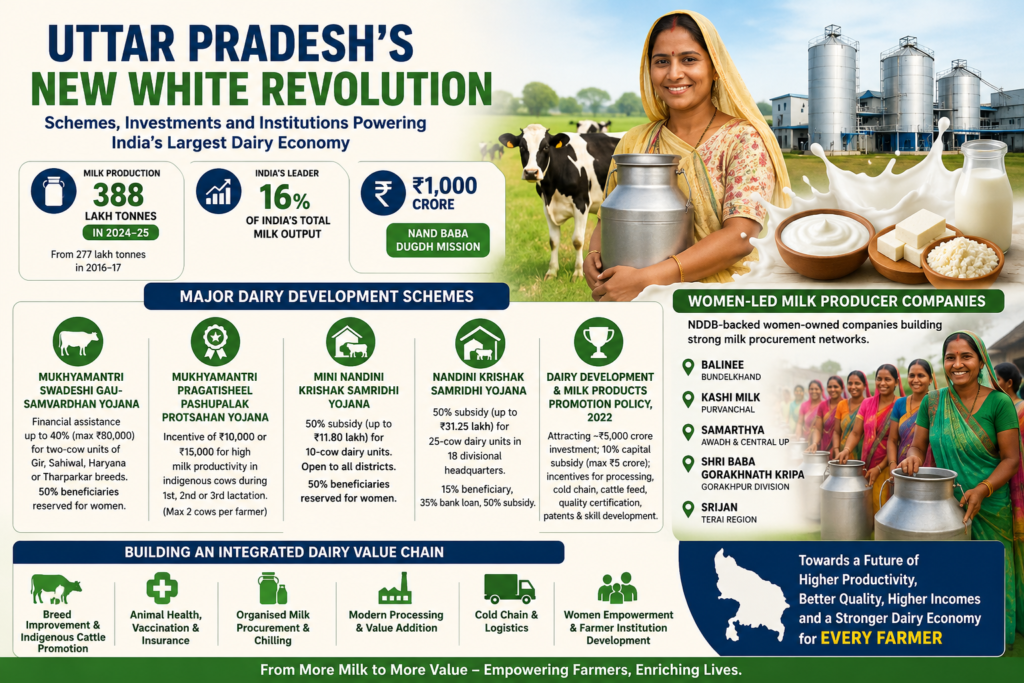
From a ₹1,000-crore dairy mission and subsidies for indigenous cattle to investment incentives for processing plants and a rapidly expanding network of women-owned milk producer companies, Uttar Pradesh is attempting to build a dairy economy that goes far beyond producing more milk.
Uttar Pradesh has always been a dairy giant. The state has the largest milk production base in India and accounts for roughly 16 per cent of the country’s milk output. But scale alone has never fully reflected the state’s dairy potential.
For decades, the central challenge was the disconnect between production and value creation. Millions of small households were producing milk. Still, organised procurement remained uneven, productivity per animal was relatively low, modern processing was limited in several regions, and many small producers lacked reliable access to transparent and competitive markets.
That landscape is now changing.
Milk production in Uttar Pradesh increased from around 277 lakh tonnes in 2016–17 to approximately 388 lakh tonnes in 2024–25. Behind these headline numbers is a broader restructuring of the dairy economy through government missions, farmer-level subsidies, dairy farm development, indigenous breed promotion, processing incentives and the development of new producer-owned institutions. The overall policy direction has increasingly moved from simply producing more milk towards creating an integrated dairy value chain.
At the centre of this transformation is the ₹1,000-crore Nand Baba Dugdh Mission, supported by a series of farm-level schemes, the Uttar Pradesh Dairy Development and Milk Products Promotion Policy, 2022, and a parallel institutional push to connect women dairy farmers with organised procurement and markets.
Nand Baba Dugdh Mission: The Umbrella for Farm-Level Dairy Transformation
The Nand Baba Dugdh Mission represents one of the most significant state-level dairy initiatives undertaken by Uttar Pradesh in recent years.
The stated objective of the ₹1,000-crore mission is to maintain Uttar Pradesh’s leadership in milk production while developing milk procurement institutions that allow producers to sell milk at a fair price closer to their villages. The mission’s official platform currently brings together four major farmer-focused schemes: the Mukhyamantri Swadeshi Gau-Samvardhan Yojana, Mukhyamantri Pragatisheel Pashupalak Protsahan Yojana, Nandini Krishak Samriddhi Yojana and Mini Nandini Krishak Samriddhi Yojana.
Taken together, these schemes represent a particularly interesting policy architecture. Instead of concentrating exclusively on animal distribution, they address dairy farming at different levels of commercialisation—from a household purchasing two cows to an entrepreneur establishing a structured 25-cow dairy unit.
Mukhyamantri Swadeshi Gau-Samvardhan Yojana: Helping Small Producers Acquire Better Animals
For a small dairy farmer, the cost of acquiring a productive animal can be one of the biggest barriers to increasing income. The Mukhyamantri Swadeshi Gau-Samvardhan Yojana attempts to address this constraint while simultaneously promoting recognised indigenous dairy breeds.
The scheme supports the establishment of a two-cow unit comprising Gir, Sahiwal, Haryana or Tharparkar cattle. Against a defined unit cost of ₹2 lakh, financial assistance is available up to 40 per cent, capped at ₹80,000.
Importantly, 50 per cent of the scheme’s targeted beneficiary selection is reserved for women milk producers and cattle keepers. Animals purchased under the programme must also be insured and ear-tagged, adding elements of risk management and traceability to the intervention.
The significance of this programme lies in its scale of entry. Not every rural household can establish a 10-cow or 25-cow dairy farm. A two-animal intervention offers a relatively accessible route into improved dairy farming for smaller producers. At the same time, the focus on identified indigenous breeds creates a direct link between rural livelihood support and breed development.
Rewarding Performance: Mukhyamantri Pragatisheel Pashupalak Protsahan Yojana
While several livestock programmes subsidise asset creation, Uttar Pradesh has also introduced a scheme that rewards demonstrated milk productivity.
Under the Mukhyamantri Pragatisheel Pashupalak Protsahan Yojana, cattle keepers managing Gir, Sahiwal, Tharparkar, Haryana and Gangatiri cows can receive an incentive of ₹10,000 or ₹15,000, depending on prescribed daily milk productivity standards.
The incentive is available for qualifying animals during the first, second or third lactation, subject to the scheme’s conditions, with support limited to a maximum of two cows per farmer.
Conceptually, this is an important departure from schemes that measure success only by the number of animals distributed. By linking support to productivity, the programme creates an incentive for better breeding, feeding, healthcare and farm management.
In the longer term, such productivity-linked incentives could become increasingly important for Indian dairying. The sector’s future competitiveness will depend less on continuously increasing animal numbers and more on improving milk output, reproductive performance, and lifetime productivity per animal.
Nandini Krishak Samriddhi Yojana: Creating a New Class of Commercial Dairy Farms
At the larger end of the farm-development spectrum is the Nandini Krishak Samriddhi Yojana.
The programme supports structured 25-cow dairy units and is currently applicable in the districts of Uttar Pradesh’s 18 divisional headquarters. Eligible units can include Sahiwal, Gir and Tharparkar cattle, along with a limited number of Gangatiri cows.
Depending on herd composition, the official project cost is approximately ₹61–62.5 lakh. The programme provides a subsidy of 50 per cent of the eligible project cost, with a maximum subsidy of approximately ₹30.5–31.25 lakh.
The financing structure envisages a 15 per cent beneficiary contribution, 3 per cent bank finance, and per cent subsidy support. The subsidy is linked to milestones including completion of infrastructure, purchase of animals and, for the final tranche, achievement of defined progeny-related conditions. Applicants are also required to demonstrate livestock-rearing experience and access to land for infrastructure and fodder production.
The policy intent is significant. Uttar Pradesh is attempting to create a layer of professionally managed medium-scale dairy farms that can operate between the traditional two-to-five-animal household and the large corporate dairy farm.
This middle segment can become critical for future milk supply. Such farmers can adopt milking technology, ration formulation, herd recording, reproductive management, manure management, and improved housing systems faster than highly fragmented subsistence farms.
Mini Nandini: Building a Bridge Between Household Dairying and Commercial Farming
Recognising that a 25-cow project remains beyond the reach of many dairy entrepreneurs, Uttar Pradesh also operates the Mini Nandini Krishak Samriddhi Yojana.
The programme supports 10-cow dairy units with Sahiwal, Gir and Tharparkar cattle. The approved project cost is ₹23.60 lakh, against which a 50 per cent subsidy, up to ₹11.80 lakh, is available in two stages.
The scheme is open across all districts of Uttar Pradesh, and 50 per cent of the intended beneficiaries are women livestock keepers or milk producers. The framework also requires experience in cattle or buffalo rearing, suitable land for the unit, animal identification and insurance, and arrangements for year-round fodder supply.
Mini Nandini may prove particularly relevant because 10-animal units can be large enough to support more systematic dairy management while remaining within the operational capabilities of a family-run enterprise.
Together, the Swadeshi Gau-Samvardhan, Pragatisheel Pashupalak, Mini Nandini, and Nandini schemes create a progression pathway: from acquiring two productive animals to rewarding high-performing indigenous cows to developing 10-animal enterprises and, eventually, structured 25-cow commercial farms.
From Milk Production to Milk Processing: The 2022 Dairy Policy
Increasing milk production without creating sufficient processing and marketing capacity can eventually put pressure on farmgate prices. Uttar Pradesh’s strategy therefore extends beyond the farm.
The Uttar Pradesh Dairy Development and Milk Products Promotion Policy, 2022 is designed to attract investment into milk processing and value-added dairy manufacturing. The policy has a stated objective of raising the share of milk processing in the state from around 10 per cent to 25 per cent, while encouraging market development, exports, and greater adoption of technology.
The policy framework supports new milk-processing and dairy-product manufacturing facilities as well as qualifying capacity expansions. An official state incentive description provides for a capital investment subsidy equivalent to 10 per cent of eligible plant and machinery, technical civil works, and spare parts, subject to a maximum of ₹5 crore for eligible projects.
The wider policy framework also covers incentives related to quality and environmental certification, as well as support for patents and design, and includes dairy-linked sectors such as cattle feed and animal nutrition manufacturing.
This processing push is crucial to the next stage of Uttar Pradesh’s dairy growth.
A state producing nearly 39 million tonnes of milk annually cannot depend indefinitely on traditional liquid milk markets alone. Sustainable value creation will increasingly require conversion into paneer, cheese, ghee, butter, fermented products, milk powders, ingredients, traditional dairy products and specialised nutrition applications.
The emergence of stronger processing competition can also influence the procurement market. As processors seek dependable milk pools, producers can gain access to more organised channels and potentially greater competition for milk.
Women-Owned Milk Producer Companies: A Parallel Dairy Revolution
Perhaps the most structurally important development in Uttar Pradesh’s dairy sector is taking place outside the conventional distinction between state cooperatives and private processors.
Across multiple regions, women-owned milk producer companies are building organised milk procurement networks and linking small producers to formal markets.
The model gained prominence through Balinee Milk Producer Company, established in Bundelkhand. Balinee is exclusively owned by women milk producers and was developed with support from the National Rural Livelihoods Mission and the Uttar Pradesh State Rural Livelihoods Mission, with NDDB Dairy Services providing technical support.
The approach has since expanded into a regional network.
Balinee operates in Bundelkhand; Kashi Milk Producer Company serves districts in the Purvanchal belt; Samarthya operates across parts of central and eastern Uttar Pradesh; Shri Baba Gorakhnath Kripa serves the Gorakhpur division; and Srijan is active across districts in the Terai region.
This model changes the role of women in the dairy economy.
Women have traditionally performed a large share of everyday dairy work—feeding, watering, cleaning sheds, caring for calves and often milking animals—without necessarily controlling milk revenues or participating in formal business decision-making.
A producer-company structure can alter that relationship by making women members and shareholders of the institution that aggregates and markets milk.
The model also demonstrates that women’s empowerment and dairy commercialisation need not be treated as separate policy objectives. Organised procurement, transparent milk testing, direct payments, livestock services, and collective ownership can reinforce one another.
Strengthening the Institutional Dairy Network
The transformation of Uttar Pradesh’s dairy economy is also involving changes in the management of existing dairy infrastructure.
In June 2025, the Uttar Pradesh government, the Pradeshik Cooperative Dairy Federation and the National Dairy Development Board signed agreements under which dairy plants at Kannauj, Gorakhpur and Kanpur, along with a cattle-feed plant at Ambedkar Nagar, were handed to NDDB on a ten-year lease.
According to NDDB, the objective was to improve the efficiency and sustainability of these operations while supporting transparent milk payments, access to cattle feed and fair milk prices for producers.
The significance of this approach goes beyond plant utilisation. Milk processing assets can only create rural value when they are connected to functioning procurement networks, reliable farmer payments, quality control systems and competitive markets.
India’s dairy experience repeatedly demonstrates that physical infrastructure alone does not create a successful milk economy. Institutional capability matters just as much.
The Next Challenge: Productivity, Quality and Market Integration
Uttar Pradesh’s dairy progress is substantial, but the next phase will arguably be more complex than the first.
Increasing aggregate milk production is only one measure of success. The future competitiveness of the state’s dairy industry will depend on several interconnected factors:
higher productivity per animal; better reproductive efficiency; reliable fodder availability; reduced disease burden; transparent quality-based milk procurement; rapid chilling; stronger cold-chain infrastructure; better testing and traceability; and the ability to convert milk into higher-value products.
The policy framework described in the state’s dairy development narrative already points in this direction, emphasising scientific animal husbandry, organised milk procurement, modern infrastructure, investment and value addition.
The strategic opportunity is therefore much larger than becoming India’s biggest producer of raw milk.
Uttar Pradesh has the potential to become India’s largest integrated dairy economy—combining millions of small producers, professionally managed medium-sized farms, women-owned producer institutions, cooperatives, private processors, modern dairy plants and an expanding value-added product sector.
From a Production Revolution to a Value-Chain Revolution
The first White Revolution in India was fundamentally about creating milk availability and connecting producers with consumers.
The emerging dairy transformation in Uttar Pradesh faces a different challenge.
The state already has enormous milk production. The task now is to improve the economics of every litre: producing milk more efficiently, maintaining quality, aggregating it transparently, chilling it quickly, processing it intelligently and ensuring that a greater share of the final value reaches the rural producer.
The combination of the ₹1,000-crore Nand Baba Dugdh Mission, tiered dairy farm development schemes, incentives for high-performing indigenous cattle, investment promotion for processing, women-owned milk producer companies and institutional restructuring represents one of India’s most ambitious state-level dairy development experiments.
The results will ultimately be measured not only in additional tonnes of milk, but in higher productivity per animal, greater organised procurement, improved milk quality, stronger farmer incomes, profitable processing investments and the number of women who move from being invisible dairy workers to owners of dairy enterprises.
For Uttar Pradesh, the next White Revolution is therefore not simply about producing more milk.
It is about creating more value from milk—and distributing that value more effectively across the dairy economy.