


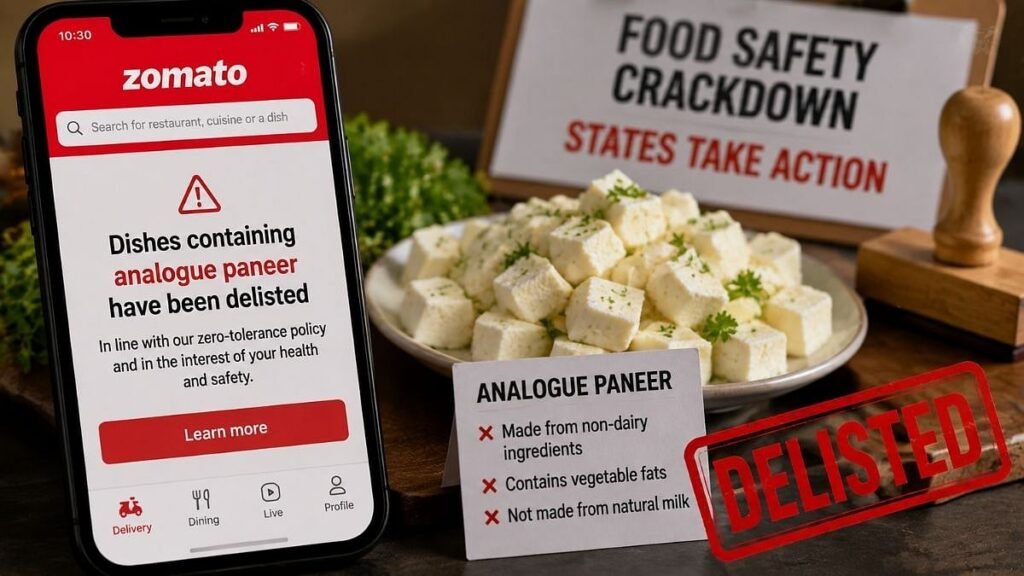
Platform Tightens Menu Standards Across India
Zomato has removed dishes containing analogue paneer and other analogue dairy products from its platform across India, as regulatory scrutiny over the use of non-dairy substitutes in food products intensifies. The move is aimed at improving ingredient transparency and ensuring customers are accurately informed about the products being offered by restaurants.
Under the new policy, restaurant partners that have declared the use of analogue dairy in their dishes have been asked to either replace those ingredients with natural dairy products or remove the affected dishes from their Zomato menus.
The company has also adopted a zero-tolerance approach towards listings that violate its requirements. Restaurants found continuing to offer non-compliant products could face delisting from the platform.
Growing Regulatory Attention on Analogue Paneer
Analogue paneer is produced using non-dairy ingredients and fats rather than conventional milk-based ingredients. Its growing use in the food-service industry has attracted increased attention from food safety authorities, particularly concerning product labelling, consumer awareness and the accurate representation of dairy products.
Regulatory action has been reported across several states. The Maharashtra Food and Drug Administration has undertaken action against establishments using analogue paneer, while Chhattisgarh, Madhya Pradesh and Gujarat have introduced temporary restrictions involving the production, sale, storage or distribution of analogue or non-dairy paneer.
The growing regulatory focus has encouraged restaurants, suppliers and food-delivery platforms to reassess how dairy substitutes are sourced, labelled and presented to consumers.
Restaurants Asked to Verify Ingredients
Zomato has instructed its restaurant partners to review the ingredients used in their food products and verify information supplied by vendors and manufacturers.
Restaurants are expected to examine product labels and ingredient declarations before listing dishes on the platform. Where analogue dairy is being used and cannot immediately be replaced with natural dairy, the affected dishes are expected to be removed.
This places greater responsibility on restaurants to ensure that their online menus accurately reflect the ingredients used in the preparation of food.
| Zomato’s New Approach | Expected Action |
|---|---|
| Analogue dairy identified | Review the affected dishes |
| Natural dairy available | Switch to natural dairy products |
| Immediate replacement not possible | Remove affected dishes |
| Incorrect ingredient declaration | Correct menu information |
| Continued non-compliance | Possible delisting |
Potential Impact Across Food-Service Industry
The decision could have wider implications for India’s restaurant and food-delivery ecosystem. Online platforms increasingly serve as an important source of information for consumers, making accurate ingredient declarations particularly important.
Restaurants using analogue dairy products may now need to reassess procurement practices and supplier documentation. They could also face additional costs if they transition from dairy analogues to conventional milk-based products.
For consumers, however, the policy could provide greater clarity about what they are purchasing. Greater transparency can help customers distinguish between traditional dairy products and alternatives made using non-dairy ingredients.
Sources indicated that other major food-ordering and delivery platforms could consider comparable measures. Such developments could encourage more consistent ingredient disclosure across digital food marketplaces.
Zomato Emphasises Food Transparency
Aditya Mangla, CEO of Zomato, said the company’s objective of providing “better food for more people” also involves protecting customer health and maintaining clear standards for products offered by restaurant partners.
The company said its latest policy is aligned with its broader focus on healthier food choices, transparency and applicable food-safety requirements.
The move comes at a time when regulators and consumers are paying closer attention to the composition and labelling of food products. For the dairy sector, the development highlights the importance of clear differentiation between milk-derived products and dairy alternatives.
A Shift Towards Greater Ingredient Accountability
Zomato’s decision could mark another step towards greater accountability within India’s rapidly expanding online food ecosystem. As regulatory scrutiny increases, restaurants may face greater pressure to maintain accurate supplier records, verify ingredients and provide transparent menu information.
For dairy producers and processors, the development could also reinforce the importance of protecting the identity and value of genuine milk-based products. Meanwhile, consumers are likely to benefit from clearer information when choosing dairy-based foods.