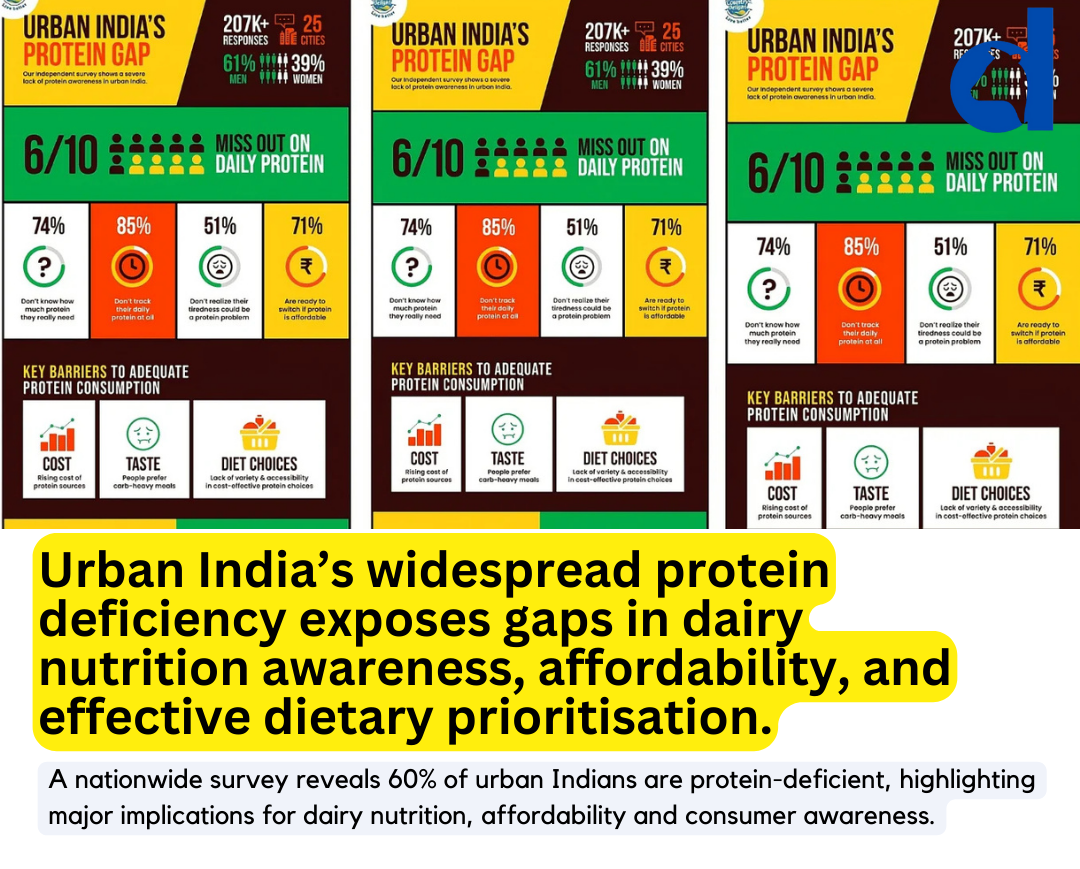
A large-scale consumer survey commissioned by Country Delight in partnership with LocalCircles has revealed a critical nutritional paradox in urban India: rising health consciousness coexisting with widespread protein deficiency. Drawing on over 2,07,000 responses across 25 major cities, the findings point to systemic gaps in awareness, affordability and dietary prioritisation areas where the dairy sector holds both responsibility and opportunity.
Protein Deficiency: An Urban, Not Rural, Problem
Contrary to long-held assumptions that undernutrition is primarily rural, the survey indicates that 60% of urban Indians do not consume protein-rich foods daily. Only four in ten respondents reported regular intake of staples such as milk, paneer, lentils, eggs, fish or nuts. This suggests that urban dietary patterns, often dominated by refined carbohydrates and convenience foods, are crowding out essential macronutrients.
From a dairy industry perspective, this challenges the notion that urbanisation automatically translates into better nutrition outcomes. While access to milk and dairy products is largely assured in cities, consumption quality and frequency remain inconsistent.
Knowledge Gap Undermining Dietary Choices
The survey highlights a striking lack of protein literacy. Nearly three-fourths of respondents were unaware of recommended daily protein requirements, as defined by the Indian Council of Medical Research (ICMR). Additionally, 85% do not track protein intake at all, underscoring how “balanced diet” perceptions often exclude quantitative nutritional understanding.
More concerning is that half of urban consumers fail to associate common health issues, such as fatigue, hair loss, and low immunity, with protein deficiency. This disconnect weakens demand for protein-forward foods and limits the effectiveness of market-led nutrition solutions without parallel education initiatives.
Affordability, Not Availability, Is the Bottleneck
While protein-rich foods are widely available in urban markets, affordability emerged as the primary barrier, followed by taste preferences and dietary restrictions. For vegetarians in particular, dairy remains the most scalable and culturally acceptable protein source. However, price sensitivity continues to influence purchasing decisions, especially amid food inflation and household budget pressures. This places renewed emphasis on value-added yet affordable dairy innovation, rather than premium-only positioning.
Dairy Sector at a Strategic Inflexion Point
Commentary from medical professionals reinforces the urgency. As Dr Vishakha Shivdasani notes, protein deficiency has long-term implications for immunity, metabolic health and cognitive function, cutting across age groups. Importantly, protein is reframed not as a fitness trend, but as a foundational public health nutrient.
Country Delight’s response to launching high-protein milk using natural filtration technology reflects a broader industry shift towards nutrition-led differentiation. The brand’s collaboration with HRX under the “Mission Protein” initiative signals how private players are attempting to bridge awareness gaps through product innovation and national campaigns.
Implications for Dairy Policy and Markets
For India’s dairy ecosystem, the findings suggest three key imperatives:
- Nutrition communication must move beyond calcium and fat to protein adequacy and functional health outcomes.
- Affordability-focused innovation, not just fortification, will be critical to scale impact.
- Partnerships between brands, health experts and policymakers are essential to convert availability into actual nutritional intake.
As India positions dairy as a pillar of food security and wellness, addressing urban protein deficiency may prove just as important as boosting rural milk productivity.