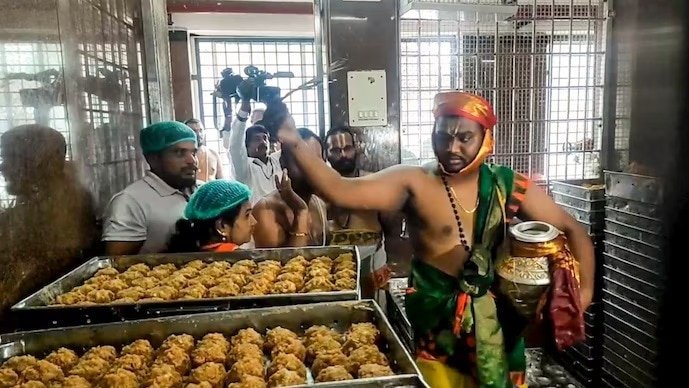
A CBI-led Special Investigation Team (SIT) has conclusively found that no milk was used in the manufacture of ghee supplied for Tirumala prasadam laddus, Andhra Pradesh Deputy Chief Minister Pawan Kalyan informed the State Legislative Assembly, triggering intense political debate and renewed scrutiny over one of India’s most revered religious offerings.
Addressing the House, Pawan Kalyan said the investigation revealed that the ghee supplied to Tirumala Tirupati Devasthanams (TTD) was manufactured using palm oil and chemical substances, rather than milk fat. While adulterants were clearly identified, the SIT could not conclusively establish the precise chemical composition or the origin of the substances used.
“The SIT has conclusively found that no milk was used in the manufacture of the ghee supplied for Tirumala laddu preparation,” he stated, adding that the findings point to a deliberate conspiracy to defile the prasadam offered at Tirumala.
Alleged Tender Manipulation and Supply Irregularities
According to the Deputy Chief Minister, the probe identified 36 accused individuals and highlighted alleged manipulation of tender conditions for ghee supply contracts. Eligibility norms were reportedly diluted to favour select firms, allowing companies with lower turnover, limited dairy expertise and insufficient production capacity to qualify.
Contracts awarded between 2020 and 2023, including those linked to Bhole Baba and associated entities, allegedly involved the supply of non-milk-based ghee, raising serious concerns about procurement oversight within one of the country’s most high-profile religious institutions. Citing official data presented in the Assembly, Pawan Kalyan said that out of approximately 480 million laddus distributed between 2019 and 2024, nearly 200 million were allegedly prepared using adulterated ghee.
“Mahapapam”: CM Naidu Calls It an Organised Conspiracy
Chief Minister N Chandrababu Naidu described the episode as a “Mahapapam”, calling it an organised conspiracy rather than an isolated lapse.“This is not just about one laddu. It is a systematic conspiracy,” Naidu told lawmakers, launching a sharp attack on the previous government led by Y. S. Jagan Mohan Reddy. He alleged that adulteration on such a scale would not have been possible without the complicity of officials, experts and laboratories involved in the tender process.
Naidu claimed that 59.71 lakh kilograms of ghee were adulterated, with public expenditure amounting to ₹234.51 crore, and that over 200 million laddus were prepared using the compromised ingredient during the five years. He further informed the Assembly that the Central Bureau of Investigation (CBI) had reached the stage of filing a chargesheet on 23 January 2026, which was submitted to the Supreme Court of India the following day.
Political Rebuttals and Judicial Caution
The controversy first surfaced in September 2024, when Naidu alleged that animal fat had been used in temple prasadam, triggering widespread religious and political backlash. The YSR Congress Party has consistently rejected the claims, asserting that the SIT findings disprove allegations of animal fat usage.
Jagan Mohan Reddy accused the current leadership of “playing politics in the name of God” and announced plans to approach both the Prime Minister and the Chief Justice. During earlier hearings, the Supreme Court cautioned against politicising religious matters, with Justice B.R. Gavai remarking that “Gods should be kept away from politics.”
Implications for Dairy Integrity and Procurement Oversight
TTD Executive Officer Shyamala Rao described the findings as “shocking” and attributed the lapse to the absence of in-house testing mechanisms. For the dairy sector, the episode underscores serious vulnerabilities in ingredient authentication, tender governance and laboratory accountability, particularly where religious institutions operate at industrial procurement scales. The findings also raise broader questions about non-dairy fat substitution, traceability and the need for stricter compliance mechanisms in high-volume food procurement systems.