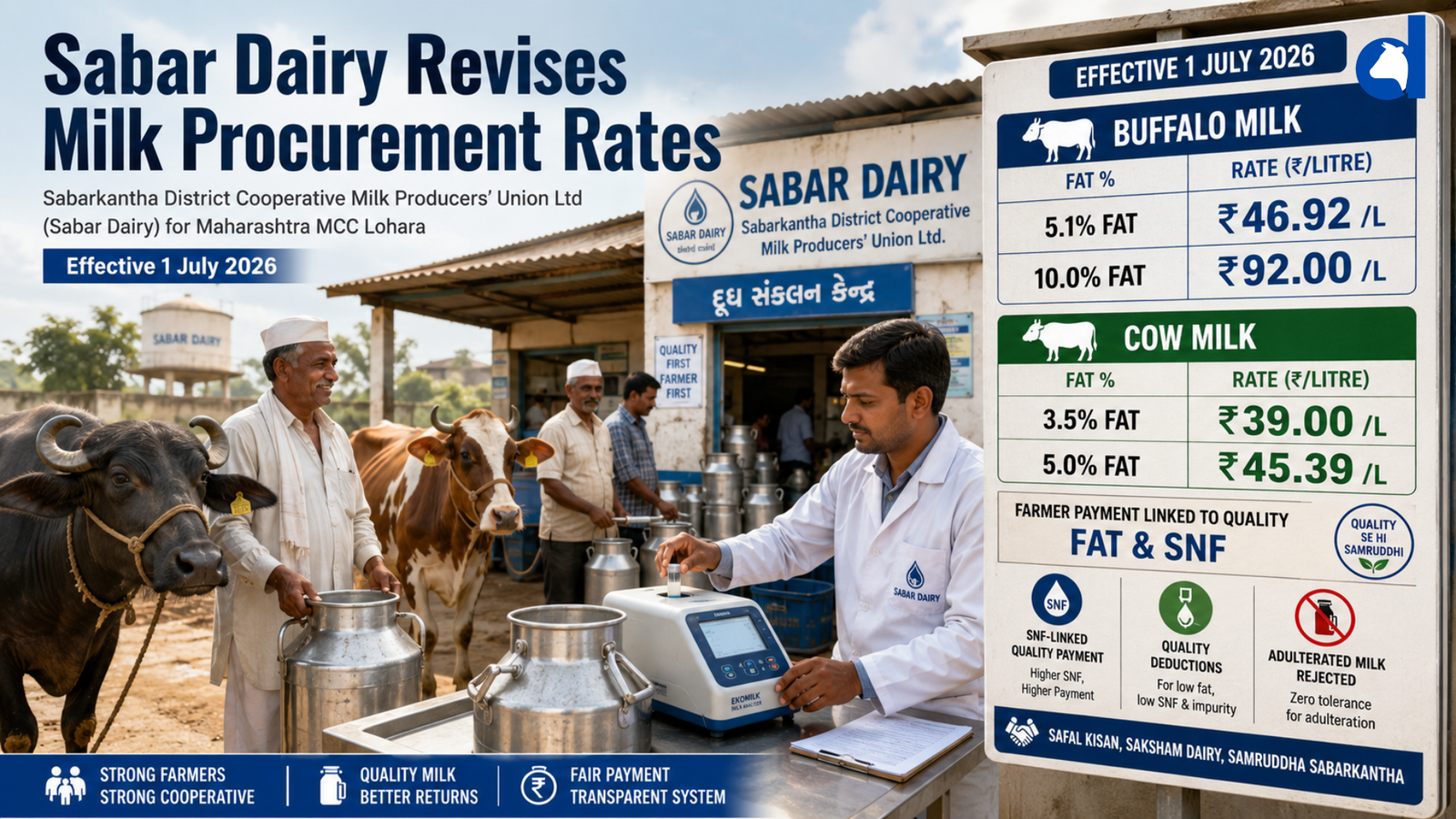
Sabarkantha District Cooperative Milk Producers’ Union Ltd has issued a revised milk procurement rate chart for its Maharashtra MCC Lohara collection operations, effective from 1 July 2026.
The rate chart links farmer payments directly to milk fat and solids-not-fat, or SNF, levels. It covers separate payment structures for buffalo and cow milk, along with quality-based deductions for milk that falls below specified SNF standards.
The revision is significant for dairy farmers and milk suppliers associated with the collection network, as the chart clearly establishes the relationship between milk composition and the amount payable per litre.
For the Indian dairy industry, litre-based fat and SNF-linked procurement systems remain central to transparent milk pricing and quality-based farmer remuneration.
Buffalo Milk Rate Reaches ₹92 Per Litre at 10% Fat
Under the revised Litrelo milk procurement chart, the standard quality category applies to milk with fat between 5.1% and 10% and SNF of 9% or above.
The payment starts at ₹46.92 per litre for buffalo milk containing 5Litreat and increases progressively with higher fat content.
Selected rates from the chart include:
| Buffalo Milk Fat | Rate Per Litre |
|---|---|
| 5.1% | ₹46.92 |
| 6.0% | ₹55.20 |
| 7.0% | ₹64.40 |
| 8.0% | ₹73.60 |
| 9.0% | ₹82.80 |
| 10.0% | ₹92.00 |
The rate structure provides a direct incentive for farmers to improve milk composition and maintain higher fat levels.
For example, buffalo milk containing 7.5% fat is priced at ₹69 per litre, while milk at 8.5% fat attracts a litre rate of ₹78.20 per litre. At 9.5% fat, the rate rises to 7.40 per litre.
This graded system means that litter size, breed productivity, feeding practices, and herd health can have a direct influence on dairy farm income.
SNF Quality Will Directly Affect Buffalo Milk Payments
The chart also establishes different payment levels when buffalo milk does not meet the SNF standard.
According to the rate sheet:
- Milk with SNF between 8.8% and 8.9% will receive 98% of the good milk rate.
- Milk with SNF between 8.5% and 8.7% will receive 96% of the good milk rate.
- Milk with 8.4% SNF will be paid at 25% of the good milk price, as stated in the chart.
- Milk falling into the lower quality condition specified in the chart is also subject to payment at 25% of the good milk value.
- Adulterated milk will be rejected, destroyed at the dock and will not receive payment.
These provisions underscore the growing importance of milk quality management at the farm and village-collection levels.
For dairy farmers, the implication is clear: higher fat alone may not be sufficient. Maintaining appropriate SNF levels is equally important for securing the full procurement value of milk.
Cow Milk Rates Also Linked to Fat and SNF
The revised chart contains a separate payment structure for cow milk.
For the farmer rate table, cow milk with 3.5% fat is priced at ₹39 per litre. The payment rises progressively. Litres of fat increase.
Selected cow milk rates include:
| Cow Milk Fat | Rate Per Litre |
|---|---|
| 3.5% | ₹39.00 |
| 3.6% | ₹39.43 |
| 3.7% | ₹39.86 |
| 3.8% | ₹40.28 |
| 3.9% | ₹40.71 |
The chart also provides a separate VLC rate structure beginning at ₹41.13 per litre for 4.0% fat and rising to ₹ 49.99 per litre for 4.9% fat.
An additional ₹45.39 per litre for milk containing 5.0% fat is shown in the cow milk section of the chart.
The rate sheet displays headline figures of 425.50 under the farmer rate and 438.27 under the VLC rate. As the image does not clearly define the unit or basis of calculation for these two figures, they should be interpreted together with the union’s operational payment methodology rather than treated as per-litre prices.
Cow Milk Quality Penalties Also Specified
The procurement chart sets separate quality conditions for cow milk.
Milk with SNF between 8.3% and 8.4% will be paid at 98% of the good milk rate, according to the sheet.
The chart also specifies a separate payment condition for milk with fat of 5.1% and above and SNF of 8.5% and above, under which payment will be calculated at 85% of the good milk value.
Cow milk containing 8.0% SNF will receive 25% of the good milk price, while adulterated milk will be rejected and no payment will be made.
These provisions demonstrate the importance of milk composition testing in modern cooperative procurement systems.
Quality-Based Procurement Becomes More Important for Dairy Farmers
The revised rate chart highlights an important trend in dairy production economics: the value of milk is increasingly determined by measurable quality parameters rather than volume alone.
For farmers, better returns depend on factors including:
animal nutrition, balanced ration management, access to clean drinking water, herd genetics, animal health, heat-stress management and hygienic milking practices.
In Maharashtra dairy operations, where milk collection networks bring together farmers with varying herd sizes and production systems, transparent fat- and SNF-linked pricing can help clarify the relationship between milk quality and farmers’ remuneration.
The rate structure may also encourage farmers to pay closer attention to ration balancing and herd productivity rather than focusing exclusively on milk volume.
What the Rate Revision Means for the Dairy Value Chain
For dairy cooperatives and milk collection centres, a composition-based procurement system enables more accurate valuation of raw milk.
Buffalo milk, with its higher fat content, is particularly valuable for several dairy product categories because milk solids influence product yield. Similarly, maintaining adequate SNF levels is important for overall milk quality and processing performance.
The latest rate chart, therefore,e has implications beyond the farmer payment level. It can influence milk collection quality, raw material planning and the economics of downstream dairy processing.
For the wider dairy sector in India, transparent milk procurement prices remain critical to maintaining farmer confidence and ensuring a stable flow of quality milk into organised processing networks.
Strong Message on Milk Adulteration
One of the strongest provisions in the rate sheet concerns milk adulteration.
The document states that adulterated milk will be rejected and destroyed at the dock, with no payment made for it.
This sends a clear message about the importance of milk quality and integrity across the procurement chain.
As organised dairying expands, rigorous collection-level testing and transparent quality parameters will remain important for protecting farmers, processors and consumers.
A Rate Structure That Rewards Milk Composition
The Sabar Dairy rate chart effective from 1 July 2026 reinforces the role of fat and SNF as central factors in milk procurement pricing.
For buffalo milk suppliers, the published standard rates range from ₹46.92 per litre at 5.1% fat to ₹92 per litre at 5.1% fat, subject to the applicable SNF and quality conditions.
For cow milk, the chart provides a graded structure linked to fat content, with separate provisions for SNF levels.
For dairy farmers associated with the Maharashtra MCC Lohara milk collection system, the message is straightforward: milk quality, composition and freedom from adulteration will directly influence the final procurement value.
As milk procurement prices remain an important topic across the Indian dairy industry, such quality-linked rate charts will continue to attract close attention from farmers, collection centres and dairy sector stakeholders.