Tamil Nadu Dairy Farmers Seek Higher Aavin Procurement Prices Amid Rising Production Costs
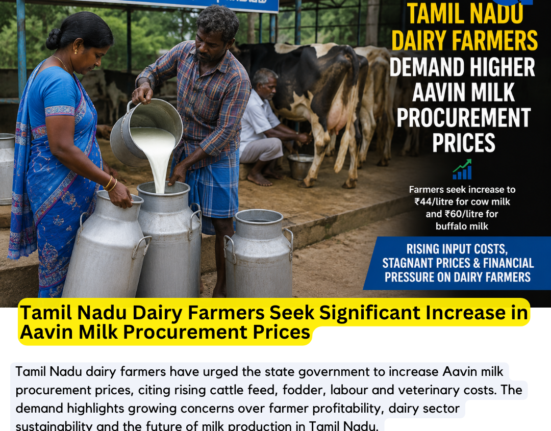
Dairy farmers across Tamil Nadu have urged the state government to revise Aavin’s milk procurement prices, arguing that existing rates are no longer sufficient to sustain dairy farming amid rapidly increasing production costs.
The growing gap between prices offered by the state-run cooperative and private dairy processors is increasingly pushing farmers away from Aavin’s procurement network, raising concerns about the long-term stability of milk supplies.
Procurement Price Gap Widens
According to farmer representatives, Aavin currently procures milk at an average price of around ₹34 per litre, while several private dairy companies are reportedly offering prices of up to ₹50 per litre.
Some producers are also achieving even higher returns by selling directly to consumers, where prices can reach approximately ₹62 per litre.
The widening price disparity has led to a gradual shift in milk supplies away from cooperative societies and toward private channels.
Rising Cost of Dairy Farming
Farmers argue that the economics of dairy farming have changed significantly in recent years.
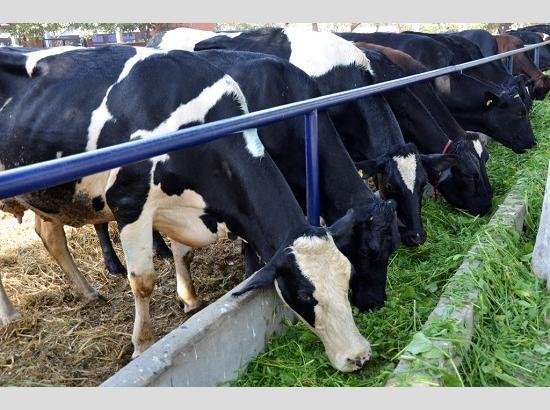
Traditionally, cattle depended largely on village grazing lands, reducing feed expenses. However, shrinking grazing areas have forced producers to increasingly rely on purchased fodder and commercial feed.
Major cost pressures include:
- 🌾 Rising green fodder costs
- 🐄 Increased dependence on commercial cattle feed
- 📈 Higher prices for oil cakes and feed ingredients
- 👷 Escalating labour expenses
- 🏥 Increasing veterinary and animal healthcare costs
Farmers noted that the price of a 50-kg bag of oil cake has risen to around ₹1,800, significantly increasing the cost of milk production.
Pressure on Farmer Profitability
Producer organisations claim that current procurement prices often barely cover production expenses, leaving minimal margins for dairy households.
As profitability declines:
- Some farmers are reducing herd sizes
- Others are exiting dairy farming altogether
- Disease-related cattle losses and lower milk yields are adding further pressure
These challenges are contributing to a gradual weakening of the cooperative milk procurement system.
Implications for Aavin and Tamil Nadu’s Dairy Sector
Aavin has historically played a critical role in ensuring:
✅ Stable market access for farmers
✅ Affordable milk supplies for consumers
✅ Cooperative-based rural livelihoods
However, declining milk procurement could impact the cooperative’s ability to maintain adequate supply levels in the future.
Farmer organisations believe that revising procurement prices could:
- Encourage producers to return to Aavin
- Improve farmer incomes
- Strengthen cooperative milk collection networks
- Ensure long-term milk supply stability in Tamil Nadu
Competitive Landscape Intensifies
The situation also highlights increasing competition between cooperative and private dairy players in India.
Private processors are becoming increasingly aggressive in milk procurement by offering:
- Higher farmgate prices
- Faster payment mechanisms
- Flexible procurement arrangements
This trend is prompting many cooperatives across India to reassess procurement strategies to retain farmer participation.
Outlook
As input costs continue to rise, procurement pricing is emerging as one of the most critical issues for India’s dairy sector.
A balanced pricing framework that supports both farmer profitability and consumer affordability will be essential to maintaining the long-term sustainability of cooperative dairy systems such as Aavin.
The coming months could prove crucial in determining whether policy interventions can help restore farmer confidence and strengthen Tamil Nadu’s dairy ecosystem.