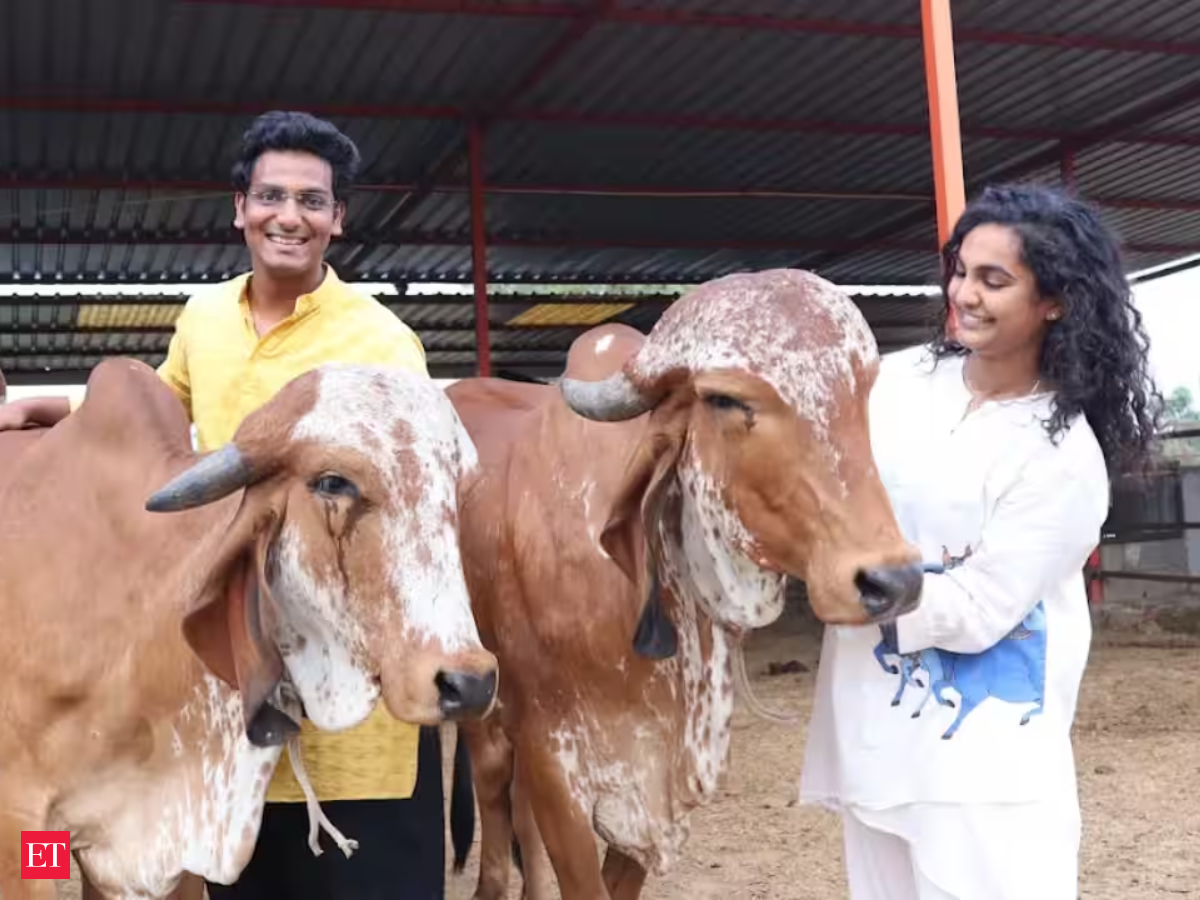
A farming venture launched near Jaipur in 2018 by engineering graduates Vibhor Jain and Ishita Jain has developed into an integrated agricultural business combining dairy production, value-added milk products, agroforestry and renewable energy. Kinaya Organic Farms and Life now operates with 100 Gir cows, more than 2,000 trees and a reported annual revenue run-rate of up to ₹2.4 crore, according to a report by Navbharat Times.
The venture illustrates how dairy businesses can diversify beyond liquid milk sales by developing processed products and connecting livestock operations with cultivation, energy generation and resource management.
From 20 Gir Cows to an Integrated Dairy Enterprise
Vibhor Jain, a computer science engineering graduate, entered farming without a conventional agricultural background. His interest in indigenous cattle developed after his family brought two cows home. In 2017, he travelled to Gujarat’s Kathiawar region to learn about Gir cattle and traditional animal husbandry practices.
In 2018, he leased land near Jaipur and began the venture with 20 Gir cows. The initial years focused on understanding cattle management, milk production and the practical challenges of running a dairy business.
Ishita Jain joined the enterprise after the couple married in 2022. An engineering graduate with an MBA in Human Resources, she became part of the business as it expanded beyond its original dairy operations.
Over time, the venture developed into a broader farming enterprise that combines milk production, food processing, fruit cultivation and resource management.
100 Gir Cows Supply Milk for Fresh Sales and Ghee
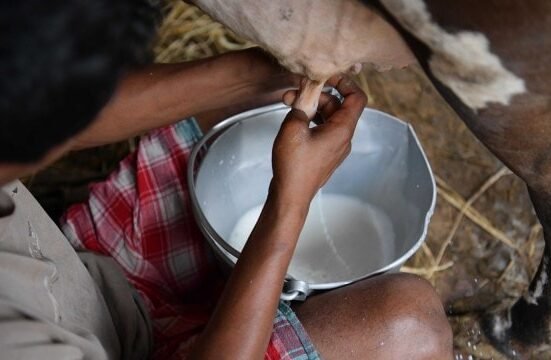
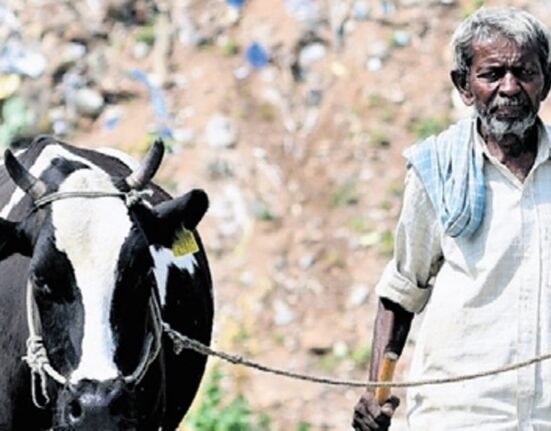
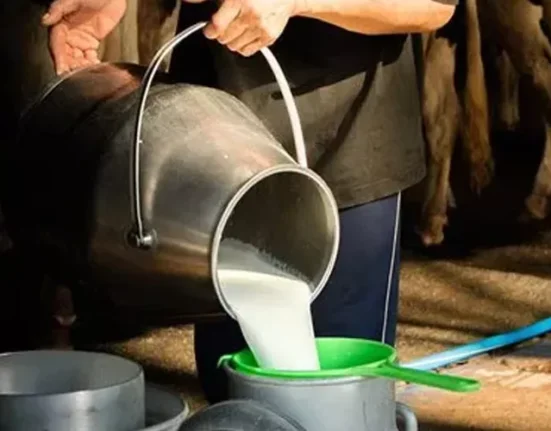
Kinaya Farms currently has a herd of 100 Gir cows and reportedly produces approximately 250–300 litres of milk daily. Part of the milk is sold as fresh liquid milk, while the remainder is processed into traditional bilona ghee.
Reported ghee production stands at approximately nine litres per day. Processing milk into ghee allows the business to offer an additional product category and generate revenue beyond fresh milk sales.
Value addition is an important strategy for dairy enterprises seeking to diversify their revenue streams. However, processing also involves additional requirements, including equipment, labour, packaging, storage, quality control and distribution.
The farm has extended its product range to include wood-pressed oils, organic vegetables and freeze-dried products such as colostrum powder. Its portfolio reportedly includes more than 25 products, broadening its reach beyond conventional dairy customers.
Agroforestry Adds Another Dimension to the Business
The farm’s operations extend beyond livestock. Kinaya Farms maintains more than 2,000 trees, including over 500 mango trees representing approximately 40 varieties, along with other fruit trees and more than 300 white sandalwood trees.
This agroforestry component diversifies the farm’s agricultural activities and creates opportunities beyond dairy production. Fruit cultivation can provide additional products for sale, while the integration of trees and agricultural land contributes to the farm’s wider land-management strategy.
Diversification can help reduce reliance on a single revenue source, although returns from different crops depend on growing conditions, production cycles, market prices and management costs.
Cow Dung Supports Biogas and Organic Fertilisation
A notable feature of Kinaya Farms is its use of livestock waste as a resource. According to the farm’s official website, it operates a 15-cubic-metre biodigester that converts cow dung into biogas for use on the property.
The material remaining after anaerobic digestion is used as fertiliser for agricultural fields. This creates a connection between dairy production, renewable energy and crop cultivation.
For dairy farmers, biogas systems can offer an additional use for manure while helping manage livestock waste. The economic benefits depend on herd size, digester efficiency, installation costs, maintenance and the farm’s energy requirements.
The approach also demonstrates how manure management can form part of a wider resource-efficiency strategy rather than being treated solely as a waste-disposal issue.
Solar Energy and Rainwater Harvesting Support Operations
Kinaya Farms has installed a 45-kilowatt solar power system to generate electricity for its operations. It also uses rainwater harvesting and drip irrigation to support water management and cultivation.
A report by The Better India cited a rainwater-harvesting reservoir with a stated capacity of 50 lakh litres. The farm also uses electric vehicles as part of its operations.
These facilities contribute to the farm’s efforts to manage energy and water resources. Their overall impact depends on seasonal rainfall, electricity consumption, irrigation demand and operating conditions.
For dairy enterprises, renewable energy and efficient water management can be particularly relevant because milking, cooling, cleaning and livestock care require reliable utilities.
Reported Annual Revenue Reaches ₹2.4 Crore
According to Navbharat Times, Kinaya Farms generates approximately ₹18 lakh to ₹20 lakh in monthly revenue, excluding cattle sales. This translates into an annual revenue run-rate of approximately ₹2.16 crore to ₹2.4 crore.
These figures represent reported revenue rather than net profit. The available information does not disclose the business’s complete operating costs, margins or net earnings.
Nevertheless, the reported scale reflects the expansion of the enterprise from its initial 20 cows to a diversified operation combining dairy products, cultivation and resource management.
Lessons for India’s Dairy Industry
Kinaya Farms’ development highlights several opportunities for dairy entrepreneurs: building direct customer relationships, processing milk into value-added products, diversifying agricultural activities and making productive use of livestock waste.
The model also demonstrates that diversification requires investment, technical knowledge and coordinated management. Dairy productivity, product quality, operating costs and access to customers remain important determinants of commercial success.
For India’s dairy industry, the venture offers an example of how a farm can combine conventional milk production with food processing, agroforestry and resource-efficiency measures to develop multiple sources of business revenue.