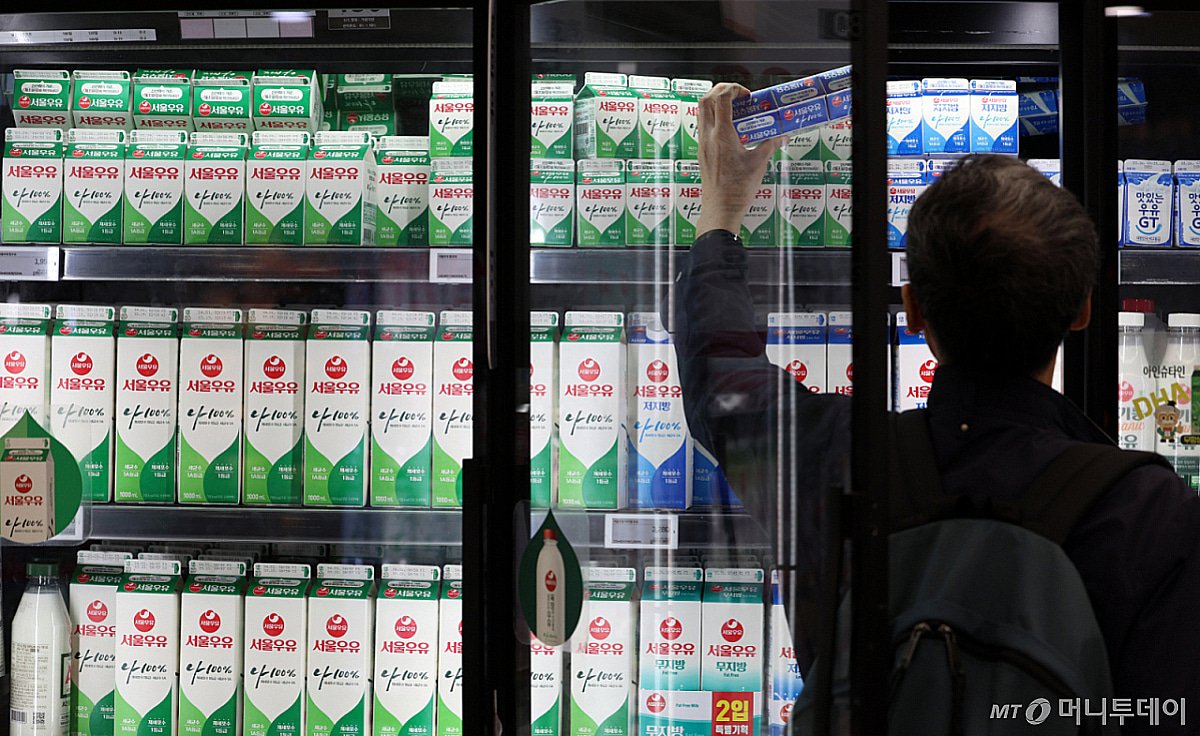
South Korea’s major low-cost coffee franchises continue to rely heavily on domestic milk despite growing competition from cheaper imported ultra-high-temperature (UHT) milk. The preference reflects concerns about latte flavour, consumer expectations and the perceived freshness of locally produced dairy products, even as imported milk gains ground in the market.
A survey conducted in October by the Milk Self-Sufficiency Promotion Committee found that 15 of 16 major low-cost coffee brands use domestic milk. The remaining brand uses both domestic and imported milk, depending on the beverage. The findings highlight the importance of milk origin and product quality in a highly competitive coffee market.
The development comes as South Korea experiences declining white milk consumption, rising imports of sterilised milk and policy discussions aimed at supporting domestic dairy farmers.
Major Coffee Brands Continue Using Local Milk
The survey identified Paik’s Coffee, Mega MGC Coffee, The Venti, Yogerpresso and Compose Coffee among the brands using domestic milk.
Ten Percent Coffee was the only surveyed brand reported to use both domestic and imported milk. It uses domestic milk for standard lattes, while imported milk supplied by its headquarters is used in signature latte beverages.
For coffee franchises, milk is more than a basic ingredient. Its flavour, texture and interaction with espresso can influence the overall taste of a latte. Changing suppliers or switching to imported milk may therefore affect product consistency and customer satisfaction.
Industry representatives have also noted that the longer shelf life of sterilised milk can be perceived negatively by some consumers, who associate domestic milk with greater freshness.
This suggests that lower procurement costs alone may not be enough to persuade coffee chains to change their sourcing strategies, particularly when milk quality is central to their beverage offerings.
Consumer Preferences Support Domestic Dairy
Consumer perceptions appear to reinforce the coffee industry’s preference for local milk.
The 2025 Milk and Dairy Product Consumption Behaviour Survey, conducted by the Dairy Policy Research Institute of the Korea Dairy Cattle Association, found that 87.3% of respondents considered milk and dairy products made with domestic ingredients superior to those made with imported ingredients.
Among respondents who had tried imported sterilised milk, 42.3% rated its taste and flavour as inferior to domestic milk.
These findings indicate that origin, perceived quality and familiarity remain important considerations for South Korean consumers. For food-service businesses, using domestic milk may help maintain established product profiles and respond to customer expectations.
However, consumer perceptions do not necessarily mean that all imported milk performs differently in coffee applications. Product specifications, processing methods, storage conditions and individual preferences can also influence the final beverage.
Imported Sterilised Milk Expands Its Market Presence
Despite the continued preference for domestic milk among coffee franchises, imports have increased substantially.
According to Korea Customs Service trade statistics, South Korea imported 50,740 tonnes of sterilised milk in 2025, more than double the 23,199 tonnes recorded in 2021.
Imported UHT milk offers two principal advantages: competitive pricing and extended storage life. These characteristics can appeal to retailers, food-service operators and consumers seeking products with longer shelf lives.
Trade policy has also increased competitive pressure. Under free trade agreements, zero tariffs were applied to US-origin milk in January 2026 and European Union-origin milk in July 2026, according to the report.
These changes could improve the price competitiveness of imported products, although their actual impact depends on exchange rates, transport expenses, distribution costs and market demand.
For domestic dairy processors, the challenge is to remain competitive while communicating the quality and product characteristics that consumers value.
Declining White Milk Consumption Adds Pressure
South Korea’s dairy industry is also facing a structural challenge from falling white milk consumption.
The Korea Dairy Promotion Agency reported that per-capita white milk consumption fell to 22.9 kilograms in 2025, down 9.5% from 25.3 kilograms in 2024. Consumption had already declined from 26.6 kilograms in 2021, with the reduction becoming more pronounced in 2025.
Lower consumption can affect demand for domestically produced raw milk and create additional pressure on producers and processors to adjust their product portfolios.
In response, dairy farmers and industry representatives have agreed to modify the allocation of raw milk between drinking-milk and processing-milk categories.
Starting in 2027, the industry plans to reduce the volume allocated to drinking-milk uses by 20,600 tonnes over two years, while increasing the volume allocated to processing applications by the same amount.
Drinking-milk raw material supports products such as white milk, fermented milk and coffee beverages, while processing-milk raw material is used for products including cheese and milk powder. The adjustment is intended to align raw-milk allocation more closely with changing market demand.
Milk-Origin Labelling Could Influence Purchasing Decisions
South Korea is also considering whether milk used by food-service establishments, including cafés, should be included in mandatory origin-labelling requirements.
Existing rules cover selected agricultural and livestock products served in food-service establishments, including beef, pork, rice and napa cabbage kimchi, but milk is currently excluded.
The Ministry of Agriculture, Food and Rural Affairs is considering extending origin labelling to milk used in cafés and other food-service businesses.
If implemented, the measure could make it easier for consumers to identify whether their beverages contain domestic or imported milk. It may also encourage cafés and food companies to highlight domestic sourcing as part of their product positioning.
For South Korean dairy farmers, the combination of consumer preference, coffee-chain procurement practices and potential labelling changes could provide support for domestic milk demand. Nevertheless, declining white milk consumption and increasingly competitive imports will remain significant challenges.
The industry’s future performance will depend on its ability to balance production with demand, strengthen value-added dairy processing and demonstrate the quality and origin of domestic milk to consumers.