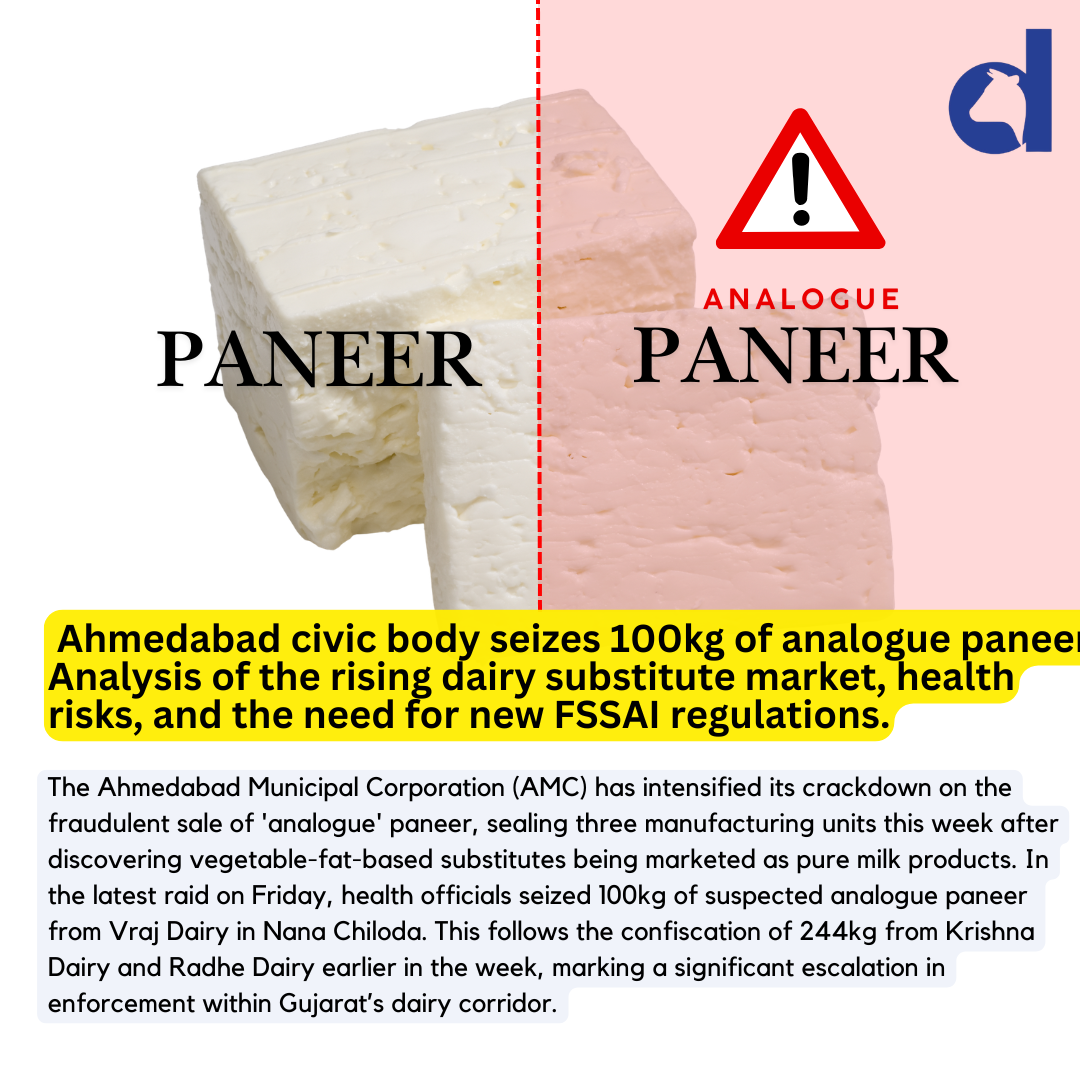
AHMEDABAD – The Ahmedabad Municipal Corporation (AMC) has intensified its crackdown on the fraudulent sale of ‘analogue’ paneer, sealing three manufacturing units this week after discovering vegetable-fat-based substitutes being marketed as pure milk products. In the latest raid on Friday, health officials seized 100kg of suspected analogue paneer from Vraj Dairy in Nana Chiloda. This follows the confiscation of 244kg from Krishna Dairy and Radhe Dairy earlier in the week, marking a significant escalation in enforcement within Gujarat’s dairy corridor.
The Scale of the Crisis
The surge in seizures—totalling nearly 350kg in a single week in Ahmedabad alone—highlights a systemic shift in food fraud. Unlike traditional adulteration, in which water or urea is added to milk, manufacturers of analogues use sophisticated industrial processes to create ‘look-alike’ products. These products replace expensive milk fat with hydrogenated vegetable oils (often palm oil), starch, and emulsifiers.
Current market data indicates that analogue paneer can be produced at roughly 40% to 50% of the cost of genuine dairy paneer. This massive price arbitrage, combined with the product’s ability to mimic the texture and appearance of the real thing, has led to its widespread adoption in the HoReCa (Hotel, Restaurant, and Catering) sector, where it is often passed off to unsuspecting diners as traditional “milk paneer.”
Health Implications and Consumer Risks
While some analogue products are technically “safe” for consumption if made with food-grade ingredients, the health implications of mislabelling are severe. Analogue paneer is typically high in trans fats and carries a significantly lower nutritional profile than its dairy counterpart.
- Nutritional Deficit: Real paneer is a primary source of high-quality protein for India’s vegetarian population. Substitutes offer minimal protein and high caloric density from unhealthy fats.
- Cardiovascular Risks: The use of hydrogenated oils increases the risk of heart disease and metabolic disorders.
- Transparency Gap: The AMC has noted that under the Food Safety and Standards Act (2006), analogues are not inherently illegal but must be clearly labelled. The fraud lies in the deception that denies consumers their right to informed choice and nutritional security.
Regulatory Imperative: Differentiation Over Destruction
The current enforcement model treats analogues and adulteration as the same “substandard” category. However, industry analysts argue that the regulator, FSSAI, should adopt a more nuanced framework.
There is a growing call to establish “Analogue” as a distinct, regulated category with mandatory front-of-pack labelling (FOPL). By differentiating between adulteration (harmful, illegal additives) and analogue (non-dairy substitutes), regulators can allow a legitimate market for low-cost alternatives to exist safely without cannibalising the premium dairy market or endangering public health through deception.
Strategic Takeaway for the Industry
For genuine dairy processors, the rise of “fake paneer” is a direct threat to brand equity and pricing power. Investors and large-scale processors should pivot toward advanced supply chain traceability and rapid testing kits at the retail level. As the AMC continues its drive, the industry must lead the charge in consumer awareness—educating the public on the ‘drop test’ or ‘iodine test’ to distinguish between fresh milk solids and vegetable-fat imitations.