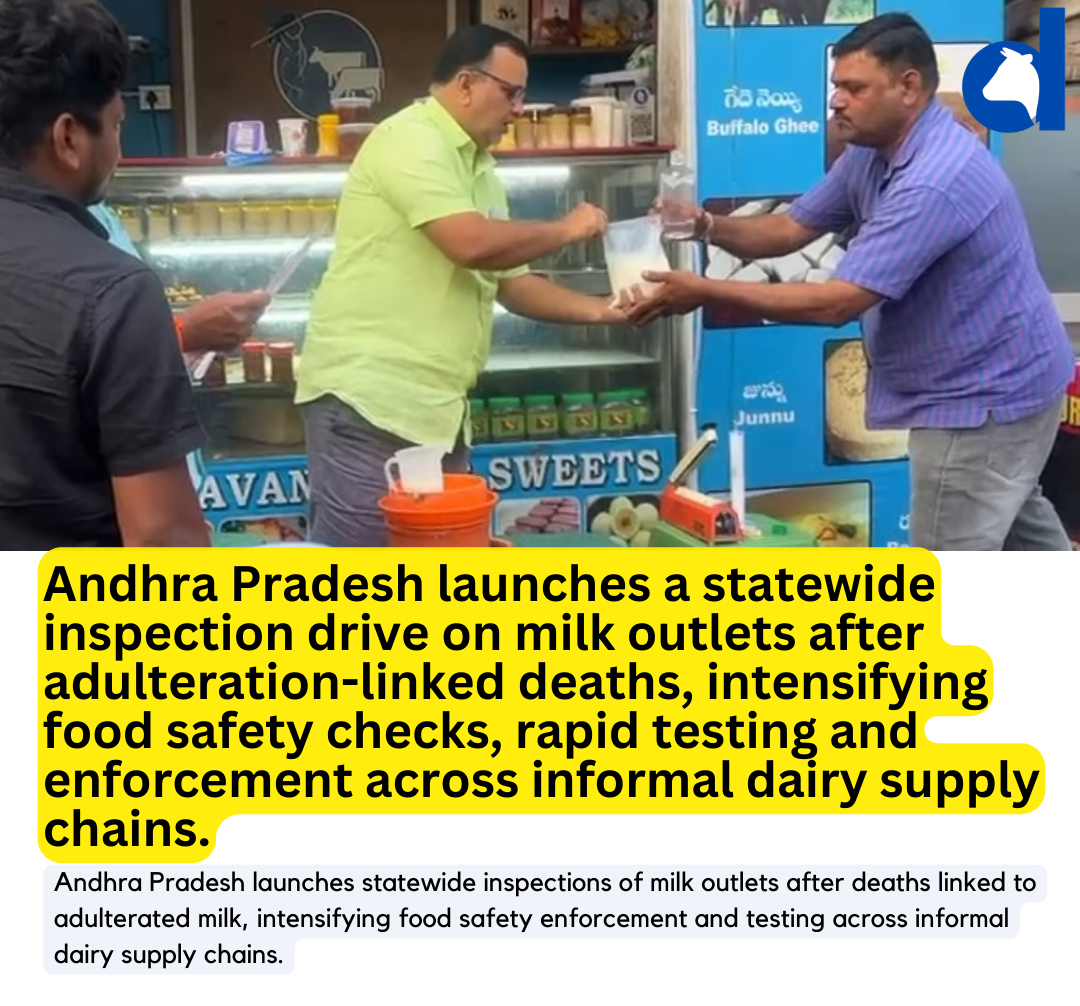
Following the deaths of five people in Rajamahendravaram linked to the consumption of adulterated milk, the Andhra Pradesh Medical and Health Department has launched a statewide inspection drive targeting milk retail outlets to curb the sale of unsafe dairy products.
Acting on the directions of Health Minister Y Sathya Kumar Yadav, food safety officials conducted surprise inspections across Andhra Pradesh, focusing on milk parlours, unauthorised retail points and loose milk supply chains.
Large-Scale Sampling and Laboratory Testing
As part of the special drive, officials collected nearly 150 milk samples from retail centres across the state. The samples have been sent for detailed analysis to accredited laboratories in Hyderabad, Chennai and Kakinada.
Preliminary inspections have already revealed multiple violations in milk handling, storage and quality compliance at dairy outlets, according to officials involved in the drive.
In Anantapur, authorities found quality deficiencies in close to 100 litres of milk at two locations. About 30 litres of spoiled milk were discarded from one outlet, while another had 70 litres declared substandard following on-the-spot testing.
Similarly, in Machilipatnam, officials detected quality issues in 20 litres of flavoured badam milk, while five kilograms of inferior milk powder were seized in Kakinada.
Use of Rapid Detection Tools
According to Neelakantha Reddy, the inspections are supported by the use of ‘Magic Kits’, rapid testing tools costing approximately ₹8,000 each. These kits allow officials to instantly assess milk quality at the point of sale.
The kits have been distributed to food safety unit officers across 28 districts, enabling quicker enforcement and reducing dependence on laboratory turnaround times for initial screening.
Focus on Loose Milk and Informal Supply Chains
Officials said the inspection drive is primarily targeting outlets selling loose milk and milk transported in cans, segments often associated with higher risks of adulteration and poor cold-chain management.
The Health Department confirmed that the special enforcement campaign will continue for at least another week, with strict action promised against those found violating food safety norms.
Implications for the Dairy Sector
The incident highlights persistent vulnerabilities in informal milk distribution networks, especially in urban and semi-urban markets. For the organised dairy sector, the crackdown reinforces the need for stronger traceability, testing infrastructure and consumer awareness to restore confidence in milk safety.
As regulatory scrutiny intensifies, dairy operators may face increasing pressure to demonstrate compliance, invest in quality assurance systems and move away from unregulated supply practices.