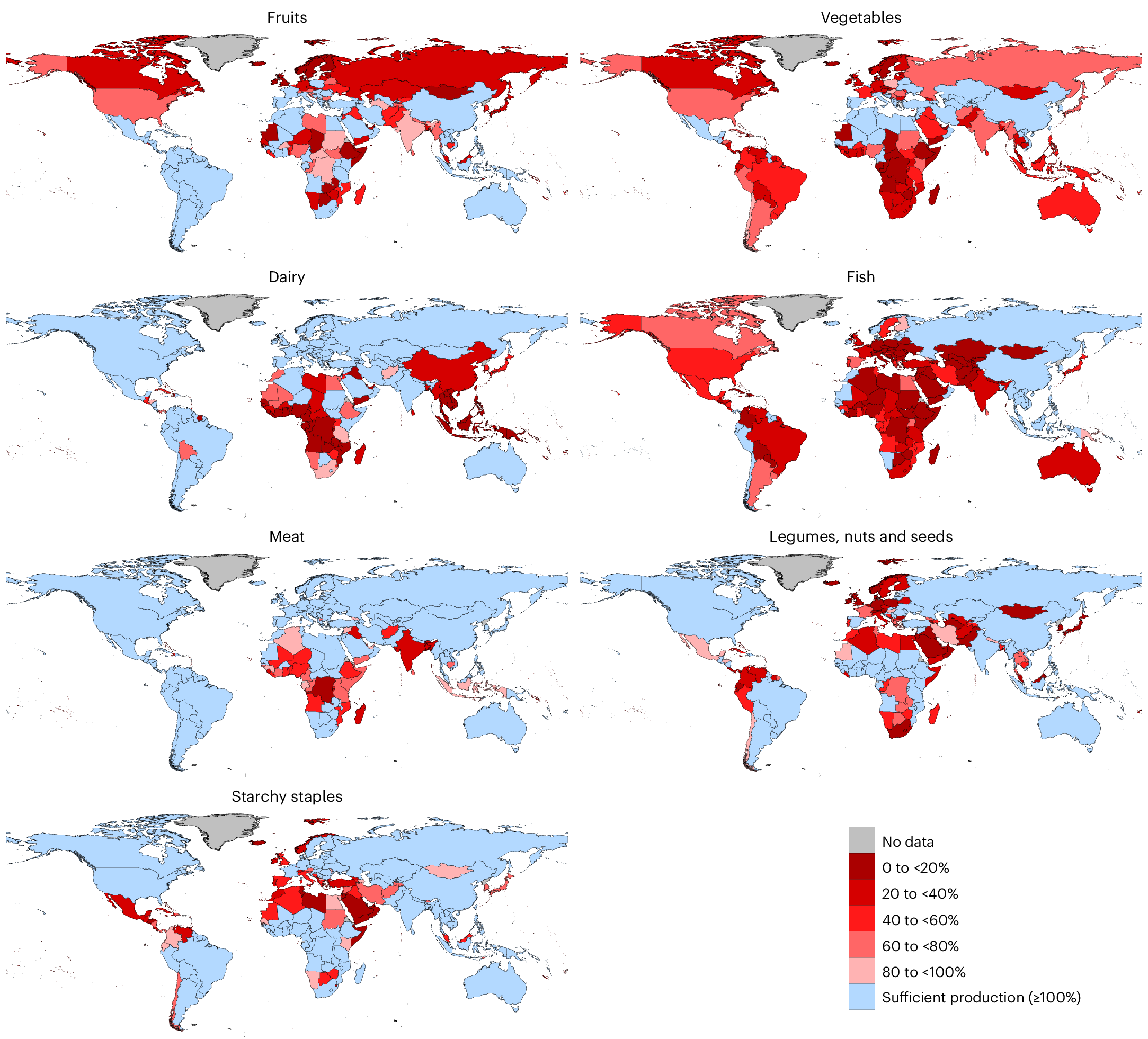
In an era marked by nationalist rhetoric, geopolitical instability, and growing calls for sustainable diets, a major study published in 2025 in Nature Food underscores a critical global issue: most nations cannot meet basic nutritional requirements solely through domestic food production.
Out of 186 countries analysed, more than one-third can only meet the dietary requirements for two or fewer essential food groups. Only Guyana meets all seven groups outlined in the WWF’s Livewell diet. Shockingly, six countries—primarily in the Middle East—fail to meet any. Even high-income or agriculturally endowed regions face stark limitations.
The research, which utilised FAO Food Balance Sheets and demographic dietary modelling, finds that while meat self-sufficiency is relatively high globally, dairy production remains a critical deficit, especially in sub-Saharan Africa and Oceania, where over 80% of nations fall short of meeting dairy needs. Only 44% of countries globally are self-sufficient in dairy, with Europe being the exception, where all countries meet domestic dairy demand.
These findings have far-reaching implications for India’s dairy sector, already under pressure from rising population demand, milk price volatility, and shifts towards sustainable consumption. As the world’s largest milk producer, India’s dairy self-sufficiency is a strategic advantage—but one that needs continuous investment in value-added dairy products, dairy technology, and climate-resilient practices.
Dairy and the Self-Sufficiency Challenge
The study highlights how fish, vegetables, and fruits are major gaps in national self-sufficiency. Only 25% of countries meet fish needs, and fewer than a quarter can meet vegetable consumption targets. In contrast, starchy staples, legumes, and meat show better alignment between production and recommended intake levels.
 In the context of dairy production, it is significant that even with future projections (up to 2032), only five countries are expected to become fully self-sufficient in dairy, and the global dairy sufficiency gap will narrow by a modest 6 percentage points. For a country like India, this underlines the importance of maintaining production leadership while expanding milk procurement infrastructure and ensuring nutrition-rich milk supply, especially for rural and low-income populations.
Regional and Trade Dependencies: A Fragile System
Economic unions and regional trade blocs provide only limited insulation. For example, the Gulf Cooperation Council (GCC) is self-sufficient only in meat. No regional bloc meets vegetable requirements, and most rely on a narrow range of trading partners, exposing them to disruptions, as seen during the COVID-19 pandemic or the Suez Canal blockage.
The report warns of the risks of overreliance on few import sources, which lowers “response diversity”—a nation’s ability to pivot when supply lines are cut. Island nations and small states, especially in the Caribbean and West Africa, are particularly vulnerable, relying on one or two nations for over 50% of critical imports.
India’s Position and Lessons for the Dairy Industry
While India’s food system remains largely self-reliant in dairy and starchy staples, it is essential to view these findings through a forward-looking lens. Structural constraints—cropping patterns, water scarcity, urbanisation—may erode self-sufficiency if supply chains aren’t modernised. Dairy, being nutritionally dense and culturally central, must be prioritised in terms of cold chain infrastructure, value chain development, and consumer education on the role of milk in sustainable diets.
Innovations such as precision dairy farming, controlled environment agriculture, and fortified milk products offer a pathway forward. Moreover, the study’s call for dynamic trade models and better policy alignment echoes India’s recent moves to safeguard its dairy interests in trade agreements.
As dietary demand surges with population growth, the findings act as a caution: nutritional security cannot be achieved without strategic food production planning, technological investment, and diversified trade policies. The Indian dairy industry, with its cooperative base, resilient farmer networks, and government support, stands at a critical juncture—poised to lead if it adapts swiftly.