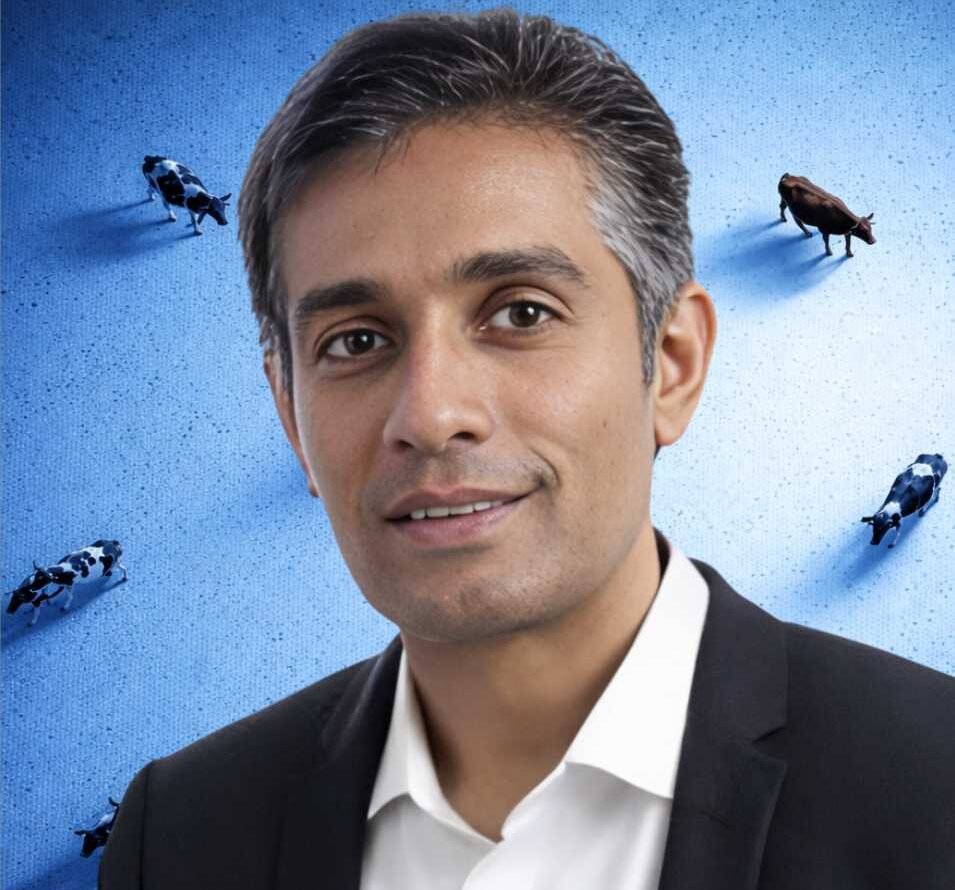
Among India’s fastest-growing listed dairies, Heritage Foods Ltd. has quietly stitched together record-breaking quarters through disciplined milk procurement, sharp route-to-market execution, and a deliberate pivot toward value-added products.
In Q1 FY26, the company reported its highest-ever quarterly revenue of INR 11,368 Mn (+10% YoY), driven by milk sales of 11.6 lakh litres/day and procurement rising nearly 10% to 17.8 lakh litres/day. Value-added products (VAPs) contributed roughly 36–41% of revenue (INR 4,034 – 4,540 Mn, including consumer ghee and butter).
FY25 consolidated results reinforce the operating momentum, revenues at INR 41,346 Mn (+9%), EBITDA +58%, PAT +77%, and procurement scaling to ~1.72–1.76 MLPD. Management continues to pursue calibrated price increases (INR 1–2/litre on toned milk) and retail expansion, targeting 3.5 lakh outlets, notably in Chennai, while anchoring its product innovation in taste leadership, even as India’s dairy consumers increasingly opt for protein-forward choices.
Set against a global backdrop, with Fonterra divesting its consumer arm to Lactalis and FrieslandCampina embedding 2030 climate targets, Heritage’s next chapter will hinge on its mix strategy, sourcing philosophy, sustainability roadmap, and ability to enhance farmer value at scale.
- Journey of becoming Srideep Kesavan
You’ve worked across diverse categories and business models before joining Heritage Foods. Looking back, what moments or turning points most shaped your worldview as a leader?
Looking back, I don’t think there’s been one big turning point; it’s really been a collection of experiences that have shaped how I think and lead. I’ve always been curious about how things connect, how patterns emerge where you least expect them. Over time, that ability to “connect the dots” and get to the first principles of a problem has become second nature.
I’ve had the chance to work in very different worlds, from consumer goods to commodities and back again. My time at Olam International, as Country Head, gave me a front-row view of how the world of commodities and macroeconomics actually works, how markets move, how trade flows shift, and how volatile global value chains behave.
Then there was Coca-Cola, which I often say is an underrated CEO factory. I spent more than 15 years there across two stints and two decades, and it shaped me profoundly, as a consumer-centric marketer, a customer-first business leader, and someone who believes that culture and people are the actual levers of performance.
A lot of what we’re building today at Heritage Foods, our “Winning Ways” culture, focus on execution, and disciplined growth, really draws from those lessons. Being part of Coca-Cola’s global nutrition initiatives and exposure to food innovation platforms, such as the Natural Products Expo in Anaheim, transformed my perspective.
- Defining values
If you had to describe your leadership philosophy in three words, what would they be, and how do they show up in your day-to-day decisions?
If I had to sum up my leadership philosophy in 3 words, it would be Curiosity, Clarity, and Courage.
Curiosity is where it all begins. I’ve always been fascinated by how things connect: people, markets, behaviour, and technology. That curiosity keeps me learning and helps me see patterns others might miss. It’s what lets us spot opportunities before they’re obvious. I often say, what you can do is always greater than what you have done, because the real excitement lies in what’s still ahead.
Clarity, for me, is about vision. As a leader, I need to see through the clutter, to get to the core of a problem, connect the dots, and paint a clear picture of where we’re going. But clarity isn’t helpful unless it’s shared. My job is to make sure everyone in the team understands the “why,” not just the “what,” so our actions move in the same direction.
And finally, Courage is the most vital of the three. Leadership, as Randall Stutman said, is the Courage to make a difference to people and situations. Courage is about conviction, about deciding, about standing by your values, and about speaking the truth even when it’s uncomfortable. It’s also about empathy and creating the psychological safety for others to be brave, to question, to take initiative. I try to lead with that kind of Courage every day, steady and rooted in purpose.
- The Heritage connection
What drew you to Heritage Foods? Was it the legacy, the growth potential, or something more profound about the brand’s purpose?
When I decided to move on from being a cog in the giant wheel of an MNC, I was looking for something very different, a place where I’d have the freedom to build, to create, and to shape a world-class food business from the ground up. Heritage Foods offered exactly that.
What drew me in instantly was its unique and sustainable business model, blending the “business for good” philosophy of cooperatives with the consumer-centricity and efficiency of modern corporations. That combination is rare. At the time I joined, the company was already serving over 1.5 million homes, sourcing milk from nearly 300,000 farmers every single day, and that scale still rested on deep purpose and partnership.
We’re standing on the shoulders of giants. Over three decades, Heritage had built a remarkable foundation, a trusted brand, strong farmer relationships, and a procurement system almost obsessed with fresh, realised purity. Few realise how disciplined the company is about how far milk travels; it’s a small but defining detail.
When I came in, Heritage was debt-free, with robust assets and enormous potential, yet under-leveraged in the market and in consumers’ minds. I saw an opportunity to modernise, strengthen our talent, technology, and brand, and reimagine Heritage for the next decade.
Today, the company stands at an inflexion point, poised to scale its value-added portfolio and emerge as one of India’s most trusted, homegrown FMCG players focused on nutrition. For me, it’s deeply fulfilling to help build that future, nourishing every home, empowering every farmer, and creating a healthier, happier tomorrow.
- People and culture
How do you approach building teams and professionalising and scaling a legacy organisation like Heritage? What kind of culture do you want to leave behind?
When I came in, my task was straightforward: to make Heritage the fastest-growing dairy company in our peer group and to help lead the organisation from the unorganised to the organised sector. But very early on, I knew that strategy alone doesn’t create growth; it’s people and culture that make it happen.
Once we had our growth strategy in place, built around consumer centricity, omni-channel reach, an efficient supply chain, and a strong, resilient farmer network, the next step was building the structure to deliver on it. That meant getting the right talent, and more importantly, the right mindset. I’ve always believed that culture starts at the top; you bring in a few inspired leaders who sincerely believe in the mission, and that energy organises throughout the organisation. It’s relatively easy to hire smart people; what’s harder is getting everyone to move in rhythm.
That’s really where Winning Ways came in, our leadership behaviour framework. It’s about being collaborative with esprit de corps, entrepreneurial with agility, solution-focused and creative, and seeking excellence, not perfection. These behaviours define how we show up every day, how we think, solve, and deliver together.
We also embedded a strong execution rhythm through Work That Matters Most, a simple process that keeps everyone focused on what truly drives outcomes.
And through all this, we’ve built on Heritage’s enduring values, humility, frugality, and innovation that are true to who we are. If there’s one culture I’d like to leave behind, it’s fast, fearless, and deeply grounded in purpose.
- Value-added portfolio & margins
Where does your VAP portfolio stand today, and what is your glidepath toward FY27 and FY30 in terms of mix and EBITDA contribution?
Today, our value-added portfolio contributes about 38% of total revenues, up from 29% four years ago. That’s one of the fastest transformations you’ll see in our peer group, driven by strong product quality, distribution depth, and an obvious execution rhythm.
We’ve built top-five national positions in curd and paneer, and we’re among the top ten in ghee. Our drinkables portfolio, buttermilk, lassi, and milkshakes, is scaling up fast, thanks to aseptic carton technology that allows us to reach more markets with ambient storage and longer shelf-life. And this year, we’ve added ice cream as our fourth growth engine, with Alpenvie in the indulgence space and our majority stake in Get-A-Way, which gives us a strong foothold in the high-protein, no-sugar, better-for-you dessert space.
When it comes to margins, the story gets even more interesting. EBITDA margins in VAP, excluding fats, are already about 5% higher than milk, and there’s a lot more headroom as we have been continuously investing to grow our brand equity. Even a minor INR 10 correction on an INR 110 paneer pack can lift margins from 12% to 21%. That’s the kind of leverage branded dairy has.
Over the next five years, our goal is to take VAP beyond 50% of our revenues, driven by premium segments like probiotic, A2, and high-protein variants. It’s a steady, disciplined build, and it’s what will make Heritage a more resilient, consumer-led, and profitable dairy business.
- Route-to-market expansion
Which cities, clusters, or channels are your next growth wedges? How do you expand distribution without compromising KPIs for freshness or working-capital discipline?
At Heritage Foods, we see our route-to-market as a real differentiator. It’s not just about reach; it’s about being fit-for-purpose and keeping the customer at the centre of every decision. That sits right alongside our obsession with product quality. Together, they define how we expand.
We look at our portfolio in three broad segments: fresh, short-shelf-life; ambient, long-shelf-life; and frozen, long-shelf-life. The first includes our core products like milk, curd, and paneer. In this segment, freshness is everything. So, our strategy is to go deeper rather than wider, building density around our existing processing hubs to ensure every product reaches the consumer at its best.
The second segment, our ambient products, already has strong national distribution and even a presence in selected international markets. And now we’re stepping up in frozen products with an INR 230 crore greenfield ice-cream facility, giving us the capacity and agility to move into new geographies.
Across all of this, we’ve built a fit-for-purpose, omnichannel model, from our own Happiness Points and franchise parlours to traditional distributors, modern trade, and quick commerce. The idea is simple: make it easy for every shopper to access Heritage, wherever they are.
And while we’ve grown the value-added products business by over 10% in four years, we’ve done it with strong financial discipline. Our working capital remains lean, primarily in milk procurement, with inventory and receivables tightly managed.
That balance between freshness, reach, and financial prudence is what really defines how we grow.
- Pricing through cycles
In times of input inflation, how do you balance farmer payouts, consumer affordability, and margin integrity, particularly given your southern consumer base?
Price volatility is a reality in any commodity business, and dairy feels it more than most. Raw material costs can go up to 75% of revenue, and when you’re a listed company operating in a space dominated mainly by cooperatives, balancing all sides becomes both complex and critical.
For us at Heritage, the answer really lies in our purpose: to delight every home with fresh, healthy products and to empower the farmer. The company was founded in 1992 during an agrarian crisis, with a singular goal of improving farmers’ livelihoods, much like a cooperative would. And we’re able to do this only because we create more value on the market side by truly delighting our consumers. That dual focus, farmer and consumer, is what keeps us grounded and growing.
To sustain that balance, there are three things we’ve always held close.
The first is quality. We work relentlessly to make genuinely superior products in terms of freshness, taste, and consistency. That’s what earns us both consumer trust and pricing power. It’s also why we call ourselves a mass-premium brand, accessible, but with a sense of aspiration built on quality.
The second is portfolio balance. Over time, we’ve consciously expanded our value-added products, curd, paneer, ghee, and now ice cream, because these categories bring healthier margins and cushion us when input costs rise. It’s how we stay affordable to consumers without compromising our financial strength.
And the third is financial discipline. We run a very tight ship. Every rupee of working capital is tracked closely. Even as our revenues have nearly doubled over the last few years, our efficiency ratios and balance sheet have only improved. That strength allows us to protect farmer payouts and consumer value, even in the toughest cycles.
In the end, it’s really about harmony, creating a system where the farmer, the consumer, and the company all win together. And that, to me, is the Heritage way.
- Milk procurement strategy
What’s your current procurement footprint (Volumes, seasonality, route mix), and how are you rationalising routes for long-term resilience?
At Heritage Foods, procurement isn’t just about milk collection; it’s about building trust that lasts.
We currently procure about 1.8 million litres of milk every day across nine states. While our deepest roots are in the South, we’ve expanded our network into Maharashtra, Odisha, Rajasthan, Punjab, and Uttar Pradesh. This wide footprint gives us access to multiple microclimatic zones, which is especially important today, as milk production is becoming increasingly unpredictable due to climate change and erratic weather.
We’ve also diversified the way we source. We collect both cow and buffalo milk, which helps us manage variations in fat content and balance supply through the year. This hybrid model provides a natural hedge, one of the reasons our procurement has remained steady even in volatile seasons.
What truly defines Heritage, though, is our relationship-farming model. It’s what we’ve built over three decades, and it rests on three simple but powerful commitments.
The first is Accuracy and Transparency: our DPU systems are recalibrated every two months, and farmers receive instant digital payment slips through our Vet+ app, which has over 120,000 daily users.
The second is Fair and Timely Payments. We pay farmers three times a month, and over 33 years and more than 1,000 payment cycles, we’ve never missed a single payday. That’s the kind of reliability that builds generational trust.
And the third is Farmer Support and Growth, we provide free vet services across 8,000+ villages, support for feed and breeding, and even affordable financing so farmers can grow sustainably.
That’s the foundation of our procurement model: diversified, disciplined, and deeply human. It’s what allows us to balance farmer prosperity, consumer trust, and business resilience, all at once.
- Farmer engagement & quality ROI
Which farmer-level interventions, from Somatic Cell Count reduction to residue control, have delivered the best ROI on quality and traceability?
At Heritage Foods, everything starts with the farmer, because the quality of milk is defined right at the source. Over the years, we’ve built one of the strongest field networks in the dairy sector, combining science, training, and deep engagement to help farmers produce clean, residue-free milk every single day.
Our veterinary team, 19 veterinarians and 54 assistants, runs approximately 340 health camps each month across our operational areas. These are very hands-on programs where farmers learn about hygienic milking, cattle care, vaccination, shed sanitation, and locally effective and even ethno-veterinary practices. Between April and September 2025 alone, we conducted over 2,000 such camps.
Alongside, our 250+ field extension team runs large-scale outreach programs, more than 5,000 sessions in that same period, focused on clean milk production and antibiotic residue control. What really amplifies the impact is our network of village-level Heritage Ambassadors, progressive farmers who lead by example and encourage others to adopt better hygiene practices.
Simple changes have made a big difference, like keeping feeding and milking areas separate, using teat-dip cups after milking, and keeping sheds dry and clean. We’ve seen clear improvements in metrics like Somatic Cell Count and MBR (Methylene Blue Reduction) time, both indicators of better hygiene and udder health.
All of this adds up to a straightforward outcome: milk that’s cleaner, safer, and completely traceable. It’s proof that when farmers win on quality, everyone in the value chain wins.
- Plants, logistics & capex
What are the top bottlenecks you’re addressing over the next 24 months? Digitalisation, digitalisation, or green-energy capex shaping that agenda?
Our Vision 2030 ambition is built on three clear axes: Quality, Access, and Capability.
Quality, of course, is our most significant differentiator. Access, both physical and mental, is how we make the brand available and convert that quality into capability. Capability is what really enables us to deliver consistently against that ambition.
When we look at it, we consider three angles: people, manufacturing, and technology. On the technology side, we’ve always believed in early adoption. In fact, Heritage was one of the first dairies to run a fully end-to-end ERP system, and today, technology is deeply woven into almost everything we do, from procurement and logistics to plant operations and sales.
On the manufacturing side, we’ve never really stopped investing. Every year, we’ve continued investing in capacity expansion and efficiency. A few years back, our annual CapEx was around USD 10 Mn. This year, it’s closer to USD 50 Mn, and we expect to stay at that level next year as well.
Most of this is going into value-added categories, curd, paneer, and ghee, and increasingly, into automated lines that help us scale with precision and consistency.
Sustainability, too, is a core part of this journey. Today, about 50% of the energy used across our plants comes from renewable sources, and as we grow, we’re adding more capacity in parallel. We’ve also started deploying electric vehicles across all three legs of transport, from farm to factory to market, as part of our move toward greener logistics.
So, in essence, every investment we make is about strengthening Heritage and building a business that’s more capable, more efficient, and more sustainable in the long run.
- Consumer thesis
Where do you see the next INR 1,000-crore opportunity, premium curd, paneer, beverages, or dairy-snacking adjacencies, and what makes that space ripe for Heritage?
To identify the next big opportunity in Indian dairy, we first need to understand the market structure.
India is already the world’s largest dairy producer, contributing nearly a quarter of global output. But that scale doesn’t automatically translate to consumption of nutritious dairy. Close to half of all milk produced is consumed right in the producing villages, and a large share of the marketable surplus still goes into traditional sweets. That leaves only about 30–35% of the total entering the organised value chain, and even within that, nearly 80% is sold as plain milk.
Now, if you look at global dairy giants, most of them don’t build scale on milk. Their revenues come primarily from value-added categories, such as yoghurts, cheese, dairy beverages, and other nutrition-forward formats. In India, the equivalents are curd and paneer, both of which are massively underpenetrated. Only about 20% of curd and 7% of paneer are packaged today.
That’s where the next INR 1,000-crore opportunity lies: accelerating the shift from unbranded to branded dairy, especially in curd, paneer, and healthy dairy fats like ghee and butter.
At Heritage, we’re investing deeply in understanding consumer beliefs, particularly around packaged dairy, and using brand communication to break myths around preservatives and purity. As we expand penetration and create new consumption occasions, we see a tremendous runway ahead for branded dairy foods to lead the next phase of growth in India.
- Taste vs. protein
As the “high-protein” narrative becomes dominant, how will Heritage defend its taste-first advantage while meeting evolving health and nutrition expectations?
At Heritage, our purpose rests on two pillars: delighting consumers and empowering farmers. And for consumers, delight isn’t just about freshness and nutrition; it’s equally about taste.
Taste, after all, is the most accurate signal of quality. Consumers might not read every label, but they always recognise a superior product through its flavour and texture. In categories like curd, paneer, ghee, or cheese, that sensorial experience is everything.
For us, health and taste aren’t trade-offs; they go together. Our goal is to make products that are nutritionally rich and irresistibly tasty. To do that, we’ve invested deeply in R&D. Our in-house team, led by one of India’s most respected dairy scientists, runs extensive lab-scale trials and consumer testing. We also partner with ‘TagTaste’, India’s largest community of trained tasters, and collaborate with ingredient experts and research institutions such as NDRI and NIN to keep pushing the boundaries of quality and nutrition.
A great example is our Livo High Protein Yoghurt, genuinely high in protein yet delightfully creamy and flavourful. It shows what we believe in: that taste and health can coexist beautifully. That’s the sweet spot Heritage wants to own: products that people love and feel good about choosing every single day.
- Sustainability at scale
What’s your sustainability roadmap across Scope 1–3, from energy and feed to manure and logistics? What incentives or metrics will truly drive change for farmers?
We don’t see sustainability as a separate agenda; it’s built into how we operate every day. In many ways, what’s efficient is also good for the planet.
Over the past few years, we’ve been modernising our manufacturing and logistics systems. While scale automation sits at the core of this, our belief is simple: what reduces costs also reduces carbon. So, we constantly look for ways to cut wastage and improve productivity per unit of input.
Across our plants, we track specific KPIs that directly tie to Scope 1 performance, such as litres of product produced per utilisation, water utilisation ratio, and milk collected per kilometre travelled in procurement. These aren’t just internal metrics used to incentivise teams; they ensure that sustainability is a shared responsibility.
On Scope 2, we’ve made significant progress. Nearly half of our total energy consumption now comes from renewable sources, and as we expand capacity, we’re adding renewable energy in tandem. We’re also piloting electric vehicles on our farm-to-market logistics routes to further reduce emissions.
Scope 3 is, admittedly, more complex, involving our extended ecosystem of farmers and suppliers, but it’s where our next frontier lies. We’re exploring collaborative models around feed efficiency, manure management, and low-emission practices.
We know this is a journey, and like everything else at Heritage, we approach it the Progressive way: improving version by version, year after year. The idea is to keep moving forward, becoming a little more efficient and a little more responsible every single year.
- Global lens
With global peers like Fonterra refocusing on ingredients and EU dairies tightening climate targets, should Indian processors pursue an ingredients-first or brand-first model? Where does Heritage position itself in that debate?
It’s a fascinating question, but I think the answer depends entirely on where you’re playing.
Global giants like Fonterra and FrieslandCampina operate in mature markets, where dairy consumption is already saturated, value-added products account for a large share, and consumer habits are deeply entrenched. Their challenges are very different: pressure from activists on climate targets, rising investments in areas like precision fermentation, and volatile global commodity prices that squeeze margins. So, their pivot toward ingredients and B2B innovation makes perfect sense in that context.
In India, the paradigm is entirely different. We’re a fast-growing, underpenetrated market, with millions of small dairy producers and thousands of operators. The real opportunity is to expand organised dairy, drive consumption of value-added products, and create new occasions for use. Brands like Heritage are at the forefront of catalysing this shift, organising and helping redefine dairy as a modern, nutrition-forward category.
As this transition gathers pace, consolidation is inevitable over the next couple of decades. But it will be a consolidation of a different kind of commoditization by purpose, scale, and innovation.
So for us, the future isn’t about choosing between ingredients or brands. It’s about building powerful consumer brands on the back of strong ingredient capability. Our commitment remains clear: to stay consumer-first, farmer-anchored, and relentlessly focused on creating value across the chain, from the farm to the future of food.
- Vision 2030 & farmer impact 2027
If you were to paint Heritage in 2030, what would that lorganizationalrms of organisational design, P&L mix, market footprint, and digital backbone? And what would qualify, in your view, as meaningful farmer impact by 2027?
Earlier this year, we set out our Vision 2030 to be the most admired dairy nutrition company in the country. That’s not just a statement of intent; it’s a roadmap with specific milestones, both financial and stakeholder-led.
At a topline level, we’re aiming to grow at a high-teens CAGR over the next few years, faster and more consistently than ever before. Alongside that, we’re equally focused on expanding EBITDA margins, which for us are closely tied to scale. As a mass-premium brand and a volume-driven business, every utilisation capacity utilisation, especially in our value-added portfolio, brings significant operating leverage.
But growth for us has to be inclusive. Our purpose has always been to empower farmers while delighting consumers. We’ve set tangible financial goals for our farmer partners, helping them expand herd size, improve breed quality, and enhance productivity. That’s how actual value gets created. When the farmer earns more, the company becomes more competitive, and the ecosystem thrives together.
Looking ahead, technology will be central, whether in improving traceabilityreducing servicece or minimisinenvironmentalal impa.And as we digitise and scale, we’ll keep our consumers at the centre of everything, strengthening brand love, improving loyalty, and building one of the most trusted food brands in India.
That, to me, is what most truly admired means, admired not just for what we achieve, but for how we achieve it.