India now leads global milk production — but exports remain negligible. At the AqAltyn 2025 Congress in Kazakhstan, JORDBRUKARE’s Prashant Tripathi laid bare the challenges, untapped potential, and the shifting dynamics of the Indian dairy economy.
Prashant Tripathi, Director – Market Access at JORDBRUKARE, recently visited Kazakhstan to speak at AqAltyn 2025, a leading agri-dairy congress. In his keynote presentation, Tripathi offered a comprehensive and strategic analysis of the Indian dairy industry — a global leader in production, yet still trailing in international competitiveness and exports.
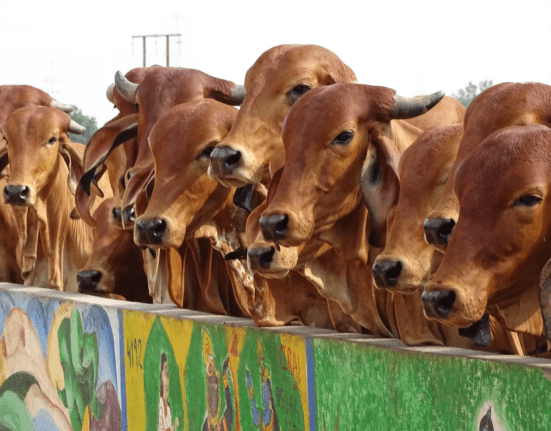
With 239 million tonnes of milk produced in 2023–2024, India accounts for 24% of the world’s milk supply, supported by the world’s largest cattle population of 536 million head. Yet its share of global dairy exports is just 0.25%.
“This is a paradox we must confront head-on,” said Tripathi. “India has the scale, but without structural reform, technology adoption, and export preparedness, the sector will remain domestically bound.”
A Sector of Extremes: Immense Scale vs. Fragmented Structure
India’s dairy sector is not just large — it is foundational to the rural economy. More than 80 million Indians are directly employed in dairy production, and the sector has grown at a 5.62% CAGR over the past decade.
However, structural fragmentation remains a core issue:
- 80% of the dairy supply operates in the informal sector, through small-scale farms and direct-to-consumer transactions.
- Only 20% is handled by formal cooperatives and private processors, limiting standardisation and traceability.
This imbalance restricts India’s capacity to scale efficiently, adopt international best practices, and meet stringent export requirements.
Export Conundrum: Size Without Reach
Despite being the world’s largest milk producer, India exported just USD 272 million in dairy goods last year — mainly to Nepal, Bangladesh, Bhutan, the UAE, and Sri Lanka. Several systemic factors explain this gap:
- Low average productivity of 1.1 tonnes per cow per year, versus 3.9–5.9 tonnes in Australia and New Zealand.
- Inconsistent quality assurance systems and sanitary compliance.
- Weak cold chain logistics and limited export-grade processing infrastructure.
According to Tripathi, “India’s domestic consumption is so vast that most production is absorbed internally — leaving tiny surplus. But with the right interventions, we can shift that balance.”
Demand Explosion: India’s Dairy Market Nears USD 687 Billion
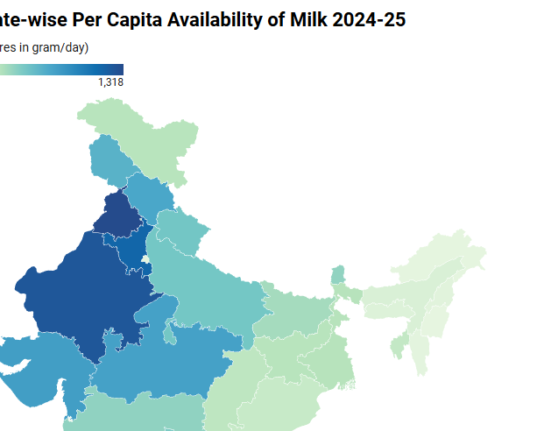
Domestically, the sector is transforming. With per capita milk consumption at 459 grams per day, India has already surpassed the global average of 322 grams per day.
The market, currently valued at USD 228 billion, is expected to nearly triple to USD 687 billion by 2033. Tripathi attributes this growth to:
- Rapid urbanisation
- Increasing disposable incomes
- A shift towards processed and value-added products
- Emergence of modern retail and e-commerce platforms
India’s B2C dairy segment is massive, with over 300 million consumers spending USD 30 billion per month.
High-Value Dairy Segments on the Rise
Tripathi identified key product segments with strong growth potential:
- Premium milk varieties (A2, organic, UHT)
- Fermented products like yoghurt, lassi, and dairy desserts
- Ghee and clarified butter
- Paneer and regional cheeses
- Premium ice cream and frozen dairy
He noted that over 50% of India’s population is over 25, a demographic that shows sustained demand for diverse, high-quality dairy offerings.
Challenges Hindering Global Competitiveness
The road to becoming a global dairy exporter is not without its roadblocks. Tripathi flagged several critical barriers:
- Persistent fragmentation of suppliers and processing units
- Climate-related disruptions and scarcity of pasturelands
- Outbreaks of livestock diseases like Foot-and-Mouth and Lumpy Skin Disease
- Gaps in storage, logistics, and temperature-controlled transport
- Inadequate adoption of dairy technology and genetics
Policy Push: Government Initiatives Reshaping the Sector
India is addressing some of these challenges through national programmes aimed at long-term sectoral reform:
- Rashtriya Gokul Mission – genetic improvement of dairy breeds
- National Programme for Dairy Development – boosting milk procurement and chilling infrastructure
- Dairy Entrepreneurship Development Scheme (DEDS) – financial incentives for private dairy investments
- National Livestock Mission – focusing on feed, disease control, and biosafety
“These initiatives are building the scaffolding for a more modern, resilient, and export-ready dairy sector,” Tripathi stated.
What Will Drive the Next Phase of Growth?
In Tripathi’s long-term forecast, the Indian dairy industry will pivot on five key drivers:
- Value-added innovation – expanding beyond raw milk into products with longer shelf life and higher margins
- Technology adoption – from automated milking to AI-driven herd health management
- Genetic and feed optimisation – to lift productivity levels closer to global benchmarks
- Digitalisation of supply chains – for traceability, logistics, and farmer payments
- Sustainable dairy farming – with lower emissions, better waste management, and eco-friendly practices
Leading Industry Players Shaping the Landscape
India’s formal dairy ecosystem includes influential cooperatives and fast-scaling private players:
- Cooperatives: Amul, Verka, Aavin, Mother Dairy, Nandini
- Private Enterprises: Hatsun Agro, Heritage Foods, Lactalis Tirumala, Dodla Dairy, Milky Mist, GRB
These organisations are investing in innovation, cold chain expansion, and export infrastructure, signalling a clear shift towards a more organised, globally attuned dairy economy.