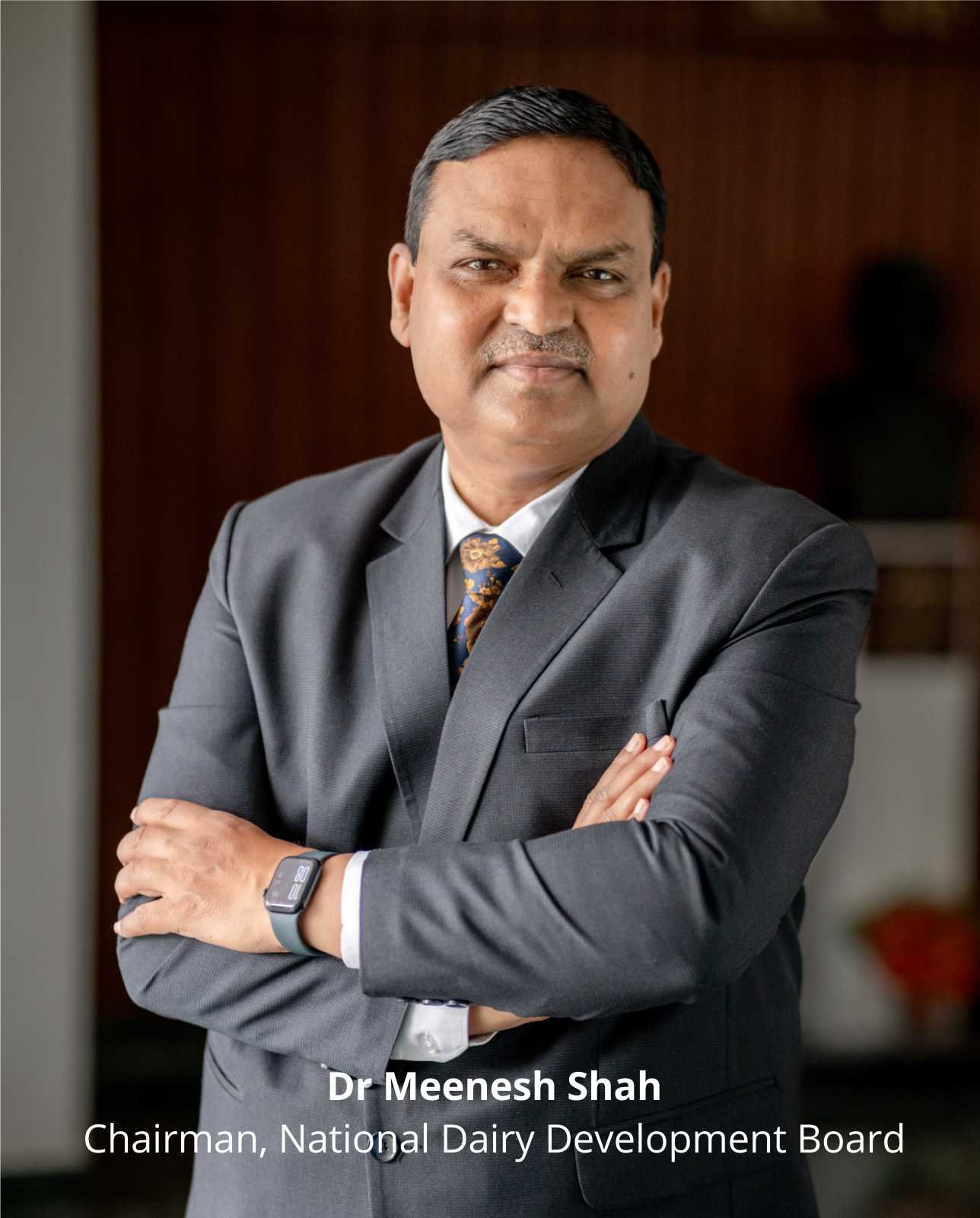
In Conversation with Dr Meenesh Shah: Chairman, National Dairy Development Board
NDDB’s Evolving Role: From Builder to System Steward
- NDDB was created as an institution-builder for India’s cooperative dairy movement. How do you define NDDB’s role today — and how has that role evolved in a more complex, competitive dairy ecosystem?
When the National Dairy Development Board (NDDB) was established, the fundamental challenge confronting India was structural scarcity of milk. We were a young, milk-deficit nation heavily dependent on imports to meet the basic nutritional needs of our citizens. At that time, the institutional objective was singular and exceptionally clear: to organize rural producers, eliminate exploitative intermediaries, and ensure remunerative returns for small and marginal farmers. Under the visionary leadership of NDDB’s founder Chairman Dr. Verghese Kurien, Operation Flood achieved this mandate with remarkable success making the nation self-sufficient or Atmanirbhar in milk.
However, the India of today is fundamentally different. We are no longer managing scarcity; we are managing abundance and aiming to make our mark on the global dairy trade. India has emerged as the largest milk producer globally, contributing an astounding 25 percent to the global milk output. The dairy sector has been growing rapidly and has become highly diversified, technologically advanced and intensely competitive. In this profoundly transformed context, NDDB’s role has organically evolved from being primarily an “institution builder” to becoming an “ecosystem architect”.
From Volume Expansion to Value Optimization: Our responsibility now goes beyond just establishing village-level societies. We must strengthen governance within cooperatives, improve professional management, incorporate digital transparency across the value chain, enhance dairy plant utilization, and align the sector’s rapid growth with environmental sustainability. Vision 2047 demands that we meticulously guide the sector’s transition from volume expansion to value optimization, from reliance on subsidies to structural competitiveness and from incremental productivity gains to significant, science-driven transformation.
Currently, NDDB is at the forefront of dairy science and technology. We are spearheading initiatives in genomics, accelerated breeding, sex-sorted semen, precision nutrition, digital milk procurement systems, circular economy initiatives converting dung to energy and organic fertilizers and ERP-enabled traceability systems. The next phase of dairy development must seamlessly blend productivity, profitability and environmental responsibility. This serves as the guiding principle for NDDB’s strategic direction towards 2047.
Revitalizing and Handholding Institutions: A critical aspect of our evolved role is stepping in to rebuild and revitalize cooperative institutions that face structural or governance challenges. We acknowledge that cooperatives remain one of the best developmental models for a perishable commodity like milk.
In 2023, GoI approved Plan to strengthen the cooperative movement in the country and deepen its reach up to the grassroots, through establishment of new Multipurpose Primary Agricultural Credit Societies (M-PACS), Dairy and Fishery Cooperative Societies covering all the Panchayats/ villages in the country, with the support of NABARD, NDDB and National Fisheries Development Board (NFDB), through convergence of various existing schemes. For dairy sector, about 1.2 lakh Dairy Cooperative Societies (DCS) will be established and strengthened under White Revolution 2.0.
For expanding the coverage of dairy cooperatives, NDDB is actively managing and supporting various State federations and unions based on their specific needs, deploying our expertise and dedicated manpower to initiate turnarounds. Currently, we are involved in managing operations in West Assam Milk Union (WAMUL) and East Assam Milk Union (EAMUL) in Assam, the Jharkhand Milk Federation, Madhya Pradesh Cooperative Dairy Federation (MPCDF), Chhattisgarh Milk Federation, Mahananda Federation in Maharashtra, Varanasi Milk Union in Uttar Pradesh, Ladakh UT Federation, and Manipur Milk Union, among others. Through these direct interventions, we safeguard livelihoods of farmers, ensure timely payments and rebuild trust in the cooperative ethos. This ensures that viable producer-owned institutions are not lost due to short-term difficulties.
Ultimately, NDDB’s role today is not just about expanding the cooperative footprint; it is about future-proofing the entire Indian dairy ecosystem. This is to ensure that our 80 million rural dairy households remain economically resilient and also globally competitive.
- Indian dairy today includes cooperatives, private processors, startups and global players. How does NDDB balance cooperative principles with the need to remain relevant in a diversified market structure?
As the world’s largest milk producing nation, we are also the biggest consumers of milk globally. This means there is room for everyone in the industry. India’s dairy ecosystem is now a vibrant and diverse landscape, including cooperatives, private enterprises, innovative agri-tech startups and multinational players. I firmly believe that this diversity is not a weakness but a clear sign of sectoral maturity. The more players involved, the better it is for our farmers and consumers. India’s dairy future will be most successful with a philosophy of coexistence and collaboration, rather than pure, cut-throat competition.
The Unique Strength of the Cooperative Anchor: Despite the market diversifying, the cooperative model continues to be uniquely suited to India’s socio-economic structure. In our cooperative system, farmers are not just mere suppliers of raw materials; they are the owners of the enterprise. This structural distinction ensures that in many of our cooperative systems, producers receive an unprecedented 75 to 80 percent of the consumer rupee—among the highest shares globally. Cooperatives anchor farmer ownership, broad-based inclusiveness, and year-round economic stability, particularly for the landless and marginal farmers who form the backbone of our agrarian economy.
However, we are keenly aware that cooperatives cannot remain stagnant in a rapidly modernizing world. To stay relevant and robust, they require immediate and continuous governance reforms, stringent digital accountability, financial discipline and aggressive brand modernization. Through our Vision 2047 roadmap, we are dedicated to strengthening institutional professionalism while steadfastly preserving the democratic ownership that sets us apart.
Creating a Level Playing Field: We welcome the presence of private dairies and startups. The private sector often brings agility, deep capital, and rapid market innovation. In fact, if you look closely at the private dairies that have achieved significant scale and lasting success in India, they are the ones that have fundamentally adopted and mirrored cooperative principles in their farmer dealings.
When both cooperatives and private entities operate within a fair, transparent, and rule-based ecosystem, they can complement each other. They can share infrastructure, accelerate technology adoption, elevate national quality standards, and aggressively expand the market. Today, NDDB’s mandate extends beyond cooperatives alone; we act in the interest of the entire dairy sector. Our goal is to ensure that every stakeholder competes strictly on merit, thereby encouraging a level playing field. Competition must undoubtedly drive efficiency, but farmer welfare must remain centric and entirely non-negotiable.
The Role of Startups and Innovation: We are also highly encouraged by the wave of new dairy and agri-tech startups emerging across the country. Companies and platforms focusing on digital technologies, data analytics, IoT, AI, and sustainable fodder solutions are proving that modern technology can deeply strengthen the entire dairy ecosystem. By fostering an environment where cooperatives can partner with these agile startups, we ensure that the traditional values of the dairy movement seamlessly merge with the technological demands of the 21st century. Ultimately, India is a vast, growing market with ample scope for both cooperatives and private players to flourish together, learning from each other while collectively elevating the prosperity of the Indian farmer.
Institutional Impact & What Has Changed on the Ground
- Over the last few years, NDDB has worked across milk procurement, breed improvement, input services, quality systems and market access. Which interventions do you believe have created the most lasting impact at the farmer level?
When we evaluate impact in agriculture, success cannot be measured in quarterly outcomes; it must be measured in generational impact. Over the past decade, NDDB has deployed a multi-pronged strategy to enhance farmer livelihoods. While all our interventions are highly interconnected, three specific areas have triggered the most profound and lasting transformation at the grassroots level: Scientific Breed Improvement, Sustainability & Circularity in the dairy sector, and Digitalization.
“The past 7 decades of India’s dairy journey have been defined by scale, inclusivity, and resilience. The next phase will hinge on efficiency, innovation, sustainability…”
- Science-Led Breed Improvement: The most powerful lever for farmer income enhancement is productivity per animal, that is more milk per animal, while not expanding herd sizes. We have democratized access to cutting-edge advance reproductive technologies that were previously out of reach for marginal farmers.
- Genomic Chips: We developed indigenous genotyping chips—GAUCHIP for cattle and MAHISHCHIP for buffalo—which enable affordable early selection of high-quality heifers and bulls.
- Sex-Sorted Semen (GauSort): We introduced indigenous sex-sorting technology that ensures 90 percent female calf births at one-third of the earlier cost. This directly addresses the economic burden of unproductive male calves and accelerates the genetic potential of the herd.
- Reproductive Technology: Reproductive technologies such as Ovum Pick-Up, In Vitro Embryo Production, and Embryo Transfer (OPU–IVEP–ET) were propagated through a hub-and-spoke model. Also, our indigenous IVF media suite, ‘Shashthi’, supports cost-effective in-vitro embryo production, reducing dependence on expensive imported media.
NDDB is advancing its productivity enhancement initiatives by adopting a three-pronged strategy that integrates scientific breeding, balanced nutrition, and improved animal management practices.
- Sustainability and Circularity – Manure Value Chain: Perhaps our most ecologically and economically transformative intervention recently has been the promotion of the manure value chain. The dairy industry globally faces intense scrutiny for methane emissions. The Biogas models developed for the dairy sector —viz. the Decentralized model (Zakariyapura Model), Centralized model (Varanasi Model) and Compressed Biogas model (Banas Model)—turn animal waste into wealth.
We have facilitated the installation of over 80,000 household-level flexi-biogas plants. These decentralized units provide rural women with clean cooking fuel (reducing dependence on firewood) and generate nutrient-rich bio-slurry that acts as a potent organic fertilizer. This drastically reduces the farmer’s expenditure on chemical fertilizers, improves yield of crops by about 20% and promotes organic farming. By linking manure management with renewable energy, we are creating a climate-responsible dairy sector while simultaneously opening up a brand-new, non-milk income stream for the farmers.
Under the centralized model, currently implemented at Varanasi Milk Union, cattle dung is procured from farmers and gaushalas located within a radius of approximately 10–15 kilometres from the dairy plant. The collected biomass is utilized for biogas production, which is used as a substitute for light diesel oil (LDO) in the plant’s boiler operations and to meet the electricity needs of the plant. This initiative has resulted in a reduction in milk processing costs. The digestate (slurry) generated as a by-product is processed into organic fertilizers and marketed to farmers.
Under the Compressed Biogas model (Banas Model), cattle dung collected from farmers is processed into bio-CNG at an industrial scale, which is chemically and functionally equivalent to conventional compressed natural gas (CNG). The bio-CNG is distributed through retail dispensing outlets for use as an automotive fuel. NDDB has partnered with Suzuki R & D Center India (SRDI) to promote and scale up this model by facilitating tie-ups with dairy cooperatives across the country for the organized collection of cattle dung, production of CBG and dung-based fertilizers. Three (3) such Compressed Biogas plants have already been established and further seven (7) CBG plants are being taken up under NDDB-SRDI partnership.
- Digitalization: The most immediate pain point for a smallholder farmer is opaque testing and delayed payments. Our aggressive push toward digitalization has fundamentally resolved this issue. The deployment of Data Processor Milk Collection Unit (DPMCU)/Automatic Milk Collection Systems (AMCS) at the village level ensures absolute transparency and fairness in milk fat and SNF (Solid Not Fat) testing. When farmers see their milk tested digitally and receive real-time, accurate payments directly into their bank accounts, it builds an unshakeable bedrock of trust.
Furthermore, the Bharat Pashudhan platform, developed in collaboration with the Department of Animal Husbandry and Dairying (DAHD) under the National Digital Livestock Mission (NDLM), is revolutionizing how we interact with farmers. By providing a digital identity i.e., Pashu Aadhaar to dairy animals, the Bharat Pashudhan platform enables real-time tracking of health, breeding, and productivity stages/activities. It transitions the Indian dairy sector from being merely scale-driven to being deeply data-driven, empowering farmers to manage their herds as informed agri-entrepreneurs. Ration balancing and other dairy farmer advisory services have been scaled through the 1962 Farmers App.
- What lessons has NDDB learned recently about what does not work anymore in dairy development, even if it worked well in the past?
Institution building is an iterative process, and acknowledging what no longer works is just as critical as pioneering new strategies. The earlier phases of India’s dairy expansion were rightfully focused on scale and volume. However, one of the most profound lessons we have learned is that procurement growth without simultaneous productivity enhancement creates a systemic imbalance. In the past, India achieved milk production growth largely by adding dairy animals. Today, this is no longer ecologically or economically viable. Increasing animal numbers put unsustainable pressure on our limited land and water resources, and directly impacts the profitability of the farmer. We now know that India’s dairy future will be determined entirely by improving genetic potential and feed efficiency, not by merely adding more animals to the system.
Another critical lesson revolves around institutional support and governance. In the past, it was often assumed that financial subsidies alone could uplift struggling dairy cooperatives. However, experience has categorically shown that subsidies without governance reform only weaken institutions in the long run. Pumping capital into a cooperative that lacks professional management or digital transparency does not yield sustainable results. We have learned that cooperatives can no longer be viewed merely as vehicles for rural development or administrative deployment; they must operate as competitive business entities to truly serve their members. Market focus is essential and non-negotiable because if one cannot market whatever is being procured, it becomes extremely difficult to survive.
Furthermore, we have realized that incremental productivity gains are no longer sufficient to keep pace with global markets and rising domestic input costs. The era of basic extension services has passed. Today, technology adoption must be field-responsive, policies must be evidence-based, and the transformation must be science-driven. Providing generic advice is no longer effective; interventions must be highly targeted, such as using indigenous genomic chips for early selection of high-quality heifers, or deploying precision ration balancing tailored to individual animals. In short, the “volume-at-any-cost” and “subsidy-first” approaches of the 20th century have been replaced by a mandate for integrated development, where productivity, sustainability, and institutional integrity must advance together.
Farmer Economics at the Core
- Farmer income stability is under pressure from climate stress, rising input costs and price volatility. How does NDDB view the next phase of dairy farmer economics in India?
The economic landscape for the Indian dairy farmer is undeniably becoming more complex. Dairy farmers face an escalating triad of challenges: rising feed costs, climate variability, and global market volatility. When you consider that approximately 70 percent of milk production costs go directly toward animal feeding, any fluctuation in fodder or feed prices severely impacts the farmer’s bottom line. Therefore, NDDB’s view on the next phase of dairy economics requires a paradigm shift: our future strategies must prioritize income stability over mere output growth.
We are engineering this income stability through a two-pronged approach: relentlessly driving down the cost of production and creating parallel, non-milk income streams. To reduce production costs, we are promoting Ration Balancing Programme (RBP), precision nutrition and alternative healthcare. Through the use of bypass proteins, Total Mixed Ration (TMR), and the 1962 Farmers App for ration balancing, we optimize feed efficiency so the farmer gets more milk per rupee spent on feed. Furthermore, we are actively promoting Ethno-Veterinary Medicine (EVM)—an Ayurveda-based alternative therapy model. EVM enables timely treatment of common animal ailments with minimal cost, drastically lowering veterinary expenses and reducing antimicrobial resistance, which improves animal longevity and productivity.
The second prong involves creating resilient parallel income streams, primarily through the circular economy and value addition. We are teaching farmers to view dairy waste as a secondary cash crop. NDDB’s biogas models turn dung into clean cooking fuel and nutrient-rich organic fertilizer. This entirely eliminates need for the farmers to purchase chemical fertilizers or traditional cooking fuels, while surplus slurry can be sold for additional income.
On the market side, the economics of stability requires a shift from selling raw liquid milk to Value-Added Products (VAPs). By diversifying into modern VAPs, cheese, whey derivatives, and probiotic beverages, protein rich dairy products cooperatives can cater to evolving consumer demands and secure higher profits. Furthermore, with the establishment of the National Cooperative Organics Limited (NCOL), we are providing institutional support for farmers to pivot to organic dairy and agriculture, which fetches premium prices under the “Bharat Organics” brand. By 2047, through these integrated economic models, dairying must be firmly established as a highly stable, aspirational, and climate-resilient livelihood.
- When you look at smallholder farmers today, what are the most significant structural vulnerabilities that still concern you, and where can institutions realistically make the most significant difference?
The Indian dairy sector is primarily a smallholder ecosystem. While this decentralized model is our greatest strength, it inherently exposes our farmers to significant structural vulnerabilities such as highly limited landholdings, severe exposure to climate risks, and deeply fragmented market access.
My main concern is that approximately 65 percent of the milk surplus in India is still handled by unorganized markets. In this unorganized space, smallholders lack quality testing, traceability, and remunerative returns. They operate without a safety net, leaving them vulnerable to price manipulation and sudden market shocks.
Institutions are essential for mitigating these massive, systemic risks. Organized procurement systems, breeding services, veterinary outreach, and digital payment frameworks ensure absolute stability and trust where individual farmers are vulnerable. When NDDB or a State cooperative enters a village, they not only buy milk but also establish an institutional ecosystem.
Guided by the vision of “Sahkar-se-Samriddhi” – prosperity through cooperation, NDDB has embarked on an ambitious mission to reach out to more and more and dairy farmers. The cooperative-led “White Revolution 2.0” is aimed at expanding cooperative coverage, employment generation, and women’s empowerment by providing market access to dairy farmers in uncovered areas and increasing the share of dairy cooperatives in organized sector. NDDB has been designated as a principal stakeholder in the implementation of this national initiative.
An action plan has been prepared and rolled out by NDDB for establishing about 75,000 new Multipurpose DCS (MDCS) during 2024-25 to 2028-29 to achieve the procurement targets. In addition, over 46,000 existing village-level DCS/PACS will be strengthened with better and advanced milk procurement and testing infrastructure. We are making good progress on this mammoth assignment as the goal is to achieve in 5 years what was done in the past 75 years.
Also, to address these structural gaps on a national scale, NDDB has led the creation of three new Multi-State Cooperative Societies.
- To address the vulnerability of rising input costs, Cooperative Input Service Delivery Multi-State Limited (CISDL) is established which integrates feed, fodder, and breeding solutions to reduce costs and improve farm-level profitability.
- To address climate vulnerability and livelihood resilience, the Gomay Sahkari Samiti Multi-State Limited (GSSL) is established, focusing on scientific manure management and renewable energy.
- To address market fragmentation, the Cooperative Milk Producers’ Organization Multi-State Limited (CMPOL) is envisioned to aggregate scale and enhance market access across states, ensuring farmers receive a fair share of the consumer value.
Another glaring structural vulnerability is the risk of generational attrition—the potential lack of interest of rural youth in traditional farming. Institutions must intervene realistically by fully modernizing the sector. By integrating technology, forming startup partnerships, and deploying digital platforms like Bharat Pashudhan, we are transforming dairy farmers from subsistence producers into informed, tech-savvy agri-entrepreneurs. Making dairy farming an aspirational, knowledge-driven enterprise is the ultimate institutional intervention to ensure generational continuity and protect the future of smallholders .
Quality, Productivity & Competitiveness
- Quality, traceability and productivity are increasingly critical for dairy competitiveness. How is NDDB helping shift the sector from a volume-led mindset to a value- and quality-led one?
For decades, the Indian dairy industry focused on increasing volume to meet the needs of a growing population. Now, as the world’s largest producer, sometime down the line the focus was shifted towards what I refer to as the “Value and Quality Era.” In a global market, having both volume and quality is a powerful advantage.
NDDB is leading this transformation through a comprehensive “Cow to Consumer” quality framework. The first component is Digital Traceability. Through the National Digital Livestock Mission (NDLM), we are establishing a clear digital trail. When a consumer in a city or an importer in a foreign country purchases a dairy product, they would be able to trace its origins back to a group of villages where animal health and vaccination records are digitally verified. This transparency is crucial in modern dairy trade.
Additionally, we are promoting quality through the Quality Mark and the Conformity Assessment Scheme (CAS). Developed in partnership with the Bureau of Indian Standards (BIS), this certification is tailored for the dairy industry. It goes beyond just the final product to assess the entire management system of the dairy plant and primary society.
Finally, the dairy cooperatives are shifting the focus to Value-Added Products (VAP). Liquid milk is a commodity with slim margins. The true value for the farmer lies in converting milk into cheese, high-quality butter, paneer, and functional foods like probiotics, protein-rich or fortified milk. NDDB is providing the technical expertise and financial support to cooperatives to upgrade their processing infrastructure. By moving up the value chain, we ensure that the “value-led” mindset results in actual “value-retention” at the farm gate.
- Do you believe India can achieve higher productivity and quality without compromising inclusiveness? What trade-offs must the sector consciously manage?
This is perhaps the most critical question facing the Indian dairy movement today. In the Western model, productivity is often achieved through “economies of scale”—large, mechanized farms with thousands of cows, whereas unproductive cows are readily culled for beef. In India, our model is “production by the masses,” not “mass production” and we revere our cattle and treat it as a family member.
I firmly believe that productivity and inclusiveness are not mutually exclusive; however, they require a uniquely Indian approach. We cannot simply import Western mega-farm technologies; we must “Indianize” them for the smallholders. For example, instead of a robotic milker for a 1,000-cow farm, we can deploy Community Milking Parlours at the village level where 200 farmers can bring their 2 cows each to be milked under hygienic, standardized conditions. This achieves “industrial-grade” quality while preserving “smallholder-grade” ownership.
Managing the Trade-offs
The primary trade-off we must manage is the cost of technology versus the ability of the small farmer to pay. If sex-sorted semen or genomic selection remains expensive, it will only benefit the wealthy farmers, leading to an “equity gap” in rural India. NDDB’s role is to act as a market stabilizer. By developing indigenous technologies like the GAUCHIP and GauSort, we have driven down the cost of innovation so that the smallest farmer can access the same genetic progress as a large-scale operator.
Another trade-off is between traditional practices and modern standards. As we move toward stricter quality norms, some smallholders may find compliance difficult. Here, the cooperative acts as the buffer. The cooperative takes on the burden of compliance, testing, and cold-chain logistics, allowing the farmer to focus on animal husbandry while still participating in a high-value, modern market. Our goal for 2047 is an “Incentivized Quality” model, where the farmer is rewarded with a price premium for higher quality, ensuring that inclusiveness is driven by economic and social empowerment.
Dairy Vision 2047: The Long Arc
- As India looks towards Dairy Vision 2047, what are the three most critical structural shifts the sector must make to remain farmer-centric while being globally competitive?
To navigate the next two decades, I see three non-negotiable structural shifts:
- From Milk-Centric to Livestock-Centric Economy: We must stop viewing the cow or buffalo merely as a “milk machine.” These animals are a biological asset that produces milk, manure, and energy. By fully operationalizing the Manure Value Chain, we transform the economics of the dairy farming. When a farmer earns from both milk and bio-slurry/biogas, their resilience against milk price fluctuations increases exponentially. This is the ultimate “Farmer-Centric” safeguard.
- Total Genetic Transformation via Genomics: We cannot reach 2047 with our current average productivity levels. We need a “Genetic Leapfrog.” This involves transitioning from traditional breeding to shifting to genomic-led selection, high quality AI, IVF technologies and sex-sorted semen technology.
- Share of Organised Sector: Presently, Indian dairy sector is dominated by unorganised sector, which poses challenges pertaining to quality, hygiene and adulteration of milk. The only way to address these issues is to increase the share of organised sector in surplus milk handling. Presently, about two-third quantity of surplus milk is flowing through unorganised channel, whereas only one-third by organised players like dairy cooperatives and private players. We need to reverse this scenario. White Revolution 2.0 is one such step towards providing market access to more and more dairy farmers in the country. Going forward, we need to cover all milk potential villages in the country under the ambit of organised sector.
- By 2047, how do you see India positioning itself globally — as a dairy exporter, a technology leader, or a model for inclusive food systems?
By 2047, India will embody all three identities, without having to choose between them. Our greatest contribution will be as a Global Model for Inclusive Food Systems.
While we will certainly be a major Dairy Exporter—leveraging our geographical proximity to milk-deficit regions in the Middle East and SE Asia & other geographies and a Technology Leader. Our true “soft power” lies in our model. Much of the developing world in Africa and Asia mirrors India’s smallholder structure. They are looking for a way to achieve food security without displacing millions of rural families.
India will serve as the proof of concept that you can be the world’s largest dairy producer while keeping the “small farmer” at the centre of the story. We will be the global hub for “Frugal Innovation” in dairy—showing the World how to use digital IDs, low-cost sex-sorted semen, and decentralized biogas to create a profitable, carbon-neutral, and socially-equitable dairy ecosystem.
The Next Five Years: NDDB’s Strategic Priorities
- Looking ahead to the next five years, what would you like NDDB to be known for when we look back at this phase of its journey?
In the next five years, I want NDDB to be remembered as the institution that “Digitalized the Soul of Indian Dairying.” We are currently in the middle of a massive institutional outreach programme. Through White Revolution 2.0, we are expanding into 75,000 new villages. In five years from now, we would have successfully created a “Digital Spine” (through NDLM) that connects these millions of new dairy farmers to transparent markets, while simultaneously scaling the “Manure-to-Wealth” model. I want NDDB to be seen not just as a policy executor, but as a high-tech partner to the Indian dairy farmer—the bridge between the rural cowshed and the global consumer.
Leadership & Legacy
- Having spent decades in institution-building, what leadership principles guide you today, and what advice would you give to the next generation of leaders shaping India’s dairy and food systems?
My leadership philosophy is built on three pillars: Integrity, Grassroots Empathy, and Data-Driven Decision Making.
In the cooperative sector, Integrity is your only currency. You are handling the hard-earned money of millions of farmers; any breach of trust is a systemic failure. Secondly, you must have Grassroots Empathy. You cannot lead the dairy sector from a glass office in a city. You must understand the smell of the cowshed, the worry of a farmer when a calf falls ill, and the joy of a woman receiving her first milk cheque.
My advice to the next generation is this: Combine a “High-Tech” head with Farmer Welfare approach. Use the best technology, the best genomics, and the best data analytics, but always ask yourself: “How does this help the woman standing at the end of the queue in a village at the dairy cooperative society (DCS)?” If your technology doesn’t solve her problem, it isn’t the right technology for India.
- If you had to advise your younger self, coming fresh out of college, what would it be?
I would tell my younger self: ““Success in dairy sector is not a solo journey; it is a lesson in the power of the collective.”
When I started 40 years ago, I understood that this conviction shaped not only the cooperative movement in India, but also my own journey. I soon realized that in rural India, change moves at the pace of trust. You have to earn the right to innovate in a village. I would tell myself to listen more than I speak, as the knowledge you gain from farmers cannot be taught through any book. Therefore, I would offer my younger self the same advice I give to those joining the organization today: remain open to learning and commit to understanding every dimension of the ecosystem you are entering.
I would also say: “Respect and appreciate the resilience of the Indian farmer.” Through droughts, floods, and unforeseen circumstances such as COVID-19 pandemic, they have never stopped working. Thus, you need to remain committed to their welfare without stopping as well. The institutions you build with the same spirit will never fail.
Finally, I would remind myself that while we work with milk, we are actually in the business of Social and Economic Empowerment. Milk is just the medium; the transformation of a farmer’s life is the real product.