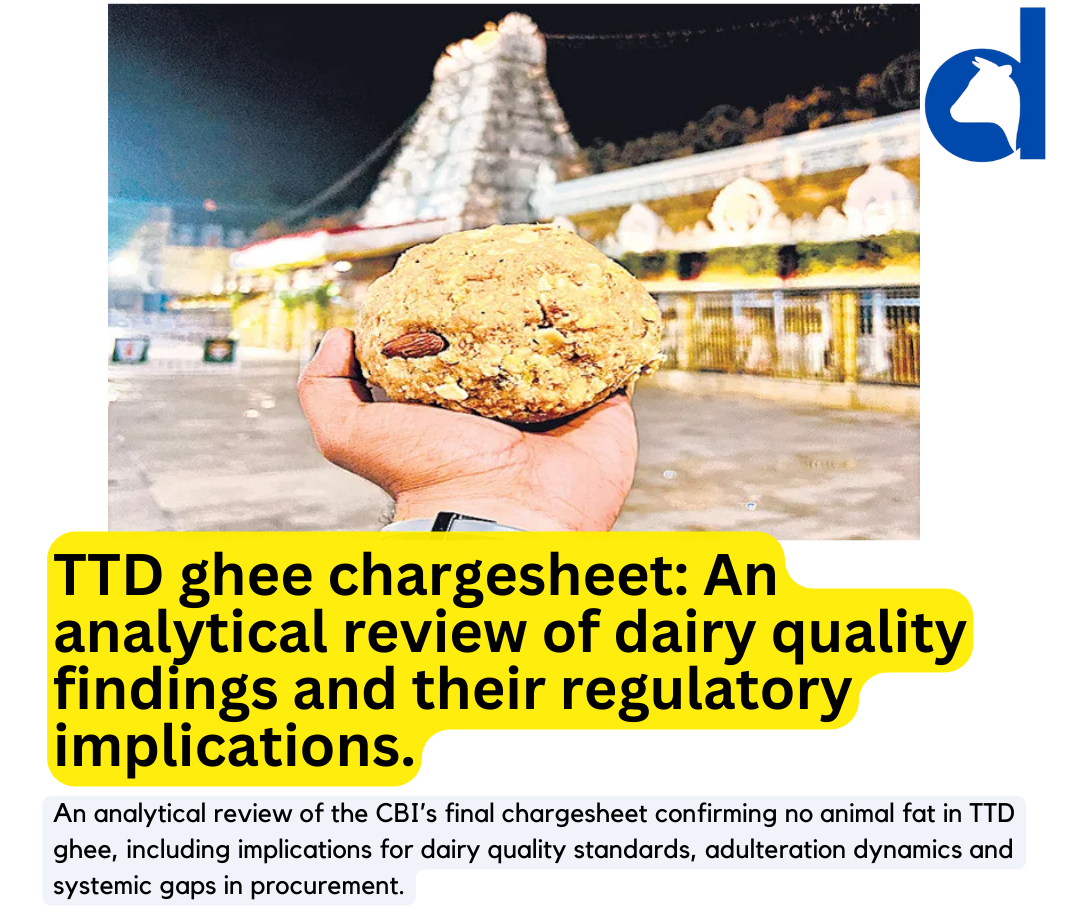
The Central Bureau of Investigation’s (CBI) recently filed final 600-page chargesheet in the Tirumala Tirupati Devasthanams (TTD) ghee adulteration case has provided a decisive clarification: the ghee supplied to the temple trust did not contain animal fat, thereby addressing a core point of public and political contention that had dominated discourse over the past year. This finding, underpinned by independent laboratory testing, necessitates a nuanced analysis of dairy quality controls, adulteration complexities and systemic gaps in procurement vigilance within religious institutional supply chains.
Scientific Validation Versus Sensational Claims
The investigation drew upon expert evaluations from two eminent dairy institutions: the Indian Council of Agricultural Research–National Dairy Research Institute (ICAR-NDRI) and the National Dairy Development Board (NDDB), Gujarat, both of which conducted rigorous analyses on ghee samples supplied to TTD. These reports collectively concluded that no animal-derived fats, such as tallow or lard, were detected in the contested batches of ghee.
This technical clarification directly counters earlier claims that had suggested the presence of animal fat in the ghee used for the temple’s famous laddus, a narrative that inflamed religious sentiments and fuelled political exchanges. The chargesheet’s reliance on established scientific methods reinforces the importance of empirical rigour over conjecture in food quality disputes.
Adulteration Complexity: Not Animal Fat but Synthetic Additives
While the absence of animal fat is now firmly established, the chargesheet does not exonerate the products entirely. Investigative findings highlighted that the ghee was adulterated with a combination of vegetable oils and laboratory-synthesised esters, formulated to mimic certain analytical parameters of pure dairy fat.
This form of adulteration, sophisticated and chemically engineered,d is indicative of evolving challenges in dairy quality assurance. Traditional purity tests may fail to detect such blends unless advanced analytical protocols are employed. Analysts therefore see this case as a cautionary example of how adulterants can be calibrated to evade routine detection and underline the need for enhanced testing methodologies across procurement and regulatory frameworks.
Systemic Procurement Vulnerabilities
The chargesheet also illuminates structural vulnerabilities in large-scale procurement contracts for dairy products. A key supplier was found to have lacked substantive milk procurement records and relied on surrogate sources for ghee production, suggesting insufficient verification of raw material origins.
The broader investigation, including allegations of proxy tendering and label manipulation, underscores the critical importance of stringently enforced quality checks at multiple stages from bid evaluation through to delivery and laboratory verification.
Implications for the Dairy Sector
From a dairy sector perspective, the TTD ghee case has several far-reaching implications:
- Strengthening analytical regimes: The prevalence of adulterants that can withstand conventional tests calls for upgrading laboratory capacities and adopting international standardised methods such as isotope ratio mass spectrometry or advanced chromatographic profiling.
- Policy and regulatory calibration: The episode highlights gaps in the enforcement of existing food safety regulations and suggests a reassessment of monitoring protocols under bodies like the Food Safety and Standards Authority of India (FSSAI).
- Supply chain transparency: Ensuring traceability from farm-gate milk procurement to end product delivery could reduce opportunities for malfeasance and rebuild consumer confidence, especially in culturally sensitive contexts.
Conclusion
The CBI’s confirmation that no animal fat was present in TTD ghee is a pivotal development in a case that intersected faith, public sentiment and dairy product integrity. By focusing analytical attention on the nature of adulteration and systemic procurement shortfalls, stakeholders in the dairy industry and regulatory landscape have an opportunity to rethink quality assurance frameworks and fortify them against increasingly sophisticated adulteration practices. Such introspection is not merely procedural but essential to uphold trust in dairy products that hold cultural, religious and economic significance.