Destinations, State Corridors and District Powerhouses
(January–October 2025 Trade Analysis)
India’s ghee export sector is entering a phase of structural consolidation. Between January and October 2025, exports reached USD 109.6 million, already surpassing the full-year 2024 levels. Imports remain negligible, reinforcing India’s strong trade surplus in clarified butter.
Yet the headline figure only tells part of the story. The bigger change is geographic. Export activity is concentrating in specific state corridors and district-level industrial clusters, indicating a shift from scattered trade to more organised, processing-led growth.
The maps included in this issue clearly illustrate this development: India’s ghee export landscape now has identifiable centres of activity.
A Stable and Expanding International Footprint
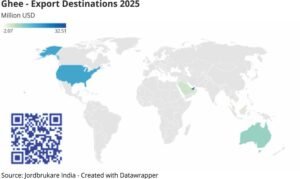 India’s ghee exports remain centred in the Gulf Cooperation Council (GCC) markets. The United Arab Emirates alone accounts for over USD 32 million in shipments, making it the largest single destination. Qatar, Saudi Arabia, Oman, Kuwait, and Bahrain collectively support the Middle East as the main source of demand.
However, the United States has become the second-largest market, with exports nearing USD 19 million in the January–October period. This is significant. Unlike GCC markets, US demand increasingly focuses on retail shelf presence and the positioning of ghee within natural and clean-label cooking fat categories.
Australia and Singapore contribute further diversification, aiding India’s shift from diaspora-driven exports to broader premium retail growth.
The global pattern indicates two concurrent strengths: stability in the Middle East and growth potential in developed retail markets.
State-Level Consolidation: Southern and Western Dominance
Ghee exports are highly concentrated at the state level. Tamil Nadu leads with a 34% share, followed closely by Gujarat at 27%. Maharashtra contributes an additional 13%, forming a dominant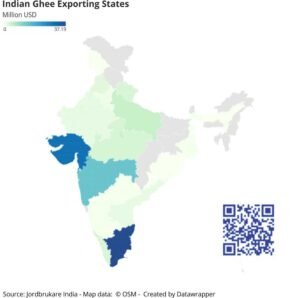 southern-western export corridor.
Together, Tamil Nadu and Gujarat account for more than 60% of India’s ghee exports.
Tamil Nadu’s strength lies in industrial-scale private processing, port proximity, and supply chain efficiency. Gujarat leverages its cooperative heritage, institutional networks, and established dairy ecosystem. Maharashtra’s exports are closely aligned with Western port infrastructure, especially through Mumbai.
Northern states are present but less dominant. Madhya Pradesh and Uttarakhand show emerging activity, indicating inland capacity expansion, though from a smaller base.
This state-level concentration reflects industrial maturity rather than regional imbalance. Ghee exports are primarily routed through organised processors equipped with compliance capabilities, sophisticated packaging, and export infrastructure.
District Powerhouses: The Industrial Nodes
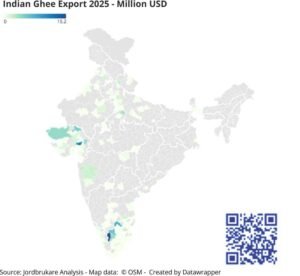 At the district level, the picture becomes even clearer. Coimbatore in Tamil Nadu leads as the largest ghee-exporting district. Krishnagiri and Erode strengthen Tamil Nadu’s cluster, while Chennai increases export capacity. In Gujarat, Anand and Banas Kantha continue to anchor cooperative-led exports. Kachchh and Ranch Mahals also contribute significantly, reinforcing the state’s multi-node processing ecosystem. Mumbai and Thane remain key western gateways, aligned with port logistics and industrial processing. Emerging districts such as Bhind (Madhya Pradesh) and Dehradun (Uttarakhand) highlight new value-addition nodes beginning to participate in export flows. The geographic arc clearly shows a strong southern and western industrial corridor, supplemented by selective inland expansion.
Broader Participation Compared to Butter and SMP
When compared with butter and skim milk powder (SMP) exports, an important structural distinction becomes clear.
Butter exports are concentrated in a few high-volume districts and tend to react strongly to global fat price fluctuations. SMP exports, on the other hand, remain closely linked to spray-drying capacity and international powder cycles.
Ghee, by contrast, involves a wider range of states and districts. Its participation is more geographically dispersed and less reliant on short-term commodity cycles. This broader engagement indicates deeper integration within India’s dairy value chain and reduces concentration risk.
The maps in this issue visually emphasise this contrast. While butter and SMP show strong activity in specific nodes, ghee demonstrates structured involvement across multiple corridors.
Why Ghee Stands Apart
- Several factors explain ghee’s relatively stable export trend:
- Persistent demand from the diaspora in the Middle East
- Growing retail acceptance in North America
- Strong domestic production infrastructure
- Organised processing capacity
- Limited reliance on imports
Unlike SMP, ghee is not primarily used to balance surpluses. Unlike butter, it is less affected by global volatility in fat prices. Instead, it holds a hybrid position: culturally significant yet commercially scalable.
The trade surplus highlights this structural advantage. With imports negligible, India retains a clear comparative advantage in clarified butter production and export.
The Strategic Outlook
With exports from January to October 2025 already surpassing last year’s total, full-year figures are likely to set a new benchmark. However, the next phase of growth will depend less on increasing volume and more on capturing value. Key drivers will include:
- Retail brand penetration in the United States
- Improved market access in Europe
- Traceability and quality assurance systems
- Premium positioning and differentiated packaging
India’s ghee export story is no longer incidental; it is becoming a defined industrial strategy. As the maps show, export strength is consolidating into identifiable power corridors. These corridors will shape India’s dairy trade trajectory in the coming decade.
If the goal is stable, value-oriented dairy exports, ghee currently offers the strongest foundation within India’s dairy portfolio.