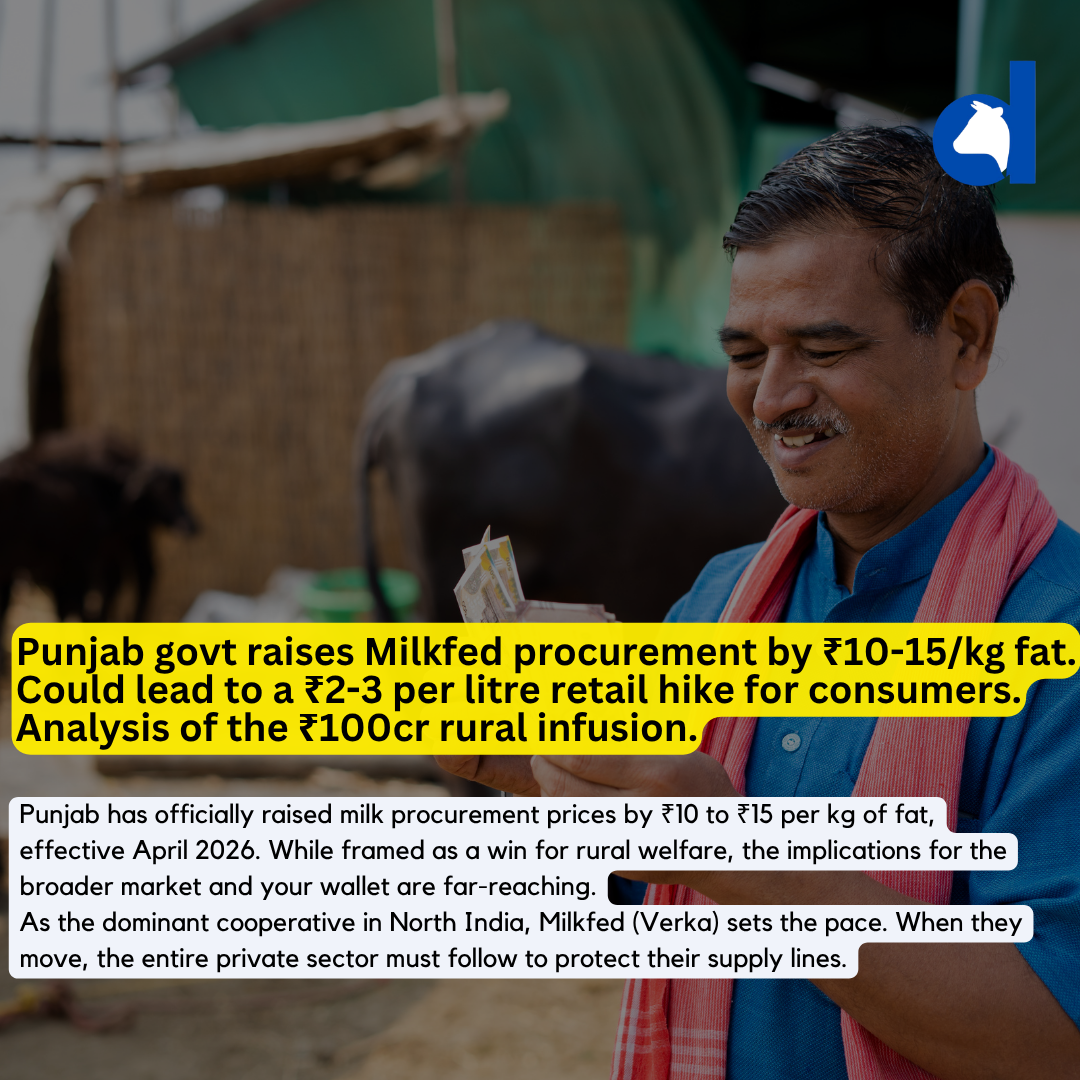
The Punjab government has announced a strategic increase in milk procurement prices for farmers affiliated with the Punjab State Cooperative Milk Producers’ Federation (Milkfed), which operates under the Verka brand. Effective 1 April 2026, the procurement rate has been raised by ₹10 to ₹15 per kilogram of fat. This fiscal intervention by the Bhagwant Mann administration is designed to strengthen the cooperative framework and provide a buffer for dairy producers against rising input costs and recent volatility in feed prices.
India’s dominant cooperative, Milkfed, sets the benchmark for the private sector. The government estimates that this move will benefit approximately 250,000 farmers directly linked to the cooperative, while indirectly influencing the income of nearly 3 million dairy producers across the state. By setting a higher floor price, the state effectively compels private processors to adjust their own procurement rates to maintain their supply chains, potentially injecting an additional ₹100 crore per month into the rural economy.
Strategic Market Implications
The timing of this hike is critical. Punjab remains a corner of India’s dairy industry. Verka’s price leadership often dictates regional market dynamics. For dairy processors and private aggregators, this move signals tighter margins. Competitors will likely face increased pressure to match these rates to “revent “milk d”version” to cooperative collection centres.
From an investment perspective, this reflects a broader trend of state-supported protectionism in the dairy sector aimed at ensuring food security and rural stability. However, for large-scale processors, the spiralling effect on raw material costs may necessitate a revision of retail prices for liquid milk and value-added products (VAPs) in the coming quarter to offset the procurement premium.
Consumer Impact: The Price of Stability
If the state government or cooperatives do not absorb these increased costs through subsidies, the burden will shift directly to the end consumer. Historically, a procurement hike of this magnitude—₹10 to ₹15 per kg fat—typically translates to a retail increase of approximately ₹2 to ₹3 per litre for liquid milk.
For the average household, this price shock could lead to a noticeable uptick in monthly grocery bills, especially for high-consumption families. Beyond liquid milk, the impact will likely extend to dairy derivatives:
- Essential Commodities: Curd, paneer, and butter prices are expected to rise by 5% to 8% as processors seek to protect their bottom lines.
- B2B Sector: Confectionery and tea vendors, operating on thin margins, may pass these costs onto consumers, further fuelling local food inflation.
Global and Domestic Outlook
While India remains the world’s largest milk producer, regional shifts in Punjab often ripple across North India, affecting supply to the National Capital Region (NCR). Compared to trend sol trends, ds where milk has been volatile due to the climate in Punjab, Punjab’s proactive adjustment aims to stabilise the domestic supply side. Investors should monitor whether other northern states follow suit to prevent inte”-state “milk”flight.”
Forward-looking Insight: Expect a short-term rise in consumer inflation for dairy products across North India. As procurement costs climb, the industry will likely accelerate its pivot towards high-margin value-added products to sustain profitability, further densifying the competition in the cheese and probiotic segments.