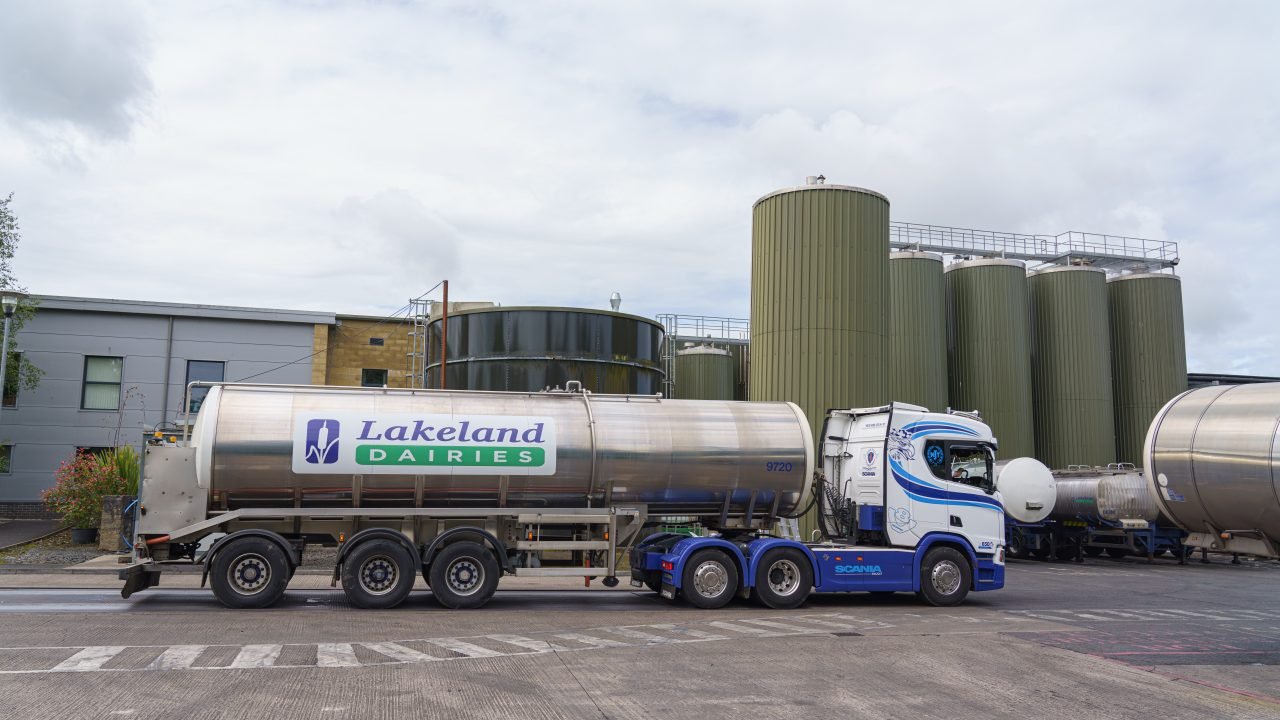
Lakeland Dairies has increased its milk price for July, citing marginally improved market conditions and easing milk supply growth across Europe.
The Irish dairy processor’s board approved a base milk price of 38.5c/L for July milk supplied in the Republic of Ireland (ROI), based on standard constituents of 3.6% butterfat and 3.3% protein.
The price includes a 0.5c/L Sustainability Incentive Payment and represents an increase of 1c/L compared with June.
Northern Ireland Price Also Increased
For suppliers in Northern Ireland, Lakeland Dairies announced a July base price of 30.9p/L, also including the Sustainability Incentive Payment.
This represents an increase of 0.8p/L from the previous month’s price.
European Milk Supply Growth Easing
Lakeland Dairies said market conditions had improved marginally compared with the previous month.
The processor noted that milk supply growth is beginning to ease, particularly across Europe, where higher summer temperatures have affected production.
If milk supplies continue to slow, the tighter availability could provide additional support to dairy markets during the remainder of the year.
Lakeland said it would continue monitoring market developments while aiming to provide farmers with the strongest possible milk price in line with prevailing market conditions.
Irish Milk Intake Falls
The latest data also points to weaker milk supplies in Ireland.
Domestic milk intake by processors and cooperatives was estimated at 1.05 billion litres in June 2026, according to the latest data.
That was 35 million litres, or 3.2%, lower than June 2025. However, June 2026 intake remained 14.3 million litres, or 1.4%, above the corresponding month in 2024.
The decline highlights the broader moderation in Irish milk production, even as supply remains above levels recorded two years earlier.
Milk Fat Content Remains Strong
Data from Ireland’s Central Statistics Office (CSO) also showed that milk fat content remained relatively strong.
Fat content was higher than in the corresponding month of the previous year for the eighth consecutive month, providing an important positive factor for dairy processors and farmers despite weaker overall milk volumes.
The combination of easing milk supply growth, stronger milk components and improving market conditions could provide some support to European dairy prices in the coming months.