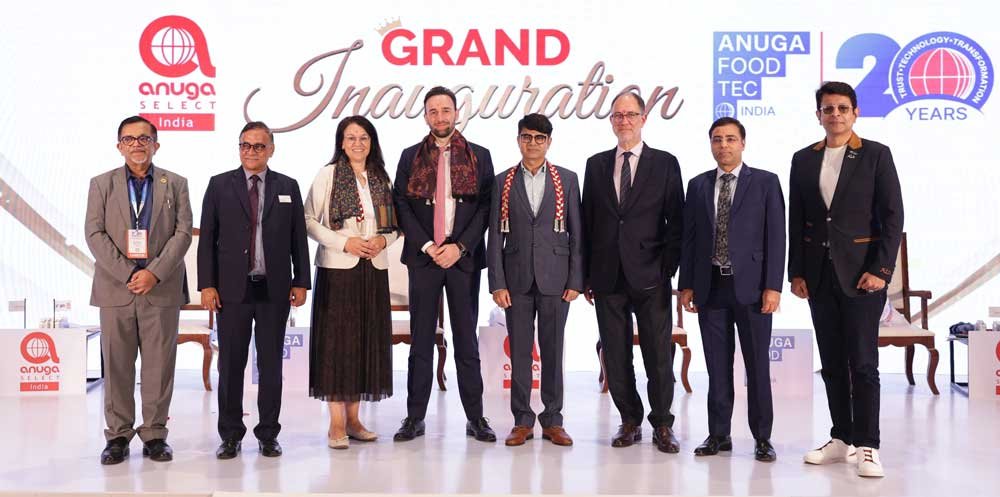
Anuga Select India 2026 and Anuga FoodTec India 2026 brought together the global food and beverage industry at the Bombay Exhibition Centre in Mumbai from September 29 to October 1, 2026. The co-located exhibitions connected manufacturers, suppliers, exporters, importers, retailers, food service professionals and technology providers to explore business opportunities across the food value chain.
Organized by Koelnmesse, the 19th edition of Anuga Select India and the 20th edition of Anuga FoodTec India featured more than 1,100 exhibitors from 43 countries. The organizers expected over 45,000 trade visitors, positioning the events as a major platform for international trade, food processing innovation and industry collaboration.
Global Participation Highlights Food Processing and Dairy Opportunities
The exhibitions covered a wide range of categories, including agricultural products, dairy, beverages, fine foods, organic products, sweets and snacks, and food service. Anuga FoodTec India showcased solutions for processing, packaging, automation, digitalization, intralogistics and supply chain management.
Supported by India’s Ministry of Food Processing Industries (MoFPI), the event featured the European Union as its Official Partner Region. Participating countries included Germany, China, Brazil, Thailand, South Korea, Belgium, Japan, Italy, Spain, Indonesia, Vietnam, Sri Lanka and several other international markets.
The platform enabled companies to explore sourcing opportunities, establish distribution partnerships and assess technologies aimed at improving food production, processing efficiency, product quality and logistics.
India Highlights Food Processing Growth and Investment Priorities
Devesh Deval, Joint Secretary at MoFPI, highlighted India’s expanding food market, estimated at USD 550–600 billion and growing at an annual compound rate of 6–7%. He emphasized that food processing contributes to agricultural value addition, investment and employment generation.
India’s position as the world’s largest milk producer and second-largest producer of fruits and vegetables provides a strong foundation for expanding processing capacity. Dairy, cereals, meat, fruits and vegetables remain important segments, while fisheries, marine products, animal husbandry and plant-based foods offer additional opportunities.
Deval also highlighted a proposed Centre of Excellence on pea protein at NIFTEM, Kundli, being developed in collaboration with Canadian partners. The initiative aims to support the development of pea protein extracts and isolates, reflecting growing interest in alternative protein ingredients and healthier food products.
India–EU Trade Cooperation Creates New Opportunities
Representatives from Germany, the Netherlands and the European Union emphasized the importance of international partnerships, sustainable technologies and resilient food supply chains.
Martina Englhardt-Kopf, Parliamentary State Secretary at Germany’s Federal Ministry of Agriculture, Food and Regional Identity, highlighted the India–EU Free Trade Agreement as an opportunity to strengthen market access and trade cooperation. The agreement was expected to be signed before the end of 2026 and enter into force around mid-2027, according to remarks delivered at the event.
She also noted Germany’s participation through the Federal Ministry and 12 enterprises, alongside the European Union’s role as the exhibition’s first Official Partner Region.
Silvio Erkens, representing the Netherlands, stressed cooperation in food safety, reducing food loss and waste, agricultural innovation and developing more resilient food systems. These priorities are particularly relevant as climate change, geopolitical uncertainty and energy constraints affect global food production and trade.
Agricultural Exports and Value Addition Remain Key Priorities
Tarun Bajaj, Senior Consultant at the Agricultural and Processed Food Products Export Development Authority (APEDA), reported that India’s agricultural and processed food exports reached USD 53 billion in 2025–26.
Rice, meat, marine products, coffee and tea were among the leading export categories. Value-added processed products accounted for nearly 30% of total agricultural and processed food exports, with the share continuing to rise.
APEDA’s stated objective is to double exports over the next five years while increasing the contribution of value-added products. Greater domestic processing could support employment, improve returns across agricultural supply chains and strengthen India’s export competitiveness.
Milind Dixit, Managing Director for India and the SAARC region at Koelnmesse, said India’s food processing industry was benefiting from rising consumption, technology adoption and stronger global market integration. The industry was valued at approximately USD 382 billion in FY2025 and projected to approach USD 689 billion by FY2034.
Industry Collaboration Supports Future Growth
The exhibitions brought together government agencies, export promotion bodies, trade associations and companies seeking new business partnerships. Participating organizations included APEDA, the Spice Board of India, Coffee Board of India, Coconut Development Board, National Turmeric Board, Forum of Indian Food Importers and Plant Based Food Industry Association.
By connecting domestic businesses with international buyers, technology providers and investors, Anuga Select India and Anuga FoodTec India provided a platform for expanding trade, modernizing food manufacturing and strengthening supply chains. The strong focus on dairy, processing technologies, sustainable production and value-added exports highlighted opportunities for India’s food industry to increase competitiveness in international markets.