By Prashant Tripathi, Policy Analyst, Jordbrukare India
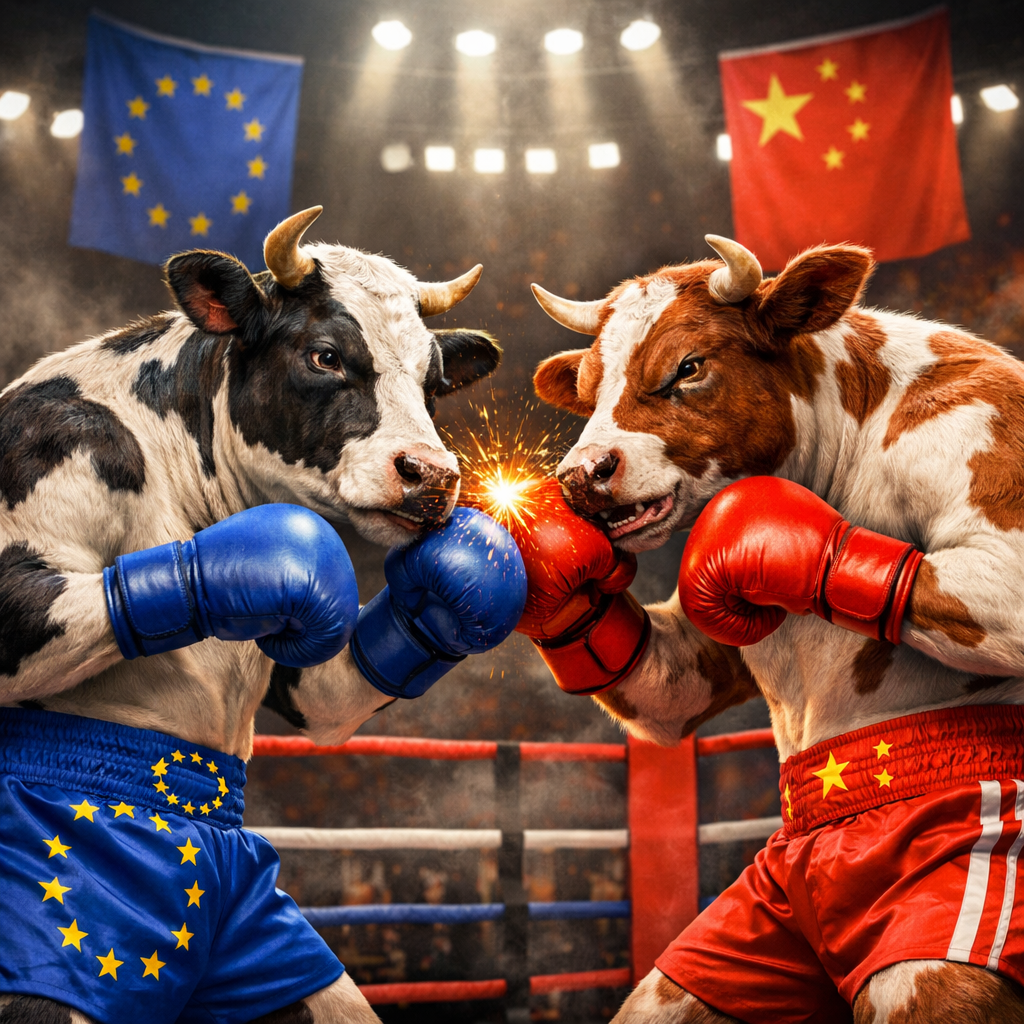
In a significant escalation of global agri-trade dynamics, China has imposed steep provisional tariffs on dairy imports originating from the European Union. While officially positioned as a move to protect its beleaguered domestic dairy producers, the broader context suggests a more layered intent — one that fuses economic nationalism with strategic geopolitical signalling.
This development merits close examination, not only for its immediate impact on bilateral EU–China trade, but also for its potential ramifications across third-party markets, including India’s increasingly exposed and globally engaged dairy sector.
A Domestic Industry Under Duress
The Chinese dairy industry has long suffered from structural inefficiencies, despite efforts at consolidation and modernisation. According to data from China’s Ministry of Agriculture, the country’s milk production grew from approximately 30.4 million tonnes in 2017 to over 40 million tonnes in 2024. However, this expansion in production capacity has not been matched by commensurate consumption growth, leading to chronic oversupply.
Factors exacerbating this imbalance include:
- A shrinking and ageing population with declining per capita milk consumption,
- A rise in imported dairy products offering competitive pricing and quality,
- And increasing input costs, rendering many domestic dairy operations economically unviable.
Recent estimates suggest that over 90% of Chinese dairy farmers are currently incurring operational losses. In this context, Beijing’s decision to implement provisional countervailing duties ranging between 21.9% and 42.7% on select EU dairy products appears rooted in domestic political economy considerations.
The objective is two-fold: provide immediate relief to local producers by limiting import-driven market depression, and buy time to recalibrate internal production structures — particularly towards value-added dairy products such as cream, processed cheese, and butter.
A Calculated Trade Strategy, Not Mere Protectionism
Yet the timing and targeting of these tariffs suggest a more strategic underpinning. The duties, which came into effect on 23 December 2025, are framed as provisional measures pending a formal anti-subsidy determination. However, they follow closely on the heels of the European Commission’s decision to impose anti-subsidy tariffs on Chinese electric vehicles.
It is therefore difficult to ignore the retaliatory nature of Beijing’s move. By targeting essential EU agri-food exports — notably dairy, pork, and spirits — China appears to be leveraging its market access as a bargaining chip in broader trade negotiations.
Interestingly, the structure of the tariff regime reveals a nuanced diplomatic calculus. Countries such as the Netherlands, Denmark, France, and Ireland — all vocal supporters of Brussels’ trade actions against China — find their national dairy exporters facing the highest tariff bands. In contrast, others are treated more leniently.
This differentiated approach indicates that China is not merely defending its dairy sector but is actively shaping a broader trade narrative, one that positions it as a retaliatory yet calculated actor on the world stage.
Implications for Global Dairy Trade and India
For EU dairy exporters, the impact will be immediate and material. China accounted for a significant share of high-value dairy imports, particularly for cheese, whey, and specialised milk powders. With the imposition of tariffs, these exporters will face margin erosion and reduced competitiveness, prompting them to seek alternative markets in Asia and the Middle East, and potentially India.
This has two key implications for India’s dairy sector:
- Increased competitive pressure: European exporters, now priced out of China, may look to offload surplus in more price-sensitive markets. India, with its expanding urban middle class and growing interest in cheese and processed dairy, may become a target destination.
- Opportunity for Indian exporters: On the flip side, Indian dairy processors focused on the value-added segment could explore export opportunities into China, particularly in product categories where tariffs have pushed out European players.
However, any such shift would require the Indian government to strengthen export facilitation frameworks, including residue-testing standards, trade diplomacy, and logistics infrastructure, to meet China’s stringent quality benchmarks.
Dairy Diplomacy and the Indian Policy Lens
From a dairy policy perspective, this episode underscores the increasing interlinkage between trade policy and agricultural sustainability. Countries are no longer engaging in dairy trade solely based on surplus; they are using agri-exports and import restrictions as tools of foreign policy, strategic retaliation, and domestic political consolidation.
India, therefore, must tread cautiously. While the temptation to absorb displaced European exports may exist — particularly to augment product variety and lower costs — the long-term impact on domestic milk procurement prices and farmer incomes could be detrimental.
Instead, India should draw lessons from China’s strategic playbook:
- Protect and modernise its dairy backbone, especially the cooperative sector,
- Develop domestic capacity for high-margin dairy products,
- And most importantly, craft a coherent dairy trade policy that balances import liberalisation with farmer livelihoods and processing capacity.
Conclusion: The Politics of the Milk Glass
China’s tariffs on EU dairy imports are a reminder that even a glass of milk can be a geopolitical statement. They offer an instructive case of how domestic agricultural fragility, international trade pressure, and strategic messaging can converge into a single policy action.
For India, this is more than just an international headline. It is an evolving case study in dairy diplomacy — one that could shape how we negotiate trade, support our farmers, and position ourselves in the global dairy value chain.